This is a notable point of the Vocational Education Law recently enacted by the National Assembly and effective from January 1, 2026.
Accordingly, from 2026, along with high school, junior high school graduates will have an additional option: vocational high school. This means that with the addition of vocational high school, secondary education will have two options: first, high school, and second, vocational high school. While high school is for the majority, vocational high school deeply integrates the core content of high school education with vocational training.
Unlike the old notion that vocational education was a "detour" or only chosen by students who failed to get into public high schools out of desperation, the vocational high school model is designed as an open pathway with an entry requirement of graduating from junior high school. The training period is 3 years with 6 semesters.
Notably, cultural subjects are not taught separately but are designed to be integrated with vocational specialization, helping students see the practical significance of their learning (the current vocational secondary education program maintains a separate, heavy curriculum for teaching cultural subjects).
The program also integrates cultural and vocational learning into each semester, instead of concentrating all cultural subjects in the first year. This approach aims to avoid overloading students – one of the main reasons for student dropout rates in previous vocational training models.


Specifically, after completing the vocational high school program, learners have an educational level equivalent to high school, and also possess a level 3 or level 4 vocational certificate, making them capable of entering the labor market or continuing their studies at the intermediate, college, or university level in the same field.
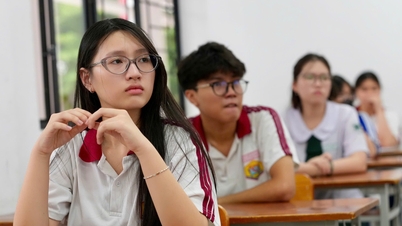
Each year, over 1 million students nationwide graduate from lower secondary school. However, for many years, after graduating from lower secondary school, the majority of students and parents have assumed that the only path is to continue to upper secondary school. Many parents and students still do not clearly distinguish between different educational models. Therefore, student streaming after lower secondary school has been identified as a key task, but in reality, it still faces many obstacles, from societal attitudes to a lack of sufficiently convincing training models. Thus, vocational secondary education is expected to become a solid foundation for effective educational streaming.
 |
| Students are learning electrical engineering at Phu Yen Vocational College. |
The reality of the annual enrollment process for 10th grade in public schools shows that most students register for the entrance exam or selection process rather than choosing other options. This further limits the channeling of junior high school students into vocational schools. Meanwhile, the labor market in recent years shows an imbalance, with many sectors having an "excess of teachers" but a "shortage" of skilled workers. Many university graduates, after graduation, are unable to find jobs and have to return to vocational training or take on unskilled jobs. This results in waste for society, especially for parents and the students themselves.
At the 2025 Vocational Education Conference, Minister of Education and Training Nguyen Kim Son stated that the vocational high school model will address many current shortcomings. This model will not replace the model of vocational education centers or continuing education centers, but rather the model of the secondary school system, resolving teachers' concerns about integrating vocational training and general education; and contributing to effectively solving the problem of student placement after lower secondary education.
“This model is for students after lower secondary school, not for adults. Therefore, in the coming time, a part of the system of vocational schools following the 9+ model will be flexibly and skillfully converted to the vocational high school model to ensure proper streaming. Some localities will review and change the functions and tasks of some Continuing Education and Vocational Training Centers, completely converting them into vocational high schools. The system of non-public vocational schools will also be encouraged to convert to this model, and this will be one of the key tasks to be implemented in 2026,” Minister Nguyen Kim Son emphasized.
We are facing a severe shortage of skilled and adaptable human resources. The Vocational Education Law recently enacted by the National Assembly has opened up an important legal framework, not only providing a solution for educational streaming but also laying the foundation for a national human resource development strategy in the new era.


To achieve this, in addition to a comprehensive legal framework, a coordinated effort from training institutions, businesses, and especially strong media coverage is essential to ensure parents and students understand the training models. When parents correctly and fully understand the legal value and educational and employment opportunities offered by vocational high schools, they will be more confident in allowing their children to choose this path.
Thuy Hang
Source: https://baodaklak.vn/giao-duc/202601/buoc-ngoat-trong-phan-luong-hoc-sinh-sau-thcs-10c0457/



![[Image] National conference summarizing one year of operation of the overall organizational model of the political system, the three-tiered government model.](https://vphoto.vietnam.vn/thumb/1200x675/vietnam/resource/IMAGE/2026/07/01/1782882811691_ndo_br_1-jpg.webp)