


A portrait of Sunnie Nguyen, one of the Vietnamese students who have mysteriously disappeared in Australia.
FACEBOOK SCREENSHOT
Sunnie Nguyen (17 years old, real name Nguyen Hoan Ngoc Anh) is the fifth Vietnamese international student at Hamilton High School (Adelaide) to mysteriously disappear in Australia recently. Authorities announced on January 11th that one person had been found, but there is still no news on four cases, including one who has been missing for over four weeks. Police believe the five disappearances are unrelated and that the students may have traveled to another state.
Five Vietnamese students missing in Australia: Strange detail: 'Unable to speak English when first arriving in Australia'
Following this incident, many people questioned what policies, regulations, and services Australia has in place to support and protect international students.
New developments
At the government level, Australia currently applies the Education Services for International Students (ESOS Framework), which includes the ESOS Act 2000, the National Code 2018 for international students registering and providing education services, the Tuition Fee Protection Service (TPS), and various other policies related to international education.
The ESOS Act requires licensed educational institutions across Australia to meet consistent standards of educational provision, facilities, and services, while also protecting international students' tuition rights in the event of visa denial or related issues. However, to be protected by the ESOS Act, international students must enter Australia on a student visa, not any other type of visa.
In December 2023, amidst numerous issues such as the housing crisis, the misuse of student visas for illegal work, and the exploitation of workers, including international students, the Australian government officially announced a new immigration strategy, outlining eight key actions, including prioritizing the resolution of issues related to international education. This move aimed to ensure the integrity of the entire system and better protect international students.

Australian Home Affairs Minister Clare O'Neil announced a new immigration strategy in December 2023.
One of the new decisions is to increase the English language requirements for students to be eligible to study. Specifically, from 2024, international students must achieve an IELTS score of 6.0 (or equivalent) instead of 5.5 as before to apply for a visa, and an IELTS score of 6.5 instead of 6.0 for post-graduation work visas. For applicants to study in Australia under the ELICOS English program or university foundation courses, these scores are IELTS 5.0 and 5.5 respectively.
Furthermore, Australia has made several other commitments to protect the rights of international students, such as strengthening and simplifying post-graduation work visas; limiting visa hopping; and increasing requirements for international education providers. The country has also increased financial requirements and shortened the post-graduation work period for applied master's degrees (from 3 to 2 years) and doctorates (from 4 to 3 years).
After arriving in Australia, one of the popular options for international students under 18 is to live with a host family, as in the case of Sunnie Nguyen. And to be allowed to host international students, host families must register and go through a rigorous vetting process from the school, the government, or the intermediary company, according to Mr. Vu Thai An, Director of GLINT Study Abroad Company (Ho Chi Minh City).
"The first type is called a host family because international students are treated like family members when they come to live with them, receiving cooking, care, and warm hospitality. The second type is called a homestay, similar to renting accommodation in Vietnam, where international students pay the landlord periodically, but they may also receive meals and laundry services," Mr. An explained.
A lot of physical and mental support
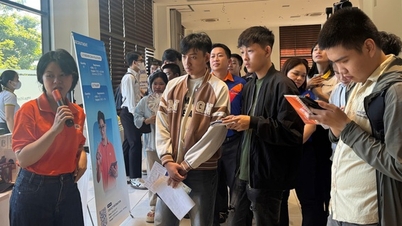
According to the Australian government, educational institutions at all levels have staff (often called international student advisors) whose job is to care for the welfare and well-being of international students, both physically and mentally, for example, through one-on-one psychological counseling. Many cities and towns in Australia also have support centers specifically for international students called international student hubs.
Notably, most of these services are free because the top priority for both the Australian government and universities is the safety and well-being of international students, according to Andy Pham, Senior Mekong Region Manager at the Australian National University (ANU). "For health check-ups specifically, students often don't have to pay or pay very little," added Andy.

International students at a counseling session at an Australian university.
Mr. Andy also stated that for students under 18, to be admitted, international students must meet two conditions: have accommodation (such as on-campus dormitories or school-approved homestays) and register for guardianship with one of two designated companies (PSC or ISA). This regulation aims to protect students who have not yet reached the legal age of majority.
"Like at ANU, we only accept international students under 18 years old, mostly for the February intake each year, because there are many dormitory rooms available for them at that time. For the July intake, the university will only accept students if they are accompanied by a parent until they turn 18, or if they have close relatives in Canberra (where ANU is located)," Andy informed.
The manager, who has lived in Australia for many years, also noted that although the land of kangaroos is considered one of the safest in the world, Vietnamese international students should still learn how to protect themselves, because "exceptional incidents can happen anywhere." "Avoiding returning home too late, not wearing headphones when walking on deserted roads, and immediately calling the police at 000 when in danger... are some small tips to know," Andy advised.
Source link

![[Image] Shipbuilders exposed to steel and record-breaking heat.](https://vphoto.vietnam.vn/thumb/1200x675/vietnam/resource/IMAGE/2026/06/04/1780545781745_ndo_br_img-5402-4683-jpg.webp)





































![[Video] Sunset at Lap An Lagoon – Where the sun sets over the fishing nets](https://vphoto.vietnam.vn/thumb/1200x675/vietnam/resource/IMAGE/2026/05/31/1780192137701_beach-landscape-sea-water-nature-grass-745871-pxhere-com.jpeg)
























Comment (0)