

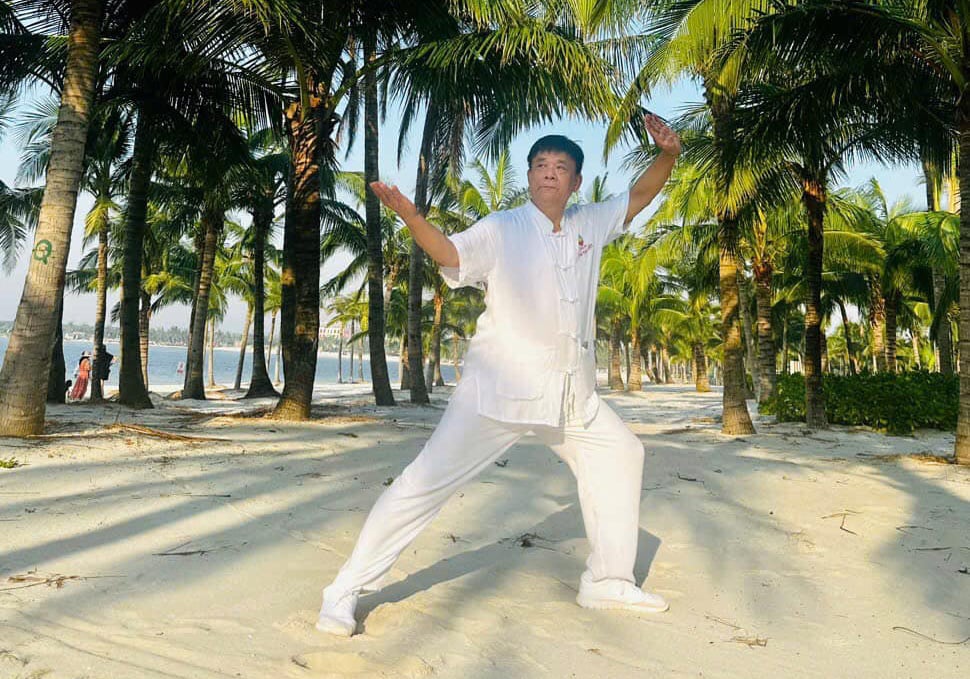
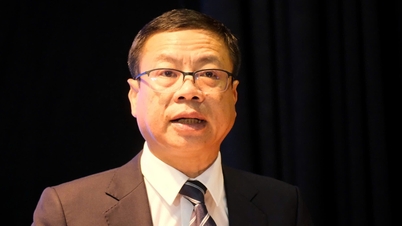
Mr. Nguyen Ngoc Dung, Chairman of the Scientific Council of the Vietnam Yoga Academy, guides the practice session - HA LINH
Everyone breathes, but what is the right way to breathe?
Currently, those practicing traditional martial arts such as yoga, martial arts, aikido, qigong, and health preservation are relearning breathing techniques. However, some people misunderstand normal breathing—inhaling by contracting the abdomen and exhaling by expanding the abdomen—as it should be the other way around.
According to Mr. Nguyen Ngoc Dung, chairman of the Scientific Council of the Vietnam Yoga Academy, there are two ways of breathing in practice and in sports : chest breathing and abdominal breathing.
Modern sports emphasize chest breathing, where air fills the chest cavity during inhalation. This breathing technique allows for powerful muscle exertion but constantly creates nervous and muscular tension, leading to fatigue and exhaustion.
Physical exercises, yoga, martial arts, aikido, qigong, and health-preserving practices all advocate abdominal breathing, which means inhaling to expand the abdomen and exhaling to contract the abdomen (energy centering at the lower abdomen and the sea of energy), creating profound inner strength, a calm mind, and regulated breathing.
From a health and wellness perspective, abdominal breathing is superior because when we inhale deeply, drawing air down to the abdomen, the alveoli in the chest are filled to the bottom third of the lungs, a feat not achieved with conventional chest breathing, thus increasing the lung's capacity (also known as breathing capacity).
On the other hand, when the abdomen expands and contracts, lifting and lowering the diaphragm creates an internal massage, allowing the internal organs to move, preventing fat accumulation and stagnation of qi.
There are generally three main methods of abdominal breathing: two-phase breathing (continuous inhalation and exhalation without pausing or forcing between phases); three-phase breathing with two methods: inhalation - holding air - exhalation and inhalation - exhalation - holding air; and four-phase breathing: inhalation - holding air - exhalation - holding air.
According to Mr. Dung, all breathing techniques are good, but they need to be analyzed and selected to suit the health condition, physical constitution, goals, and abilities of the practitioner.
Healthy individuals without serious medical conditions can choose any type of breathing exercise. However, those with cardiovascular disease, high or low blood pressure, circulatory insufficiency, cerebral ischemia, nervous exhaustion, or general weakness should only choose the two-phase and three-phase breathing methods (inhalation - compression - exhalation) to ensure effectiveness and safety.
As for breathing techniques 3b and 4, extreme caution is needed because when breathing deeply, the body is subjected to pressure in a state of air retention (oxygen deprivation), which can easily lead to injury or complications (like a bicycle tire that is flat but still being ridden and carrying a heavy load, easily damaging the bike or damaging the rim...).
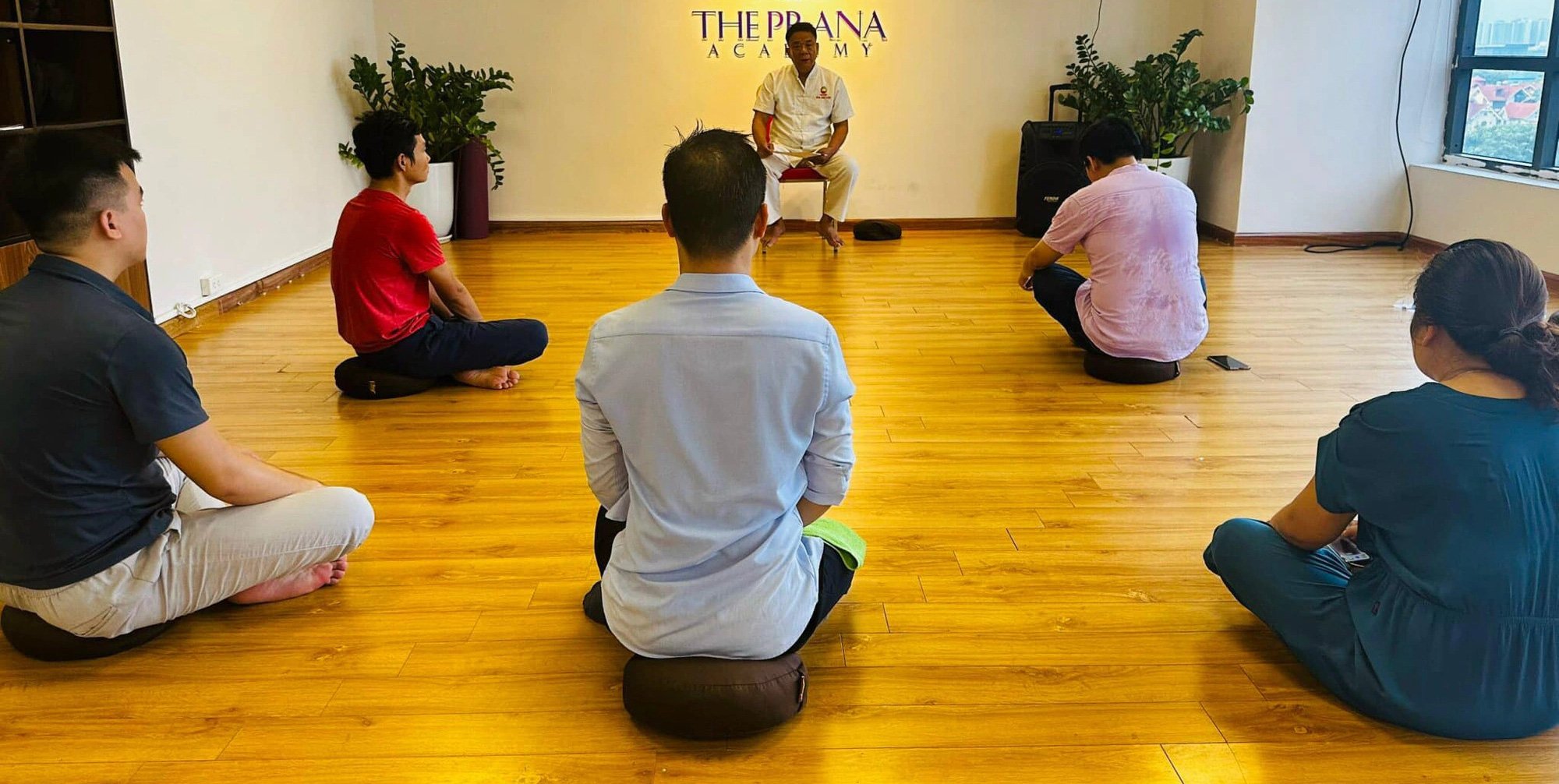
Sitting in meditation and practicing breathing exercises to absorb positive energy is good for your health - Illustration.
Understanding proper breathing techniques can improve your health.
Dr. Nguyen Van Thang, head of the Thang Long martial arts school, said that in the Tibetan One-Element Qigong original method, there are several breathing techniques to readjust the body's energy system, aiming to regulate the internal meridians and energy centers, helping the body to regulate the homeostasis and endocrine systems...
This ensures the normal functioning of the body's systems. It maintains the three flows of vital energy: qi, blood, and internal fluids. Through these breathing techniques, the qi of the five internal organs returns to the center.
1. First Qi-regulating technique: When breathing, direct your mind towards the dantian (lower abdominal cavity) belonging to the qi sea (qi reservoir), allowing the dantian to function naturally. Increased pressure and warmth in the dantian will bring peace of mind and qi, a cool head, and warm kidneys.
2 - Life Gate Qi Technique (Activating Life Gate Energy): After the Dantian breath, allowing the Dantian to function naturally, practice Life Gate breathing. When inhaling, be aware of the Dantian to gather energy; when exhaling, direct your mind towards the Life Gate to transfer energy. This stage is for clearing the Governing Vessel energy.
3 - Perineum Qi Activation Method (activating energy at the perineum - the energy center between the genitals and anus): When inhaling, focus your mind on the lower abdomen to gather energy. When exhaling, direct your spirit to the perineum to transfer the energy.
4 - Breathing Method 4 - Activating the Lower Abdomen (belonging to the lower abdominal cavity to regulate the kidneys). This method involves rotating the air in a circular motion at the lower abdomen (lower abdominal cavity in a front-to-back direction). Thus, nauli breathing (a movement in yoga) is method 4.
5 - Opening the Heavenly Cycle : This method utilizes reverse breathing; when inhaling, the abdomen is contracted, and when exhaling, the energy flows from the crown of the brain along the Ren meridian in front of the abdomen down to the Dan Tian.
6 - Whole-body Dantian breathing: When inhaling, focus your mind on the Dantian to gather energy; when exhaling, relax your entire body and feel the energy spreading.
When practicing breathing exercises, you need to listen to your body. If you experience shortness of breath, chest tightness, nausea, etc., stop. The exercises should be tailored to your individual needs, and it's best to have guidance from a professional to ensure effectiveness and safety, avoiding unfortunate complications.
When practicing cultivation with intention and energy, one should not overdo it, exceeding the limit and losing control of the energy. The energy rising to the brain causes stress, leading to high blood pressure, cardiovascular disorders, central nervous system disturbances, and emotional disorders.
Source: https://tuoitre.vn/cac-phuong-phap-tho-tot-cho-suc-khoe-2024101107583005.htm

![[Image] National Assembly discusses the implementation of the socio-economic development plan.](https://vphoto.vietnam.vn/thumb/1200x675/vietnam/resource/IMAGE/2026/04/20/1776696707422_ndo_br_img-20260420-185419-jpg.webp)
![[Photo] General Secretary and President To Lam meets with National Assembly delegates from ethnic minorities.](https://vphoto.vietnam.vn/thumb/1200x675/vietnam/resource/IMAGE/2026/04/20/1776696701056_a1-bnd-8331-3342-jpg.webp)





























































Comment (0)