From a coastal area isolated from the center of Ho Chi Minh City by the Binh Khanh ferry, Can Gio is gradually emerging in the city's new development vision: a hub for marine economic growth, ecotourism, and high-end international-standard resorts.
Speaking with a reporter from Nguoi Lao Dong Newspaper, Ms. Huynh Phan Phuong Hoang, Vice President of the Ho Chi Minh City Tourism Association and Deputy General Director of Vietravel Tourism Company, stated that the aspiration to make Can Gio a new international tourism symbol is entirely feasible, thanks to its unique advantages that few destinations in the world possess.
According to Ms. Hoang, Ho Chi Minh City's tourism sector continues to play a leading role nationwide, with a projected target of welcoming approximately 8.6 million international visitors, 46 million domestic visitors, and generating revenue exceeding 278,000 billion VND by 2025.
Nevertheless, the city is facing the need to find new drivers of growth. For many years, Ho Chi Minh City has primarily served as a transit gateway before tourists continue their journey to the Mekong Delta or other coastal resorts.
"Ho Chi Minh City will find it difficult to achieve breakthrough growth without a large-scale resort hub capable of retaining tourists throughout their trip. Can Gio is the missing piece to help the city reposition itself as a coastal, ecological, and entertainment hub," said Ms. Hoang.
Mega-projects are changing the face of Can Gio.
According to her, Can Gio should not be viewed as merely a suburban commune. It has the potential to develop into a complete resort, entertainment, and marine ecological space, both complementing and counterbalancing the central urban ecosystem.
From a tourism perspective, Ms. Hoang believes that Ho Chi Minh City is facing an opportunity to transform its image from a traditional tourist city into a "super destination" integrating urban, river, sea, ecological, and entertainment elements.
What makes Can Gio special is its rare combination of mangrove forests, the sea, and resort-like spaces right next to a megacity with over 10 million inhabitants.
"Compared to destinations like Marina Bay or Sentosa in Singapore, or Palm Jumeirah in Dubai, Can Gio has a unique advantage in possessing a multi-experience complex including mangrove forests, beaches, resorts, and green MICE (Meetings, Incentives, Conferences, and Exhibitions). This is a rare combination in the world," Ms. Hoang commented.
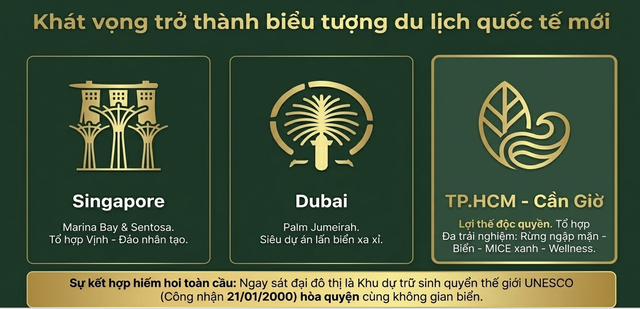
Source: VieTravel
According to experts, the UNESCO World Biosphere Reserve in Can Gio is a unique asset that not many large cities possess.
In its development plan until 2030, Ho Chi Minh City aims to strongly develop the marine economy, ecotourism, and high-end resort tourism in Can Gio, while ensuring ESG standards and sustainable development.
In recent years, a series of large-scale infrastructure projects have been promoted to expand connectivity to this area.
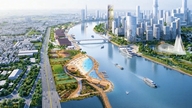

These include the Ben Thanh - Can Gio high-speed railway line, the Can Gio bridge project to replace the Binh Khanh ferry, and the Can Gio - Vung Tau sea route.
Alongside road infrastructure, waterway tourism routes from Bach Dang Wharf to Can Gio and Vung Tau are also being restored, opening up many new experiences for tourists.
According to the leaders of the Ho Chi Minh City Department of Tourism, this will be the foundation for Can Gio to transform from an "ecological oasis" into a high-end resort destination, contributing to reducing the density of tourists away from the central area and redistributing tourism development space in a more sustainable direction.
The city has also determined to develop Can Gio in its own unique direction, avoiding becoming a "copy" of any other destination. The focus will be on ecotourism, high-end resorts, and local culture, based on green technology and the participation of the local community.
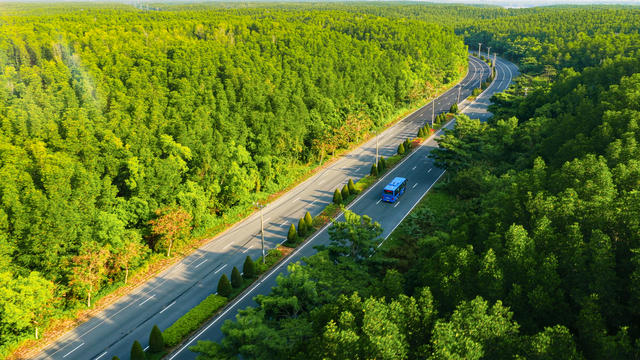
Along with road transport, the waterway routes from Bach Dang Wharf to Can Gio and Vung Tau are also being restored with unique waterway tourism products.
Speaking to the Nguoi Lao Dong newspaper , Dr. Nguyen Van Nen, a lecturer at the University of Economics and Law, commented that developing Can Gio into a new growth pole is a strategic step for Ho Chi Minh City.
According to him, this is almost the last large-scale development area in the city with ample room to create a distinct economic model.
Dr. Nguyen Van Nen believes that it is crucial to identify the "central core" of this new development model in order to create lasting ripple effects.
In this context, the Can Gio International Transshipment Port is considered a crucial nucleus. When a large-scale seaport is established, the ecosystem of logistics, international trade, maritime finance, warehousing, and value-added services will develop alongside it.
Alongside this is a modern eco-urban model, linked to resort tourism, green economy, and the conservation of the unique mangrove forest ecosystem.
"Can Gio has the potential to become a new blue-water economic growth hub and international logistics gateway for Ho Chi Minh City in the next phase of development," commented Dr. Nguyen Van Nen.
Amidst the rapid development of Ho Chi Minh City, Can Gio is facing its greatest opportunity for transformation ever. And if developed in the right direction, this coastal area could not only become a new destination for the city, but also a new symbol of marine ecotourism in the Asian region.
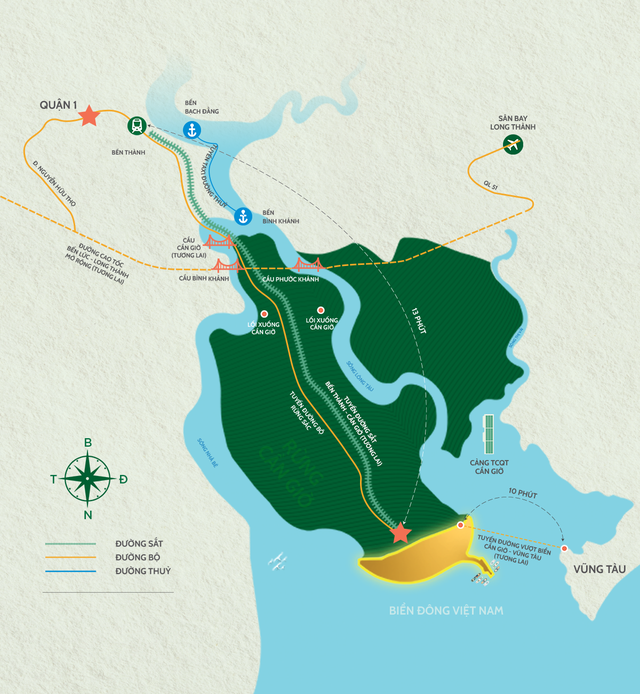
The Can Gio - Vung Tau sea route has received approval in principle from Ho Chi Minh City for investment.
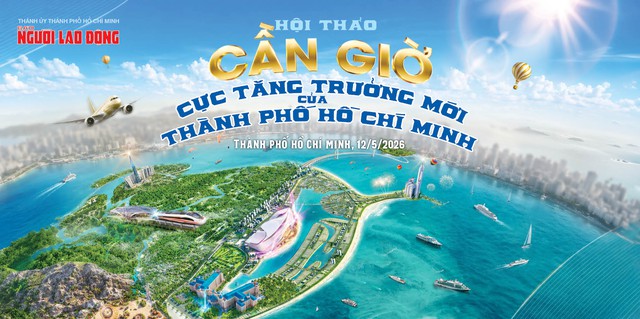
The seminar "Can Gio – A New Growth Pole of Ho Chi Minh City" is about to take place.


With the whole country aiming for double-digit growth, Ho Chi Minh City, as the economic engine, is implementing groundbreaking solutions to boost strong growth. Finding new growth drivers is crucial, and Can Gio – with its strategic location and the influx of numerous projects, especially the Vinhomes Green Paradise mega-urban development – is expected to become a new growth hub for Ho Chi Minh City.
The workshop will focus on analyzing the role of Can Gio as a new growth pole, adding the "missing piece" to Ho Chi Minh City's tourism. It will compare it with successful international models to clarify the direction and, importantly, propose solutions at the Ho Chi Minh City and national levels to transform Can Gio into a large-scale destination capable of attracting 40 million visitors per year.
Source: https://nld.com.vn/can-gio-dang-viet-lai-ban-do-du-lich-tphcm-196260507151911156.htm






















































![[Live] Exchange program “80 Years of Keeping the Oath” commemorating the 80th anniversary of the People's Security Force's traditional day.](https://vphoto.vietnam.vn/thumb/402x226/vietnam/resource/IMAGE/2026/07/02/1782997764964_truc-tiep-nbsp-w1200t0-di2626d272d4194258t13840l1-banner-80-nam-n2.webp)