Fungal skin infections transmitted from dogs and cats are quite common, especially in hot and humid tropical climates, during the rainy season, or at transitional periods between seasons. These are favorable environmental conditions for the growth of many types of fungi. Therefore, fungal skin diseases account for a relatively high percentage of all skin diseases.
Easily contract fungal skin infections from pets.
- Easily contract fungal skin infections from pets.
- Manifestations of fungal skin infections in humans.
- How is a fungal skin infection treated?
- How to prevent fungal skin infections from dogs and cats.
Fungal infections in dogs and cats usually belong to the dermatophyte group, with Microsporum canis being the most common. In addition, some less common cases may be caused by Trichophyton mentagrophytes.
These fungi are capable of living and growing on keratin-containing tissues such as skin, hair, fur, and nails. When pets are infected with fungi, fungal spores can survive on their fur, skin, or in the surrounding environment, and can then be transmitted to humans through close contact.
Notably, fungal infections in dogs and cats don't always show obvious symptoms. In many cases, pets only have very minor lesions or lesions located in hard-to-see areas, so owners don't detect them.
Humans can contract fungal skin infections from dogs and cats through various forms of contact. The most common route of transmission is direct contact with pets.
Common actions such as hugging dogs and cats, letting pets sleep in the same bed, petting, or grooming them can all cause fungal spores from animal fur or skin to transfer to human skin.
Additionally, fungi can also spread indirectly through items such as pet blankets and bedding, grooming tools, floors, or carpets contaminated with pet hair. Fungal spores can survive for a considerable time in the environment, especially in hot and humid conditions. If a person has minor skin abrasions or a weakened immune system, the risk of fungal infection increases.
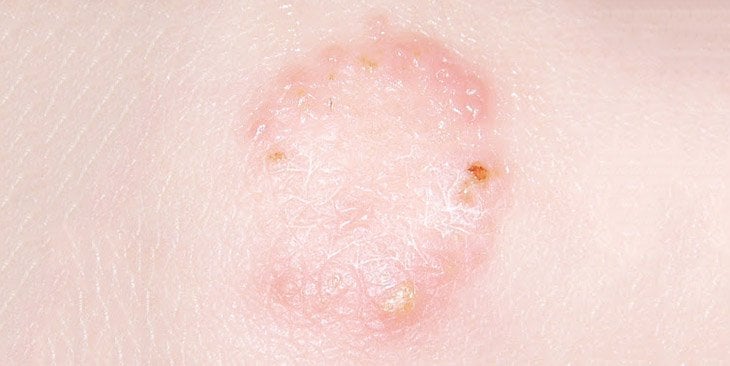
Fungal skin infections transmitted from dogs and cats can appear in many areas of the body.
Manifestations of fungal skin infections in humans.
After exposure to the fungal source, patients may develop symptoms after a few days to a few weeks.
The most typical sign is the appearance of round, macular lesions on the skin with the following characteristics:
- Circle or oval
- Clear boundaries
- The border is slightly raised compared to the surrounding skin.
- The surface has dry, scaly skin.
- Small blisters may appear.
The lesions typically spread gradually from the center outwards, forming a characteristic circle. Therefore, it is commonly known as ringworm or tinea versicolor in folk terminology.
Itching is a fairly common symptom. Patients often feel more itchy when sweating or in hot weather.


Fungal skin infections transmitted from dogs and cats can appear in many areas of the body. However, exposed skin areas are more susceptible to infection, such as the arms, hands, neck, face, and legs. In children, fungal skin lesions can also appear on the scalp, causing patchy hair loss.
If a fungal skin infection is suspected, patients should visit a dermatology specialist for examination and accurate diagnosis.
How is a fungal skin infection treated?
Most cases of fungal skin infections transmitted from dogs and cats can be treated with topical antifungal medication.
Patients need to use medication exactly as directed by their doctor; treatment usually lasts at least 2-4 weeks to completely eradicate the fungus.
In cases of widespread or recurrent lesions, the doctor may prescribe additional oral antifungal medication.
An important note is that patients should not self-medicate with topical corticosteroids, as these medications may temporarily relieve symptoms but can actually cause the fungus to thrive later on.
How to prevent fungal skin infections from dogs and cats.
To reduce the risk of fungal skin infections from pets, experts recommend that people take the following measures:
Regular health check-ups for pets.
Dogs and cats should have regular health checkups at veterinary clinics. If you notice any unusual hair loss or skin lesions, you should take your pet to the vet as soon as possible for timely treatment.
Keep your pets clean.
Bathing and grooming dogs and cats helps reduce the risk of fungal infections. Pet owners should bathe their pets regularly, keep their cages clean, and dry their bedding in the sun.
Avoid close contact.
Although pets offer many mental benefits, owners should limit actions such as kissing pets, letting pets sleep in the same bed, or allowing pets to lick their face or hands. After playing with dogs or cats, hands should be washed thoroughly with soap.
Keep the living environment dry.



Fungi thrive in humid environments. Therefore, homes should be kept well-ventilated and clean to prevent mold growth.
Early detection and treatment
If circular, itchy, or scaly lesions appear on the skin, people should seek medical attention early instead of self-treating. Early detection not only leads to more effective treatment but also limits the spread to other family members.
Raising awareness of disease prevention.
Owning pets is a hobby for many families and offers numerous mental benefits. However, to ensure health and safety, pet owners need to pay attention to hygiene and disease prevention for both pets and humans.
Most cases of fungal skin infections transmitted from dogs and cats are treatable if detected early and treated correctly. It is crucial that people raise awareness about the risk of infection from pets and proactively take appropriate preventive measures.
Source: https://suckhoedoisong.vn/canh-giac-nam-da-lay-tu-cho-meo-169260306081919856.htm





![[Image] National conference summarizing one year of operation of the overall organizational model of the political system, the three-tiered government model.](https://vphoto.vietnam.vn/thumb/1200x675/vietnam/resource/IMAGE/2026/07/01/1782882811691_ndo_br_1-jpg.webp)