


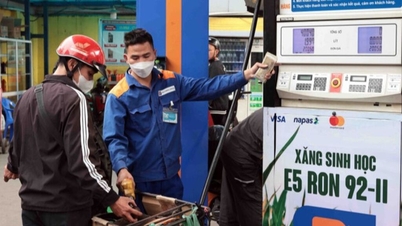
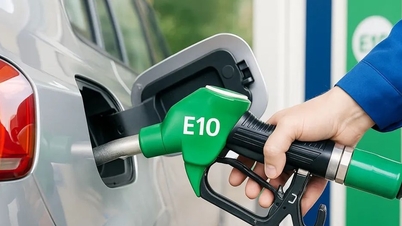
E10 gasoline is a blend of 90% mineral gasoline and 10% bioethanol, which helps reduce emissions and increase octane rating - Photo: HUU HANH
Therefore, according to the biofuel transition roadmap previously approved by the Ministry of Industry and Trade , the deadline for bioethanol (E10) to completely replace mineral gasoline (RON95, RON92) across the entire market, set for June 1, 2026, will be implemented approximately two months earlier.
Intensive infrastructure preparation
According to Tuoi Tre newspaper, many businesses with large market shares have already prepared the infrastructure and supply to completely replace conventional gasoline and distribute E10 gasoline to the market.
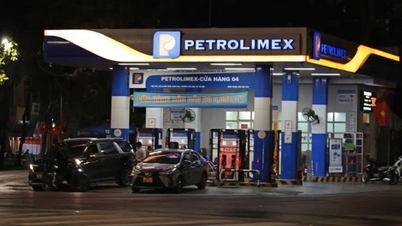
According to a representative of the Vietnam National Petroleum Group ( Petrolimex ), E10 RON95-III gasoline has now been deployed at 60 gas stations in Ho Chi Minh City and Quang Ngai. To date, an average of about 95 cubic meters of E10 RON95-III fuel is supplied to customers daily, an increase of about 40% compared to the initial days of the pilot program.
Petrolimex has implemented a comprehensive set of tasks, from renovating and upgrading storage tanks and biofuel blending systems, to developing ethanol and base gasoline production plans, logistics, and a detailed roadmap for expanding the E10 gasoline business. It is expected that by April 2026, the entire supply of mineral gasoline will be replaced, meeting the new requirements set forth by the Prime Minister .
A representative from Petrolimex stated that because it's impossible to implement the transition simultaneously, it will be carried out gradually between conventional gasoline and E10 gasoline to allow for the sale of E10 gasoline throughout the entire system. The corporation estimates that this transition to E10 gasoline distribution will reduce gasoline consumption by approximately 10%, easing pressure on the petroleum supply chain amidst current supply and demand imbalances.
Mr. Cao Hoai Duong, Chairman of the Board of Directors of Vietnam Oil Corporation (PV Oil), also stated that the entire system of tanks, infrastructure, blending facilities, laboratories, and chemical testing facilities have been invested in and upgraded by PV Oil in 2025. In particular, for ethanol storage, the company has invested in additional tanks and blending equipment, so that by April 2026, the tanks will be flushed to prepare for distribution throughout the system.
Mr. Duong believes that in the context of a tense global oil supply due to the conflict in the Middle East, accelerating the implementation of E10 gasoline will help businesses reduce the amount of mineral gasoline they need to import.
Meanwhile, the supply of ethanol is more favorable due to domestic procurement and imports being less affected by the conflict, making transportation easier.

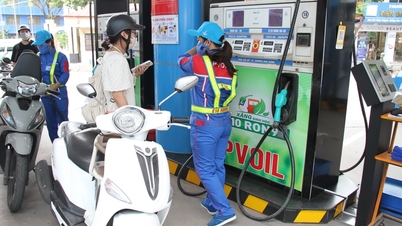
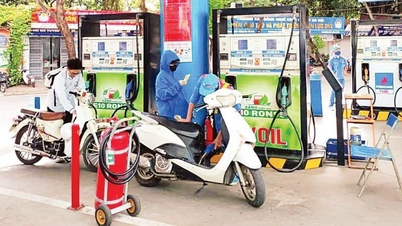
The transition to biofuels helps reduce supply and price pressures - Photo: HUU HANH
Import more ethanol.
Mr. Do Minh Quan - Director of the Domestic Market Management and Development Department (Ministry of Industry and Trade) - stated that according to reports from petroleum traders, the total gasoline consumption in 2025 will be approximately 11.37 million m³. If the transition to using E10 gasoline is implemented according to the roadmap, the estimated amount of ethanol needed for blending will be around 1.1 million m³.
Currently, Vietnam has 6 ethanol production plants, but only about 3 are operational, and even those are not operating at full capacity due to the previously insufficient market size. Therefore, if all 6 plants operate at maximum design capacity, the output could reach approximately 400,000 - 500,000 m³, equivalent to meeting about 40% of the domestic ethanol demand.
Thus, in the initial phase of implementing the roadmap, Vietnam will still have to import about 60% of its ethanol from abroad. The Ministry of Industry and Trade estimates that the remaining volume of 600,000 - 700,000 m3/year in the initial phase will be imported from the two major ethanol exporting countries, the US and Brazil, along with distribution centers in the region such as South Korea and Singapore.
"The Ministry of Industry and Trade is coordinating with other ministries, agencies, associations, and businesses to support ethanol imports, while also promoting the restoration of factories that are currently closed or not operating at full capacity. Once the market stabilizes, the restoration and expansion of domestic production will help Vietnam gradually become more self-sufficient in ethanol supply, reducing its dependence on imports," Mr. Quan affirmed.

Reduce gasoline imports, increase environmental protection.
Mr. Bui Ngoc Bao, Chairman of the Vietnam Petroleum Association, believes that accelerating the transition to using biofuels is of great significance in the current context.
Firstly, biofuels contribute to achieving the environmental protection, green transition, and emission reduction goals that Vietnam committed to at COP26. With blending ratios of 5% or 10%, such as E5, E10, B5, and B10, Vietnam can reduce its dependence on fossil fuels.
"This is particularly significant for an economy like Vietnam, which still has a large agricultural sector. The biofuel program not only creates outlets for agricultural products like cassava and corn, but also contributes to strengthening the links between agriculture and the processing industry," Mr. Bao said.
Furthermore, if Vietnam uses approximately 26 million cubic meters of petroleum products annually, a 10% blending ratio would significantly replace a substantial amount of fossil fuel. If the program is implemented effectively and progresses to E15, E20, or B15/B20 fuels, as some countries have done, reducing dependence on imported fuels will be even more effective. This is especially important considering that Vietnam currently only meets about 30% of its domestic petroleum needs, with the remaining 70% being imported. Therefore, any program that helps reduce dependence on fossil fuels is strategically significant.
Mr. Bao stated that it can now be confirmed that petroleum businesses have been preparing for a long time thanks to their experience in implementing E5. If implemented earlier than scheduled, when E10 gasoline is uniformly applied to replace conventional gasoline, businesses will have to restructure their technical systems, raw material sources, and market plans. Businesses without existing facilities have also proactively worked with major distributors to hire blending and storage services.
Allowing the leasing of chemical laboratories should happen soon.
According to a major fuel distributor in the South, investing in a laboratory with a RON analyzer costs approximately $1 million, not including other investment costs. A draft amendment to Decree 80 on petroleum business allows businesses to rent external laboratories, but the new decree has yet to be issued.
This resulted in the company not meeting the requirements to conduct testing and distribute biofuel to the market.
Therefore, in the current urgent situation, there is a need for a plan to support businesses in flexibly utilizing qualified and licensed laboratories and chemical testing facilities so that businesses can outsource these services, ensuring that petroleum products meet quality standards and adhere to the roadmap required by the Government.
Planning for raw material sourcing areas for ethanol plants.
Mr. Pham Van Tuan, Director of Nha Xanh Vietnam Co., Ltd., believes that the State needs to clearly plan the raw material areas, identifying key areas for growing corn and cassava specifically for ethanol factories. Along with this, investment in infrastructure such as transportation and irrigation is necessary to reduce logistics and procurement costs. To promote ethanol production, consideration should be given to exempting or reducing corporate income tax for 5-10 years for businesses, encouraging long-term investment.
This is linked to maintaining the current import tax rate of 5% on ethanol; and establishing a mechanism to reduce the environmental tax on E10 gasoline.
We hope to have biofuel that is affordable and of good quality.
Ms. Nguyen Thao Vy (27 years old), a communications employee at a hospital in Tan Son Hoa ward, currently residing in Nha Be commune (Ho Chi Minh City), is also facing pressure from transportation costs due to constantly fluctuating gasoline prices, traveling more than 30km every day. Ms. Vy said she proactively researched and read information from many sources about E10 gasoline, from its ethanol blend composition to assessments of fuel consumption and its impact on engines.
According to her, the notable point is that E10 gasoline has the potential to help the combustion process be cleaner, reduce deposits in the combustion chamber, and somewhat improve operating efficiency if used consistently. In addition, environmental factors are also a consideration, as this type of fuel is said to help reduce harmful emissions compared to traditional mineral gasoline.
"I also asked friends who work in the engineering field, and they said that most cars nowadays can use E10 gasoline without any major modifications, so I can use it with peace of mind. I hope there will be bio-gasoline with good price and good quality," Ms. Vy said.
Ready to switch to E10 gasoline.
As a construction engineer in Ho Chi Minh City, Le Van Nhan (32 years old) travels more than 45km round trip every day (he lives in District 12 and works in the former District 7). With an average fuel consumption of about 2-2.5 liters of gasoline per day (not including trips to construction sites or delivering documents), his fuel costs currently range from 1.8 to 2 million VND per month and tend to increase with each recent gasoline price adjustment.
According to preliminary calculations, with its generally lower price compared to conventional gasoline, E10 gasoline could help him save several hundred thousand dong per month. "If the price is reasonable and the supply is guaranteed, I am willing to switch to E10 gasoline, which will both save costs and contribute to reducing emissions," Mr. Nhan said.
International experience in the transition to biofuels:
Clear policies, accompanied by incentives.
Experience in the US, Europe, and India shows that countries that have successfully implemented these initiatives have based their efforts on clear policies, coupled with financial incentives and investment for technological innovation.
In the context of the energy transition and increasing pressure to reduce emissions, biofuels are becoming an important solution in the transportation sector.
Establishing a legal framework and preferential policies.
According to the research organization ORF America, governments are using a variety of tools—from blending rate regulations, tax credits, loan guarantees to production subsidies—to reduce costs, attract investment, and accelerate the adoption of biofuels.
A report from the International Energy Agency (IEA) shows that the United States currently leads the world with approximately 40% of global biofuel production. This success is based on a mandatory national policy framework, with the cornerstone being the Renewable Fuel Standard (RFS) issued in 2005, which requires distributors to blend a certain amount of bioethanol into traditional gasoline.
Alongside mandatory regulations, the US government implemented a range of financial support tools such as tax credits, production subsidies, and agricultural policies to ensure a stable supply of raw materials. As a result, US ethanol production reached approximately 58 billion liters in 2022, with strong growth in the initial phase of implementation.
In Europe, the Renewable Energy Directives (RED, RED II) provide the legal framework for the use of biofuels in transport. France was a pioneer in deploying E10 gasoline in 2009. By 2022, E10 accounted for 56% of total gasoline consumption in the country. The EU aims to achieve 14% renewable energy in transport by 2030, contributing to reduced emissions and promoting the distribution infrastructure for E10 gasoline.
In Brazil, ethanol is often priced lower than or close to gasoline due to tax incentives. The government can adjust blending ratios and support policies to stabilize the market as needed. Thailand also maintains E20 gasoline at a lower price than traditional gasoline to encourage consumption.

Workers pump E10 gasoline into tanker trucks at the Nha Be oil depot for distribution to gas stations in Ho Chi Minh City - Photo: TTD
Promoting technological innovation
To commercialize advanced biofuels under a net-zero emissions scenario, the pace of technology deployment needs to accelerate significantly by 2030 compared to the present. In this process, technological innovation plays a key role in improving productivity, optimizing land use, and effectively utilizing agricultural by-products and waste.
Brazil, India, and Indonesia are leading the way in integrating research with production to enhance energy security and sustainability. In Brazil, biofuel growth is supported by research led by Embrapa – a state-owned research corporation under the Ministry of Agriculture. Solutions such as improved fermentation technology, bagasse recycling, and soil reclamation are optimizing resources.
India is also a leader in biofuel production technology, having invested $17 million in 75 collaborative projects focusing on sustainable fuels, carbon capture, and smart grids. The country has deployed 5,000 compressed biogas plants and is developing second-generation ethanol and bioenergy research centers.
International experience shows that the effective deployment of biofuels depends on several core factors. First and foremost is a stable and clear policy system with mandatory blending regulations, coupled with sufficiently strong financial incentives to reduce costs and encourage businesses to enter the market.
In addition, ensuring a sustainable supply and building consumer trust through transparent communication also plays a crucial role in maintaining and expanding the biofuel market.
Source: https://tuoitre.vn/cap-bach-chuyen-doi-xang-sinh-hoc-20260323082516961.htm


![[Image] Nguyen Tat Thanh Street is expected to be widened, reducing traffic congestion.](https://vphoto.vietnam.vn/thumb/1200x675/vietnam/resource/IMAGE/2026/03/24/1774326200262_ndo_br_3-6869-jpg.webp)







































































Comment (0)