

According to Dr. Nguyen Khac Diep, Department of Gastrointestinal Surgery, E Hospital, a 63-year-old male patient residing in Hanoi was admitted with severe abdominal pain, high fever accompanied by chills, jaundice (yellowing of the eyes and skin), and tenderness in the epigastric and left hypochondriac regions…
For the past three days, he had been experiencing abdominal pain in the upper left quadrant, a high fever of 39 degrees Celsius, and progressively worsening jaundice (yellowing of the skin and eyes)... As the symptoms became increasingly severe, his family took him to the emergency room.
Doctors quickly identified the man as having a biliary tract infection - bile duct obstruction, acute pancreatitis due to gallstones in the common bile duct, on a background of complete situs inversus. However, upon arrival at the emergency room, doctors discovered he had his heart on the right side and a situs inversus.
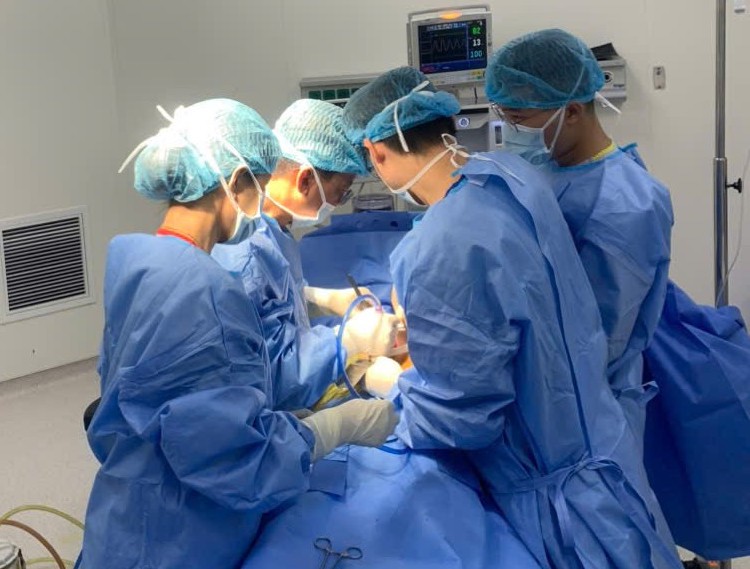
Recognizing the unique nature of the case, the doctors quickly held a multidisciplinary consultation to develop the optimal plan, ensuring the patient's safety.
The doctors decided to start with intensive medical treatment to control the acute hepatitis and infection, then proceed with open surgery to remove the gallstones from the common bile duct. Because the patient had complete situs inversus (reversed internal organs), the surgical team had to perform the procedures in reverse order compared to conventional surgery.
According to Dr. Nguyen Khac Diep, situs inversus is a rare congenital defect, inherited through a recessive gene on an autosomal chromosome, with an incidence rate of only about 1 in 5,000 to 1 in 20,000 people depending on the region.
In people with this condition, the internal organs in the chest and abdomen are arranged in a "mirror image" compared to their normal structure.
Situs inversus does not increase the risk of gallstones, but it creates many difficulties in diagnosis and treatment because the clinical signs and anatomical images are reversed. Therefore, understanding the pathological characteristics and choosing the appropriate management method is key to ensuring successful treatment.
Source: https://cand.com.vn/y-te/cap-cuu-nguoi-dan-ong-co-trai-tim-ben-phai-i780765/










































































![[Infographic] Stock Market on April 1st: VN-Index increased by 28.44 points in the opening session of Q2/2026](https://vphoto.vietnam.vn/thumb/402x226/vietnam/resource/IMAGE/2026/04/02/1775095305328_648382_thumb_1775082921_05352102.jpeg)


















Comment (0)