

The reputation of longan
In the song "Quang Nam - Da Nang, Land of Deep Affection ," composer Nguyen Van Ty wrote the line, "I'll take you to eat long-lasting bon bon fruit, eat until you're tired." It's said that when the song was first released, some people from other regions questioned why Quang Nam didn't have long-lasting bon bon fruit (bon bon is the common name) and why the composer would take someone to eat it "until they're tired." Actually, long-lasting bon bon is also known as Nam Tran or Phung Quan Moc, associated with the story of Lord Nguyen's army (during a battle with the Tay Son army) taking refuge in the forest upstream of the Vu Gia River, Dai Loc, Quang Nam. They encountered a long-lasting bon bon forest and ate the fruit to quench their hunger and thirst. Upon ascending the throne as Emperor Gia Long, Nguyen Anh named the long-lasting bon fruit Nam Tran (precious gem of the South) and had the image of the Nam Tran tree engraved on the upper tier of the Nhan Dinh in the Nine Dynastic Urns of the Imperial Citadel ( Hue ) to show his respect and gratitude.
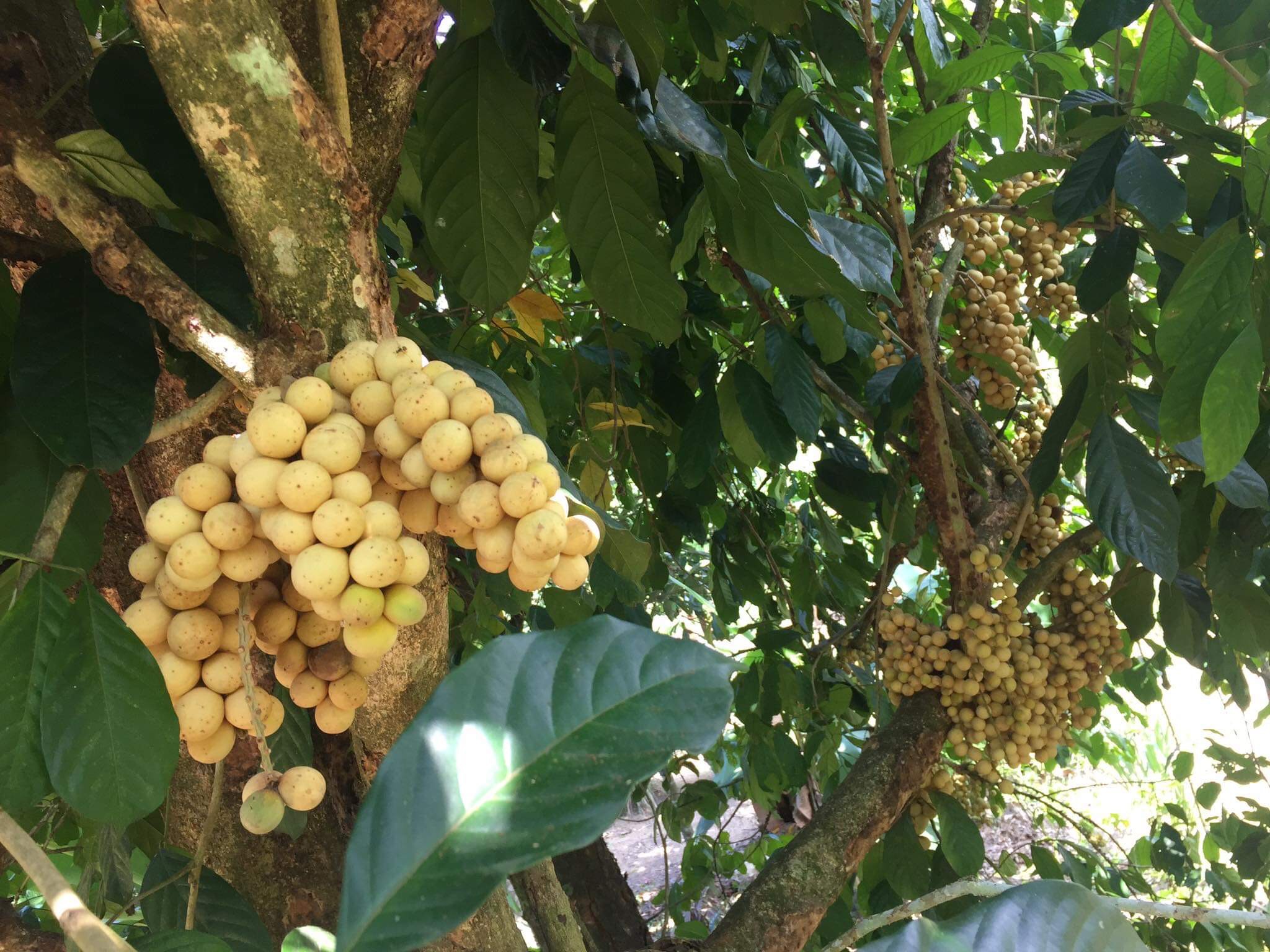
Lòn bon in Tiên Phước
However, the longan from Dai Loc is not as well-known as the longan from Tien Phuoc. Tien Phuoc longan is sweet and has a rich flavor. This fruit can be eaten at any time, whether hungry or full; its sweet, refreshing taste lingers on the tongue, captivating anyone who tries it. Tien Phuoc longan is also used to make wine with a light and appealing flavor.
Many people in Tien Phuoc have become wealthy thanks to longan fruit. Tien Chau commune has the most famous longan orchards. Some households harvest tens of tons each season when the weather is favorable. Tien Phuoc district has organized a scientific workshop on conservation and development to exploit the economic value of longan and to develop its potential for ecotourism, combining culture and cuisine.
Strange fruity flavor
The people of Tien Phuoc mainly live by farming, with their primary income coming from livestock and horticulture. Horticulture plays a key role in this. The most typical example is Loc Yen village in Tien Canh commune. This fairytale-like village has about 20 orchards, ranging from native fruit trees to those introduced from the South, such as durian, mangosteen, and green pomelo. Surprisingly, these characteristic fruit varieties from the South, when "settled" in Tien Phuoc, not only thrive but also produce fruit with a flavor considered superior to their "original" varieties.
We visited Tien My commune, a major mangosteen growing area in Tien Phuoc district. Local residents said that almost every household here grows mangosteen. Some orchards have mangosteen trees nearly 100 years old, such as those of Mr. Pham Van Luc, Mr. Dong Thanh Cuong, Mr. Nguyen Duc Hung, and Mr. Tang Ngoc Chanh. In this central midland district, mangosteen alone can bring in around 30 billion VND annually, a considerable sum for farmers. It is known that Tien My mangosteen has been recognized as a 3-star OCOP product at the provincial level.
Tien Phuoc also boasts another famous fruit: the pomelo. When people talk about Tien Phuoc pomelo, they immediately think of Tra Khan pomelo. Tra Khan is a village in Tien Hiep commune. This is the birthplace of the famous pomelo tree, which is now found throughout the communes of the district. Tra Khan pomelo originates from Hue. The villagers of Tra Khan still recount the story of Mr. Huynh Duan, a descendant of Mr. Huynh Thuc Khang, a local official in the 19th century. During a trip to the imperial capital of Hue, Mr. Duan brought back several carefully grafted pomelo branches. The fertile soil and relatively cool climate of Tra Khan are perfect for this fruit, so after about 4-5 years, the trees began to bear fruit. The pomelo has a sweet and refreshing taste, without the sourness and bitterness of pomelo from the countryside, so people have spread the pomelo variety throughout the village, commune, and even the entire district. The pomelo ripening season is from July to September in the lunar calendar.
There is a type of fruit (or rather, spice seed) called pepper, grown on this "fairyland," which is also the best pepper in the country. Hundreds of years ago, foreign merchants brought Tien Phuoc pepper to the world market. In the book "Modern History of Annam ," author Maybon wrote: "Goods at Hoi An in the first half of the 16th century included raw silk, pepper, agarwood, cinnamon... Chinese and Indian ships came to collect goods." The regions supplying raw silk (Duy Xuyen), pepper (Tien Phuoc), agarwood, and cinnamon (Tra My) all belong to Quang Nam.
Source link


![[Hightling] Conference on the Implementation of Tasks for 2026](/_next/image?url=https%3A%2F%2Fvphoto.vietnam.vn%2Fthumb%2F402x226%2Fvietnam%2Fresource%2FIMAGE%2F2026%2F01%2F27%2F1769477856197_dsc01637.jpeg&w=3840&q=75)


![OCOP during Tet season: [Part 2] Hoa Thanh incense village glows red.](/_next/image?url=https%3A%2F%2Fvphoto.vietnam.vn%2Fthumb%2F402x226%2Fvietnam%2Fresource%2FIMAGE%2F2026%2F01%2F27%2F1769480573807_505139049_683408031333867_2820052735775418136_n-180643_808-092229.jpeg&w=3840&q=75)
![OCOP during Tet season: [Part 1] Ba Den custard apples in their 'golden season'](/_next/image?url=https%3A%2F%2Fvphoto.vietnam.vn%2Fthumb%2F402x226%2Fvietnam%2Fresource%2FIMAGE%2F2026%2F01%2F26%2F1769417540049_03-174213_554-154843.jpeg&w=3840&q=75)


Comment (0)