

 |
| Ms. Hoang Thi Yen (Ha village, Duong Hoa commune, Huong Thuy town) is picking "Tuoc Thiet" tea in her garden. |
National treasure, family heirloom, and the renowned "Tước thiệt" tea.
During the Nguyen dynasty, tea drinking became a refined pleasure, even considered the pinnacle of culinary art. Nguyen emperors often commissioned porcelain teapots and cups, designed and manufactured abroad. During the reign of Minh Mang, the emperor commissioned the Copeland & Garrett pottery factory in Liverpool (England) to create tea sets made of faience porcelain, adding his favorite patterns and inscribing in Chinese characters: "Minh Mang… year added to the painting" (added in the Minh Mang year…). During the reign of Thieu Tri, he commissioned the Sèvres factory in Paris (France) to make porcelain tea sets, decorated with botanical patterns… These items are still preserved at the Hue Imperial Antiquities Museum.
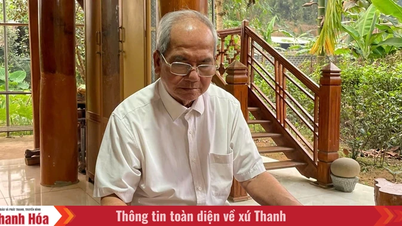
Around 2007, after decades of keeping his collection secret, Mr. Le Van Kinh unexpectedly decided to reveal his collection of antique teapots and other artifacts left behind by his maternal grandfather, Nguyen Van Giao, a high-ranking official in the Ministry of Rites. Among them was a Manh Than brand teapot, over 500 years old, one of the most valuable antique teapots, mentioned in Nguyen Tuan's work "Echoes of a Bygone Era." Mr. Kinh said he was angry when he heard someone say, " Hue has no tea ceremony": "Hue has both national treasures for tea drinking in the royal court and family heirlooms for enjoying tea in the home, like in my house. How can you say Hue has no tea ceremony?"
Mr. Le Van Kinh is right. Hue is a place where everyone, from young to old, knows the poem "At dawn, everyone knows the tea ceremony / ...The doctor doesn't come to the house," so it's impossible to say that Hue doesn't have a tea ceremony. Moreover, in the past, Hue-style tea drinking was so famous that there was a saying: "A man who knows how to play card games / Drinks Hue-style tea, recites Thuy Kieu in vernacular." In Hue, there are also oral traditions about famous tea sets called Mai Hac, depicting a crane standing beside an old plum tree with two lines of vernacular poetry by Nguyen Du: "Wandering and enjoying the peaceful scenery / The plum tree is an old friend, the crane is an acquaintance..."
Hue in the past also had its own "great famous tea," a type of tea called "Tước thiệt" (sparrow's tongue), renowned since the 14th century. This tea has young shoots, and even after processing, the buds retain the shape of a sparrow's tongue. In "Ô Châu Cận Lục," Mr. Dương Văn An wrote: "Tea from Kim Trà district, now Hương Trà district in Hue, called 'sparrow's tongue' (tước thiệt), grown on the hills of An Cựu; it relieves distress, cures diarrhea, and is the best of hundreds of herbs, possessing miraculous properties..."
Kim Tra, once a vast area encompassing the western hills of Hue, is easily understandable given that the "Tuoc Thiet" tea variety once flourished in the hilly areas at the headwaters of the Perfume River. Legend says that "Tuoc Thiet" tea completely disappeared after the 19th century; however, recently, photographer Nguyen Phuc Bao Minh, while visiting Duong Hoa commune, captured images of elderly women harvesting "Tuoc Thiet" tea, as if the pages of Duong Van An's book were still open there.
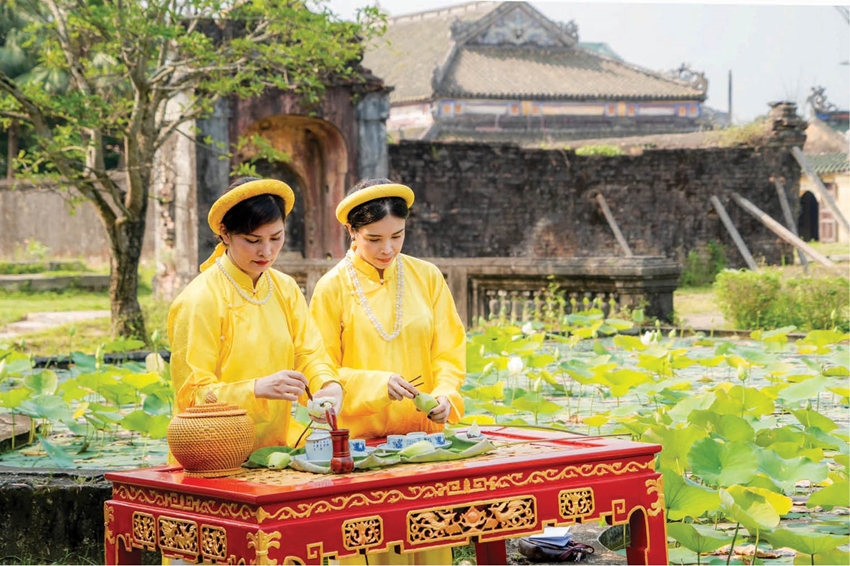 |
| Spring Tea |
Hue-style tea time
In ancient China, Lu Yu wrote about the art of tea drinking, known as the "nine ways of tea," which was later adopted in many parts of the world . In Hue, tea drinking is also based on these rules, but with some additions to "adapt to local customs," resulting in a more distinctly "Hue" flavor. In Hue, tea drinking was traditionally called "tea time." The very term itself shows Hue's uniqueness compared to other places, and the way tea time is practiced is also very flexible, not as rigid as the tea ceremonies of other regions…
Some "Hue tea connoisseurs," whether in large or small gardens, would set up a "tea room," inside which were placed several tea tables: one for solo drinking (enjoying tea alone); one for two people (also called couple drinking); or one for three people, the standard "tea for three, wine for four." In other tea ceremonies, four or more people are considered "group drinking," but for these "Hue tea connoisseurs," it's not quite that simple; they're even more "flexible" in a very "unconventional" way: a tea table with three people is called "three abundances," four people is called "four treasures," and so on, named "five blessings," "six wealths," "seven sages," "eight immortals," "nine dragons," and only ten or more people are considered "group drinking." Truly, only the "Hue ladies" could be so "unconventional"!
According to Mr. Le Van Kinh, the traditional way of drinking tea in Hue also had its own unique characteristics. Once guests were seated, the host would personally rinse the cups and prepare the tea. On the tea table, alongside a tray of betel nuts and a tobacco box, there was also a brass spittoon, a brass basin, and a red cloth. In those days, a cup of tea consisted of three parts. The first part was a light sip to appreciate the warmth and aroma of the tea. The second part was a larger gulp, and from the third part onwards, the remaining tea was savored. During the first round of tea, the host would personally pour the tea into the cup and respectfully offer it to the guest with both hands. After the second round, the host would delegate the tea-making task to a fellow tea drinker seated to their right, usually a close friend or relative.
Conversations around the tea table usually blossom after the second round of tea. The ancients never completely emptied the teapot, always leaving a little behind, a practice called "leaving some for posterity," signifying a reminder to preserve some virtue for future generations. This shows that for the ancients, drinking tea was not simply an ordinary daily habit.
The delicate spring tea cup
Regarding the meticulous process of tea making, a native of Hue – the poet Pham Van Sau – even compiled a collection of 4,889 verses titled "Six-Eight-Verse Tea Poems" to convey various ways of enjoying tea. In it, the water used for brewing tea is described as requiring extraordinary care: "The best spring water from the source / Collected rainwater from thatched roofs and ordinary tiled roofs / A well made of laterite stone, not simple / Digging deep enough for a good vein requires more than a pole / Rainwater collected from betel nut trees / Using the veins of palm leaves tied to the base of the tree"...
In Hue, there's a legend about collecting dew from lotus leaves to make tea, and the tea itself being wrapped in lotus flowers to enhance its natural fragrance. Besides infusing tea with lotus and wolfberry fragrances, Hue people also have a custom called "freshly scented tea." Despite the fancy name, the method is simple: just drop freshly picked fragrant flowers like lotus, jasmine, chrysanthemum, osmanthus, and wolfberry directly into a teapot, add boiling water, and enjoy a truly delightful tea-drinking experience in the garden.
Learning from the refined tastes of the ancients, a Hue tea house has now linked tea culture with the Perfume River. The water used to brew the tea is collected by the "tea ladies" from the upstream of the river, so the teapot, in addition to the aroma of the tea itself, also carries the fragrance of the pure Perfume River water from its source, subtly infused with the scents of countless wildflowers from the vast forest... On the full moon of each month, the "tea ladies" of the tea house also perform the ritual of offering tea and scattering flowers on the Perfume River, praying for the peaceful and serene atmosphere of Hue's tea ceremony.
In the tea-drinking tradition of Hue, it's interesting to note that there are always accompanying snacks, usually various types of rice cakes made with lotus seeds, mung beans, or glutinous rice flour, wrapped in colorful paper. During Tet (Lunar New Year), Hue tea is further enhanced with candied ginger. Sipping a hot cup of tea and tasting a slice of spicy, warm Kim Long candied ginger, one realizes that spring has arrived in the land and in the heart.
Source: https://huengaynay.vn/du-lich/am-thuc-hue/chen-tra-xuan-149946.html

![[Photo] “Red Journey” 2026: Vietnamese Youth Continue Building the Bridge of Friendship Between Vietnam and China](https://vphoto.vietnam.vn/thumb/1200x675/vietnam/resource/IMAGE/2026/04/20/1776629730866_4055880775670638308-9618-4200-jpg.webp)



















































Comment (0)