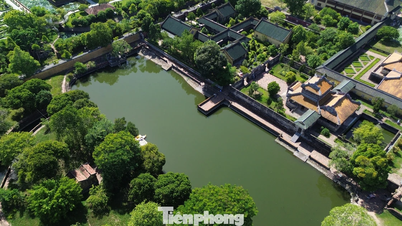
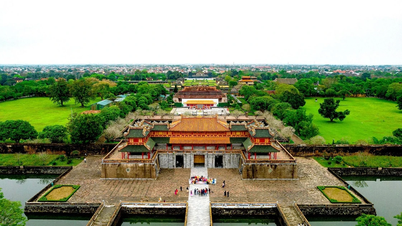
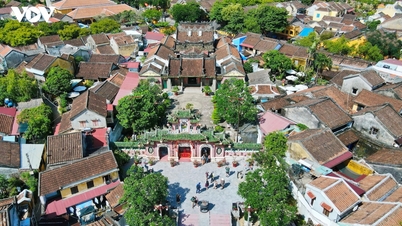
The pagoda is nestled against a cliff, with the Liệt Thủy (Rào Nướt) stream flowing into the Ngàn Sâu River in front. The scenery is elegant and truly a famous landmark of La Sơn, as described in a couplet inscribed on the two pillars at the front of the pagoda:
The vast palace walls and majestic mountain peaks;
The merits of the river are immense.
(Mount Am is high, the sacred land is vast;
The Hac River is long, its merits are immeasurable.
According to genealogical records and published research documents, Empress Bach Ngoc's real name was Tran Thi Ngoc Hao, the wife of King Tran Due Tong. After the Tran dynasty fell, the Ming dynasty used the pretext of attacking the Ho dynasty to invade Vietnam. She took her daughter, Princess Huy Chan (Tran Thi Ngoc Hien), and her family to Nghe An, where she organized the reclamation of barren land and established many villages in the lower Huong Khe, upper Duc Tho, and upper Can Loc regions. She and her daughter provided the stored rice to the Lam Son rebels. Princess Huy Chan was chosen by Binh Dinh Vuong as a concubine and gave birth to Princess Trang Tu (Le Thi Ngoc Chau). After the victory, Empress Bach Ngoc requested permission from the king to build a temple in Am Son and became a nun there. Later, Princess Huy Chan also requested to join her mother in religious practice. Princess Trang Tu, after her husband, Duke Bui Ban, died in battle, remarried Duke Tran Hong, but eventually returned here to practice Buddhism with her mother... Thus, Dien Quang Pagoda was built around the Thuan Thien period (1428-1433) during the reign of Le Thai To. However, currently, no documents or evidence have been found indicating the condition of the pagoda when it was first built and the time of subsequent renovations and restorations. On the rafters, only the inscription remains: "Nguyen Dynasty, Duy Tan fourth year, summer month (June), rebuilt, completed, mid-winter, December, inaugurated (...)" (The fourth year of Duy Tan (1910) of the Nguyen Dynasty,... rebuilt in the last month of summer (June), completed, inaugurated (...) in the middle of the last month of winter). This may be information about the last renovation.
Visitors knowledgeable about ancient architecture will be surprised and delighted to see that Am Pagoda still retains its "Công" shaped architectural style with a wooden frame, brick walls, and yin-yang tiled roof – a distinctive architectural style of the late 19th century.
The graceful, flowing curves of the roof further enhance the beauty of the temple. The entire main hall is built with 60 jackfruit wood columns, 14 of which have been replaced; from the outside, it appears as a monolithic structure divided into three interconnected sections forming a solid and coherent whole. Viewed from the sides or rear, the tiled roofs of the main hall are layered; the middle section slopes slightly downward, and the two ends gradually curve upwards, making the overall structure resemble a boat gliding on waves. Many have likened the architecture of the main hall of Am Pagoda to the image of the Prajna boat.
The temple floor is paved with blue stone. The main hall houses statues of Shakyamuni Buddha, Amitabha Buddha, and other Bodhisattvas. On either side are couplets:
Listening to Buddhist scriptures and texts enhances the intelligence of the ears and eyes.
Cultivating virtue and practicing the righteous path benefits both humanity and heaven.
(Hearing the Dharma, understanding the scriptures, ears become clear, eyes become bright)
According to the Way, one should correct oneself and benefit others, so that Heaven will be pleased.
In front is an elaborately carved nine-dragon structure. To the right are shrines dedicated to the local deities, and to the left is a shrine to Queen Bach Ngoc.
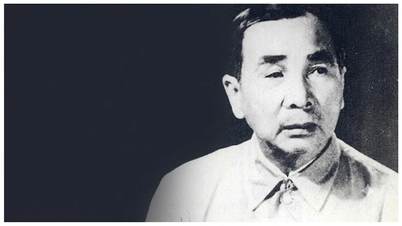
Located near the screen wall, next to the steps leading up to the main hall of the temple, are two tomb towers. There are a total of seven such towers, which, according to local people, are the burial places of the monks who previously presided over the temple. Most of these tomb towers, besides the couplets, lack inscriptions, making it difficult to identify the deceased. Only the tomb tower of Venerable Thích Trí Liễn, located in the front left near the temple entrance, clearly records the date and name. The Venerable's secular name was Nguyễn Tất Tố, born in 1868 and died in 1936. Before becoming a monk, he had a son named Nguyễn Tất Toán, who participated in revolutionary activities and became a member of the Communist Party in 1930-1931, active in the Đồng Công branch, and later also came to the temple to practice Buddhism with his father.
Furthermore, opposite to the left of the temple garden, there is another pagoda called "An Tap Pagoda." An inscription carved on the base of the pagoda indicates that, during the reign of Emperor Khai Dinh, the novice monk Thanh Lien, the abbot of the temple, completed the construction of three pagodas on an auspicious day in the year Quy Hoi (1923).
From the triple gate to the main hall of the temple, visitors walk along a gently sloping path of steps. They pass two tomb towers, a shrine to the local deity, and a row of buildings on the right. Climbing a few dozen more steps leads to a spacious courtyard. Every few dozen steps there is a courtyard like this, symbolizing connection and creating a harmonious balance within the overall architecture of Am Pagoda, serving as a resting place to calm the mind before entering to worship Buddha.
Behind the main hall, a trail leads up the mountain lined with rocks resembling kneeling figures, hence the locals call them "Buddha-worshiping rocks" or "Divine Child rocks." Additionally, the temple grounds boast many ancient trees providing shade year-round, especially centuries-old trees that still stand strong against the ravages of time. Nestled among these ancient trees with numerous steps leading up the path, Am Pagoda exudes an air of antiquity.
Right behind the pagoda is a very large freshwater lake, with clear blue water, surrounded by mountains. If you climb Am Son mountain and stand amidst the vast green pine forest looking down at the pagoda and out at the Ngan Sau River, you will see how beautiful the scenery is. It can be said that Am Pagoda is an ancient temple with a long history, possessing scenery and architecture that are rare in our country.
For over five centuries, the ancient Dien Quang Pagoda has not only been famous for its stunning scenery but also for its association with the name of Empress Bach Ngoc and the resistance against the Ming invaders by the people of Duc Tho, Ha Tinh province.
Instructions:



From Ha Tinh city, follow National Highway 1A north for 30km to Hong Linh town, then follow National Highway 8A west for about 18km, and continue along Provincial Road 28 for about 4km to reach Am Pagoda.
Contact: 01234 105111 (Mr. Doan Van Hieu – Head of Management Board)
Nearby tourist attractions: Tran Phu Memorial Site, Phan Dinh Phung Tomb, Truong Xuan craft village.
Article author: Pham Ai (compiled and edited). Photo: Dau Binh
Source: https://dulichhatinh.com.vn/tai-nguyen-du-lich/di-tich-danh-thang/chua-am-8/

![[Photo] Strengthening character and expertise: Intense training for artillery soldiers.](https://vphoto.vietnam.vn/thumb/1200x675/vietnam/resource/IMAGE/2026/06/30/1782815602541_lu-368-1875-4571-jpg.webp)