

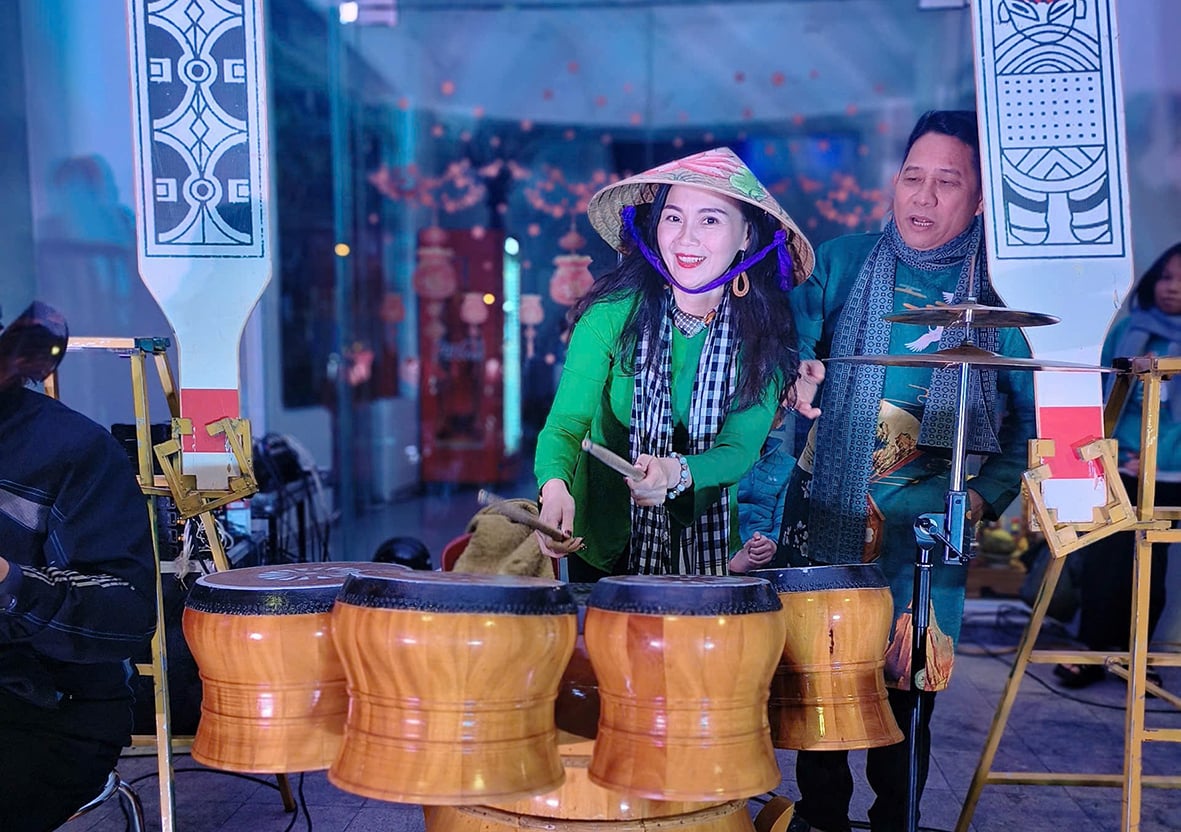
Artist Thuy Ai performs the rice-pounding folk song at a Bài Chòi festival in Quang Tri province - Photo: Provided by the artist.
Songs from labor
Folk songs are the voice of the poor farmers, the self-confession of the sun-drenched, windswept land of Central Vietnam, and the embodiment of both labor and spirit.
According to Ms. Nguyen Thi Nuong, Acting Head of the Cultural Management Department of the Quang Tri Provincial Department of Culture, Sports and Tourism, the Quang Tri rice-pounding folk songs are closely associated with the act of pounding rice, a daily activity of rural people in the past. Each rice-pounding session was usually a collective gathering, where young men and women in the village worked together and... sang. Their hands rhythmically held the pestles, their mouths hummed songs, making the work, though arduous, feel light and joyful.
Similarly, the Le Thuy folk singing style also originates from labor activities, but specifically river and field labor. During boat trips across the Kien Giang River, or during rice planting and harvesting, the folk songs resonate, leisurely yet heartfelt. The name "khoan" (leisurely) also comes from the phrase "khoan khoan ho khoan," which serves as both a rhythmic command and an introduction to an impromptu call-and-response.
Both melodies originate from labor, clearly reflecting the close and simple relationship of the people of Central Vietnam with nature and their arduous struggle for survival. But it is precisely in this labor that the folk songs become a flame that ignites human connection and hope.
A prominent feature of rice-pounding folk songs and "ho khoan" folk songs is their call-and-response format. One person sings the opening line (the "troi" line), and the other immediately responds with another. This call-and-response is filled with humor, charm, wit, and often sweet declarations of love, hidden behind the shyness of the villagers. " I sing on this side of the mountain, you listen on that side of the river; if you know how high the mountain is, then the river also fills your heart" (Quang Tri Rice-Pounding Folk Song) .
“ Ho khoan ho khoan, I ask you honestly, whose field has such good rice, or is it your own field that you're sparing?” (Le Thuy folk song).
Both begin with a question or call, followed by a gentle, witty, or profound response, showcasing the cleverness, intelligence, and even emotion in male-female communication. Folk songs are a language for conveying feelings, a place to express intelligence and subtlety in behavior. Folk songs are a special "communication channel" of rural people, both profound, joyful, lyrical, and delicate. In these songs, love is not sentimental or sorrowful, but always bright, hopeful, sincere, discreet, yet deeply meaningful.
Simple yet profound heartfelt emotions
Artist Thuy Ai, from the Quang Tri Provincial Cultural and Film Center, who has been involved with the two folk melodies for many years, commented: "What people remember most is the simplicity and naturalness in each song. The melodies are not forced; sometimes they are calm like a whisper, sometimes they soar like a joyful song during the harvest season."
Without embellishment or elaborate metaphors, the imagery in the folk songs is as familiar as the lives of rural people: rice fields, houses, boats, riverbanks, banyan trees, village courtyards... These images are not only present in the lyrics but also represent collective memory, the cultural space where generations of Vietnamese people have grown up together. What is special is that the folk songs do not use abstract images but rather familiar and relatable ones such as thatched roofs, wells, village courtyards, rural rivers, and banyan trees at the edge of the village... These images are not just the setting but also cultural symbols, the foundation that gives the folk songs more soul and meaning.
Try listening to the call-and-response folk songs of Le Thuy, which have a subtly satirical quality:
Male: Le Thuy has the Kien Giang river,/ And gentle, heartfelt folk songs,/ Country girls are both capable and beautiful,/ If they become daughters-in-law, your mother will surely approve!
Woman: My homeland is full of warm hospitality, / I invite anyone who is truly sincere to come and visit!
The wit, humor, and richness of the country folk lie not in their reasoning but in their folk songs, which are both playful and full of hidden meanings, both innocent and profound.
Similarly, the Quang Tri rice pounding folk song, with lyrics compiled by Ms. Thuy Ai, is performed as follows:
Woman: Where in our homeland are there so many shrimp and fish specialties? What dishes are famous far and wide on Con Co Island?
Alcohol is useless without hesitation or thought/ A man of integrity, if you can speak your mind/ A man of integrity, if you can speak your mind/ Then I will follow you, I beg to follow you.
Nam: Cua Viet and Cua Tung are places with lots of shrimp and fish / Famous far and wide are the delicious and fragrant Stone Crabs from Con Co Island / I've been to Trieu Hai and Gio An many times / Kim Long wine - Que and Hai Que / Kim Long wine - Hai Que, so my dear, come with me!
Village stage, where art takes root.
Before being recognized as intangible cultural heritage, rice-pounding folk songs and chanting songs were the true "village stage." No need for backdrops, lights, or elaborate stages; just a moonlit evening, a village courtyard, and people gathered to sing call-and-response songs.
There, there are no boundaries between artist and audience; everyone is a singer and a listener, a community sharing stories of their village, their hometown, and their people.
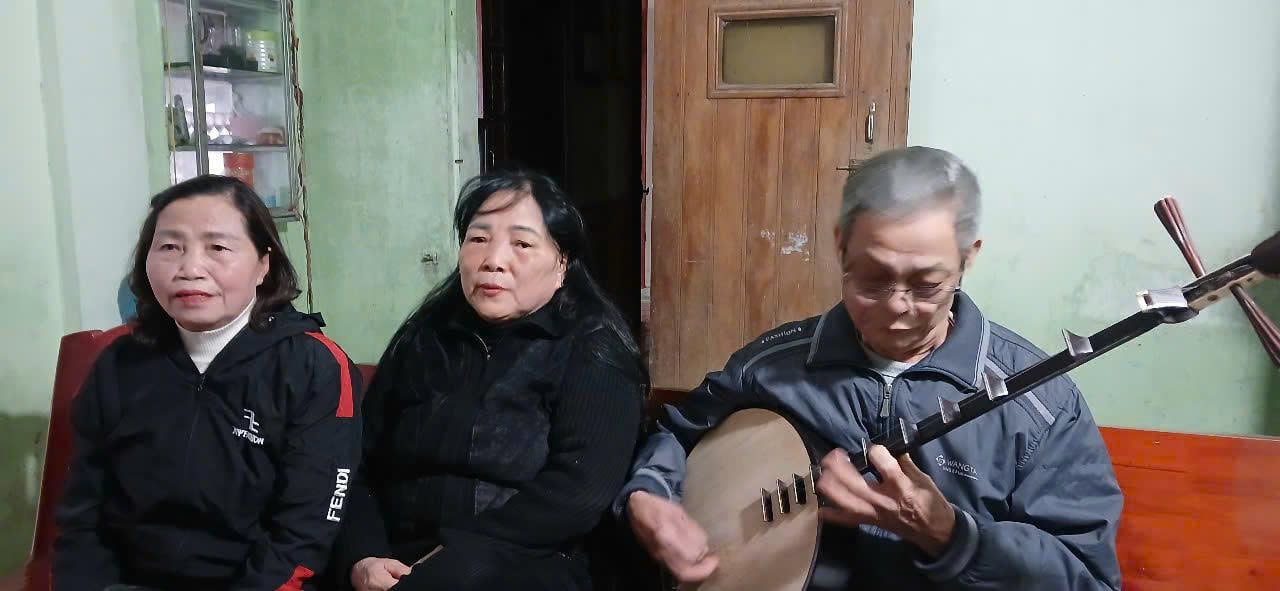
Distinguished artist Nguyen Thi Ly (in the middle) and artists from the Le Thuy Folk Song Club, Quang Binh province, are performing - Photo: MT
Distinguished artisan Nguyen Thi Ly (70 years old) from Phong Thuy commune, Le Thuy district, Quang Binh province, enthusiastically said: “Le Thuy folk singing is a precious heritage passed down from our ancestors. Once you fall in love with it, you can't let go. Once you start singing, you sing with passion. Wherever you hear folk singing, cultural performances, or festivals, you feel a surge of excitement. I've loved folk singing since I was little, and now at 70, I'm still in love, perhaps even more so than when I was young. And it's not just me; anyone who loves folk singing feels the same way.”
That simplicity is its special charm. Folk singing is not ostentatious or flashy, but it carries a noble mission: to pass on moral values, a way of life, and love for the homeland to future generations.
Amidst the hustle and bustle of modern life, where digital music permeates spiritual life, the rice-pounding folk songs of Quang Tri and the folk songs of Le Thuy, Quang Binh still quietly resonate, like a loving reminder of homeland, roots, traditions, and timeless values.
Minh Tuan
Source: https://baoquangtri.vn/chung-dieu-ho-tinh-que-194303.htm
![[Photo] Young people in Da Nang radiate the spirit of spring in traditional ao dai dresses.](/_next/image?url=https%3A%2F%2Fvphoto.vietnam.vn%2Fthumb%2F1200x675%2Fvietnam%2Fresource%2FIMAGE%2F2026%2F02%2F05%2F1770283565383_ndo_br_d7fd33c1bcc2329c6bd3-3439-jpg.webp&w=3840&q=75)



Comment (0)