

The Vietnamese stock market just experienced a turbulent trading session with extremely large price fluctuations.
Entering the morning trading session, news of the joint US-Israeli attack on Iran caused immense anxiety among global investors, and particularly in Vietnam. Concerns about the potential disruption of oil supplies in the Middle East and the prospect of a global economic recession immediately cast a dark shadow over the market.
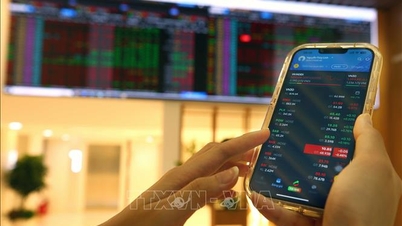
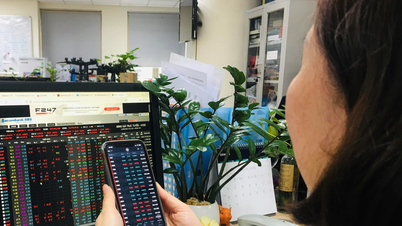
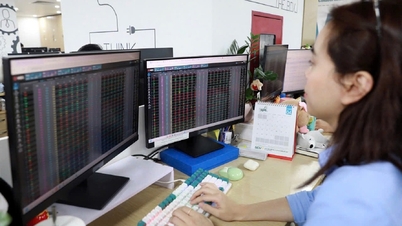
In response to external risks, a defensive and capital-preserving mentality immediately prevailed. From the opening auction (ATO), strong and widespread selling pressure emerged across a range of stock groups. At one point, the VN-Index plummeted by more than 40 points, falling close to the psychological support level of 1,840 points. The trading screen was awash in red, with millions of shares being sold off at any price.
However, the stock market always holds surprises. After the initial psychological shock, when the VN-Index hit deep discount levels, a large portion of the capital that had been on the sidelines decided to enter the market. During the continuous trading session, bottom-buying demand increased significantly, helping many stocks recover quickly and narrowing the index's decline.

News of armed conflict in the Middle East created a massive psychological shock, wiping out market gains on Monday, March 2-3.
After just over an hour of trading, the panic seemed to have subsided. The VN-Index made an effort to climb and was only down about 15 points from the reference level. The decline continued to narrow afterwards, closing the morning session with a mere 3.15 point decrease (equivalent to 0.17%), with the VN-Index closing at lunchtime at 1,877.18 points.
Total trading volume reached 866.4 million shares, with a corresponding value of 26,639 billion VND, a surge of over 90% in both volume and value compared to the morning session of last weekend. Block trades alone contributed significantly with 44.3 million shares, equivalent to 1,328.7 billion VND.
The VN30 basket faced significant downward pressure in the morning session, falling by more than 14 points, with a large disparity: 21 stocks declined and only 8 stocks rose. Stocks dragging down the index included VHM (-3.5%), VJC (-3.3%), VCB (-2.5%),FPT (-2.3%), and BID (-2.2%).
However, on the other hand, VIC shares unexpectedly reversed course and rose 1.5%, becoming the "hero" and the most positive contributor.
Meanwhile, STB played the role of a "rare star" in the banking industry by going against the trend, at one point reaching the ceiling price and closing the morning session up 5% at 68,800 VND/share, with explosive trading volume of 15.7 million units.
On the HNX exchange, the situation was similar, with the HNX-Index only falling 2.98 points (1.13%) to 259.84 points. Trading was particularly active in the oil and gas and fertilizer sectors, with a series of gains including PVS, PVC, PLC, PVB, and LAS, which rose 9.6%. The UPCoM exchange even turned green, increasing 0.25 points to 129.56 points thanks to improved demand.
It was thought that the impressive recovery in the morning would pave the way for a calm afternoon, but the reality was much more chaotic. Bottom-buying demand seemed to have run out of ammunition, while profit-taking, stop-loss orders, and margin calls poured in like a waterfall as soon as the afternoon session opened. The morning recovery was officially confirmed to be a classic "bull trap."
Ending a turbulent trading session, the VN-Index officially surrendered, plummeting 34.23 points (equivalent to 1.82%), falling to 1,846.10 points. The situation on the Hanoi Stock Exchange was equally dire, with the HNX-Index dropping 3.82 points (1.45%) to 259.00 points, and the UPCoM-Index reversing course to fall 0.35 points (0.27%) to 128.96 points.
This sharp decline was heavily influenced by large-cap stocks, with the VN30 index plummeting by 51 points (a drastic 2.47% drop), falling to 2,010.75 points. The core reason stemmed from the simultaneous weakening of the two largest pillars: finance (-2.86%) and real estate (-3.56%). The technology sector also failed to hold its ground, falling by 2.56%.
Market liquidity surged, with the HoSE exchange alone seeing nearly 1.55 billion shares traded, worth over 47,226 billion VND. Net buying by foreign investors of 766 billion VND still failed to stem the market's decline.
In the banking sector, selling pressure was also strong. Unlike the isolated positive performance of STB in the morning (+2.3% at closing), other major stocks were surrounded by red. BID shares, after a 2.2% drop in the morning, plummeted to -5.6% at closing. This was followed by a series of large-cap stocks such as TCB (-4.4%), CTG (-3.7%), HDB (-3.6%), VCB and VPB (both down 3.1%).
A similar situation swept through the real estate sector. Demand proved hopeless in the face of a massive sell-off, driving market prices down dramatically. Notable examples include CEO, which plummeted 8.8%, HDC (-6.9%), CII (-6.8%), DIG (-6.4%), and NVL (-5.7%).
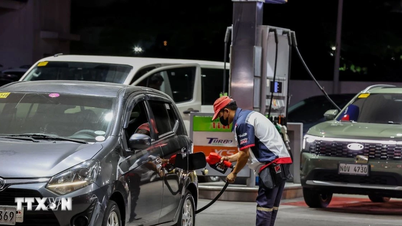
Amidst the gloomy market outlook, the aftermath of the Middle East crisis transformed energy and oil and gas stocks into the brightest spot, acting as a rare "safe haven" for capital. The energy sector index surged dramatically, rising by 7.56%.
The electronic trading board for the oil and gas sector was awash in purple. Continuing its momentum from the morning session, PVS shares surged spectacularly with a 9.9% increase at closing. A series of stocks such as PVD, GAS, PVC, and ASP also turned purple, with gains ranging from 7% to 10%.
Stocks like PLX, POW, and PVT also closed at or near their ceiling prices (+6.9%). Notably, APP surged by a staggering 14.9%. The strong resurgence of Oil and Gas, along with Basic Materials (+3.44%) and Utilities (+4.51%), salvaged some last vestiges of confidence, preventing a complete collapse of the VN-Index.
Source: https://nld.com.vn/chung-khoan-lai-don-cu-soc-moi-196260302152944616.htm































































































Comment (0)