The terraced fields are barren, and poverty clings relentlessly.
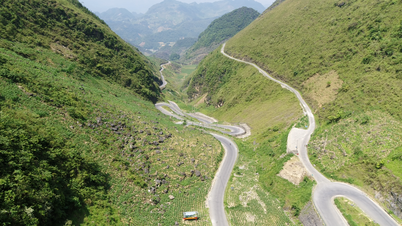
We arrived in Pha Long commune, Lao Cai province, in late April, when the first rains of the season were still a rarity. Unlike the lush green usually seen in the highlands during springtime, the terraced rice fields on the mountainside here were still covered in a dry, gray hue.
Leading us along the treacherous trail, Mr. Nguyen Duc Luan, Vice Chairman of the People's Committee of Pha Long commune, shared the unique characteristics that have caused poverty to persistently cling to this land.
Pha Long commune, formed by the merger of four former communes (Ta Ngai Cho, Pha Long, Din Chin, and Ta Gia Khau), currently covers an area of over 105 km2 and has a population of over 14,600 people, scattered across 35 villages, 17 of which border the national border. The commune is primarily mountainous with steep slopes and is heavily fragmented. This makes arable land scarce. The soil here is mainly composed of limestone, with a thin topsoil layer and poor water retention.
In particular, the scarcity of water for production is the biggest difficulty. This region has a long dry season, and irrigation water is almost entirely dependent on rainwater. The terraced fields are dry and scorched by the cold winter to early summer , making single-crop rice and corn cultivation precarious and resulting in low yields.
Mr. Luan added: "The entire commune has a high percentage of ethnic minorities, with the Hmong making up the majority (about 60%), along with the Nung, Bo Y, and Pa Di people... Each ethnic group has its own unique cultural characteristics, but generally, old production customs and practices still persist. A segment of the population still maintains a self-sufficient production mindset, 'leaving everything to fate.' The traditional habit of cultivating rice and corn on steep mountain slopes is no longer suitable for the context of climate change and the demands of commercial agriculture."

Many households are converting single-crop rice land to pear cultivation. (Photo: Thanh Tien)
Furthermore, due to the fragmented terrain and remote geographical distance, farmers have slow access to market information, new technologies, and value chains, resulting in low agricultural product values and vulnerability to price manipulation by traders. The combination of harsh natural conditions and outdated production methods has led to a very high percentage of poor and near-poor households in the commune, currently exceeding 70%.
When pear and mandarin trees take root on the mountain slopes
After a long conversation along the mountain road, our first stop was Sin Chai B village, where 100% of the residents are ethnic Mong people. Welcoming us beside his lush green pear orchard, Mr. Luu Seo Hoa excitedly shared that the villagers are gradually converting their less productive corn and rice fields to cultivate Tai Nung pears and Muong Khuong tangerines.
Mr. Hoa shared: "In this village, people have converted more than 10 hectares of land to pear trees and 2 hectares to tangerine trees. Previously, growing upland rice and corn was hard work, yielding only one harvest per year. In years with natural disasters, everything would be lost. Now, growing pears and tangerines provides a more stable income, and the people are very happy."

Pear trees thrive in Pha Long soil. (Photo: Thanh Tien)

He led us through his lush green pear orchard, where the branches were laden with thumb-sized young pears, signaling an impending bountiful harvest. Mr. Hoa's orchard has about 300 trees, all over four years old, and this year is the first time they've borne fruit.
Mr. Hoa confided: "Previously, a rice field only yielded 7-8 bags of rice (about 3-4 quintals), which sold for 12,000 VND/kg, not much. But these pear trees are worth much more. A single pear tree, when in full harvest, can bring in an income of 500,000 to 1 million VND. That's dozens of times more than growing rice."
Not only the people in Sin Chai B village, but also in Mao Choa Su village, Mr. Hang Seo Du's family is a prime example of converting single-crop upland rice land to pear cultivation. Mr. Du was one of the pioneers who went to Bac Ha to buy pear saplings to plant 8 years ago.
"Previously, growing corn was inefficient and laborious, and after deducting expenses, there wasn't much left over. I decided to switch to growing fruit trees. For the first three years of growing pears, I had to accept that there would be no income, focusing only on caring for the trees, shaping the canopy, and pruning. But when it came time to harvest, the results exceeded expectations. Last year, with just over 200 fruit-bearing trees, my family earned over 80 million dong," Mr. Du happily shared.
Currently, Mr. Du's orchard has expanded to over 1,000 trees covering an area of more than 2 hectares. During cultivation, his family does not use chemical herbicides but instead practices entirely manual farming to keep the soil clean and ensure the quality of naturally ripened fruit.
Shifting the mindset from subsistence production to commodity production.
According to Mr. Tran Van Thang, Head of the Economic Department of Pha Long commune, in response to the frequent droughts affecting many areas of cultivated land, the local government has been actively seeking new crops to replace traditional food crops with low yields. Among these, Tai Nung pears have been identified as a key crop with promising potential for breakthrough growth due to their suitability to the local soil and climate.
In recent years, pear trees in Pha Long have yielded very stable productivity and output. The market highly values the fruit for its characteristic sweetness, juiciness, and crisp aroma. To truly make pear trees a poverty-alleviating crop, the commune has directed agricultural extension workers to directly visit orchards and provide hands-on guidance to farmers. From planting density and fertilization techniques to pest and disease control, and even advanced techniques like pruning and shaping to create beautiful canopies and increase fruit set, everything is meticulously explained.
Currently, Pha Long has developed over 100 hectares of pear orchards, primarily concentrated in 18 villages in the former Pha Long and Ta Ngai Cho areas. In the coming period, the commune will continue to focus resources on promoting and supporting people to expand the area to approximately 400-500 hectares.
"Not only are we expanding the scale of production, but the commune is also planning to have Tai Nung pears recognized as an OCOP (One Commune One Product) product by 2026. We are actively connecting with cooperatives, purchasing units, and supermarket chains to establish a sustainable consumption chain. Building an OCOP product brand will be a passport for Pha Long pears to reach larger and more professional markets, ensuring long-term livelihoods for the people," Mr. Thang said.
Further discussing long-term directions, Mr. Nguyen Duc Luan, Vice Chairman of the People's Committee of Pha Long commune, affirmed that the transformation of crop structure in Pha Long is part of the implementation of Resolution 10 of the Lao Cai Provincial Party Committee on the strategy for developing commercial agriculture.

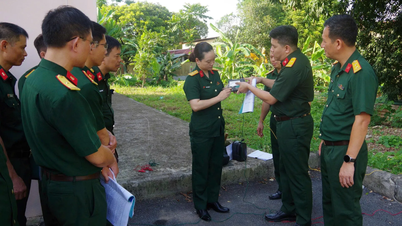
The Pha Long commune authorities are encouraging residents to switch to different crops. (Photo: Thanh Tien)



"We have identified key crops including: Shan tea (currently 298 hectares), Tai Nung pears (over 100 hectares), Muong Khuong tangerines (over 60 hectares), and bananas (44 hectares). In particular, the commune has proactively acted as a bridge between farmers and businesses. For example, with tea, we organized a signing ceremony between households and Thanh Binh Tea Company to ensure a minimum purchase price, helping farmers feel secure in their production."

Shan tea plants have also recently been introduced and planted in this area. (Photo: Thanh Tien)
The shift from rice and corn in this "thirsty" land to crops like tea, pears, and tangerines is not simply a change in crops, but a shift in economic thinking, moving away from the fragmented, self-sufficient production of the past and towards commodity production. Although the poverty rate remains high, and the product distribution channels still need more connections, with the close support of the government and the diligence of the Mong, Nung, Bo Y, and Pa Di ethnic groups, it is believed that in the near future, the remote border region of Pha Long will be covered in a green hue of prosperity and happiness.
Source: https://vtv.vn/chuyen-doi-cay-trong-tren-vung-dat-khat-100260629213820873.htm


![[Photo] Strengthening character and expertise: Intense training for artillery soldiers.](https://vphoto.vietnam.vn/thumb/1200x675/vietnam/resource/IMAGE/2026/06/30/1782815602541_lu-368-1875-4571-jpg.webp)






















![[Infographic] Resolution 10-NQ/TW: Breakthrough Thinking and Strategic Goals](https://vphoto.vietnam.vn/thumb/402x226/vietnam/resource/IMAGE/2026/07/01/1782868414750_fdi-tang-truong-16776932056711117498670-79555354177318461307519.webp)