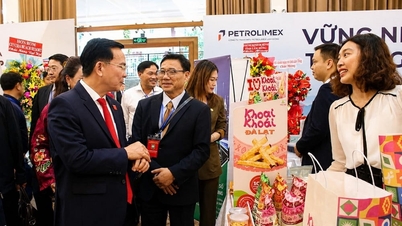
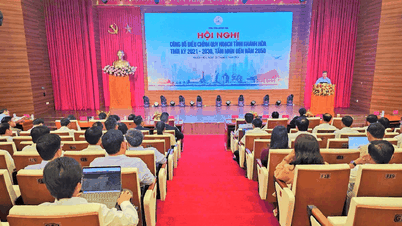
This information was presented by experts at a recent idea-building event themed "Applying Green Solutions in Supply Chains and Logistics," organized by the Ho Chi Minh City Department of Science and Technology.
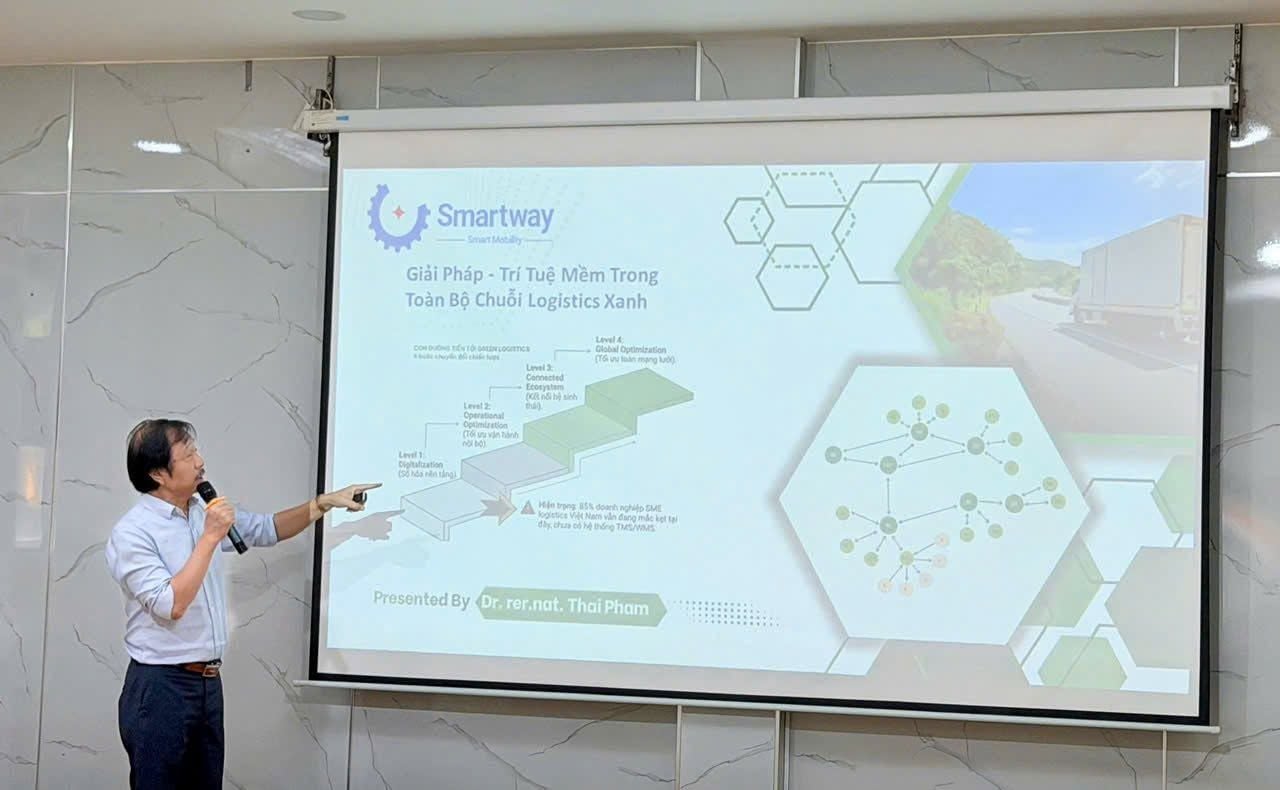 Dr. Pham Thai – Director of Smartway Information Technology Joint Stock Company.
Speaking at the event, Mr. Pham Thai, Director of Smartway Information Technology Joint Stock Company, said that currently, the Vietnamese logistics industry is growing very rapidly, but the operating system is still not optimized to match the scale of development.
According to Mr. Thai, logistics costs in Vietnam are very high, accounting for 16% to 20% of GDP, much higher than the 10% to 12% in other countries. Notably, 70% of goods are transported by road, but the rate of empty truck runs reaches 40% to 60%.
“This waste has reached a national scale. This is not a problem for individual businesses; it’s a matter of economic efficiency. The root cause stems from the traditional ‘each vehicle for itself’ operational mindset, fragmented manual coordination, and a lack of real-world data,” said Mr. Pham Thai.
Mr. Phan Duy Minh, representative of Gozo Joint Stock Company, stated that transportation businesses are clearly aware of this waste, especially the surplus of vehicles on the outbound journey but a shortage on the return journey. Furthermore, empty vehicle runs lead to five different types of costs: fuel, driver's salary, vehicle depreciation, maintenance, and increased environmental emissions, resulting in enormous losses.


To solve this problem, experts emphasize that green logistics is not simply about replacing vehicles with electric ones, but that the core principle must begin with optimizing operations. Instead of focusing solely on investing in expensive hardware infrastructure, Dr. Pham Thai proposed a solution: "Software intelligence throughout the entire green logistics chain"—with intelligent software systems for calculation and management based on data and optimized at the ecosystem scale—to reduce costs.
Dr. Pham Thai's solution is an ecosystem with three main components: data digitization, optimized vehicle dispatch, and a trading platform to connect vehicles. The technological breakthrough lies in building a closed ecosystem based on the concept of a "digital twin." All real-world data, from warehouses and trucks to the smallest packages, is digitized into a digital copy and updated in real time. Any physical movement of goods is immediately reflected in the digital space, minimizing errors and managing inventory with high accuracy.
Advanced warehouse management systems (WMS) and transportation management systems (TMS) integrated with AI are significantly changing logistics operations. With automated dispatch tools like "Route for Green," these systems not only solve the last-mile delivery problem but also automatically consolidate orders and calculate detailed routes. Instead of needing 10 separate vehicles, the AI system can arrange for a significantly reduced number of vehicles while still completing the same workload, contributing to solving urban traffic congestion problems.
Practical application at a large corporation in Thai Nguyen has shown impressive results: instead of spending 61 million VND on transporting 40 tons of goods across 18 areas, the optimized system saved 40 million VND in operating costs and simultaneously reduced CO2 emissions by 1.8 tons.



Ultimately, the smart exchange is not simply a place to post supply and demand information, but a place where algorithms automatically find the best connections to share resources, significantly reducing empty trips. Building this shared platform opens opportunities for everyone – from logistics businesses to farmers – to participate in sharing transportation space in real time, realizing the goal of a green economy and sustainable development.
Source: https://doanhnghiepvn.vn/doanh-nghiep/chuyen-doi-so-giup-giam-chi-phi-va-phat-thai-trong-logistics/20260623054521998

![[Image] National conference summarizing one year of operation of the overall organizational model of the political system, the three-tiered government model.](https://vphoto.vietnam.vn/thumb/1200x675/vietnam/resource/IMAGE/2026/07/01/1782882811691_ndo_br_1-jpg.webp)