

The taste of hospitality
From Mang Den town, the approximately 6km road led us through pine-covered hills, along the slopes, to Kon Chenh village. Recently, the name Kon Chenh has been mentioned frequently on travel forums and social media because it is full of inspiring stories about a community preserving its identity while simultaneously forging new paths for development.
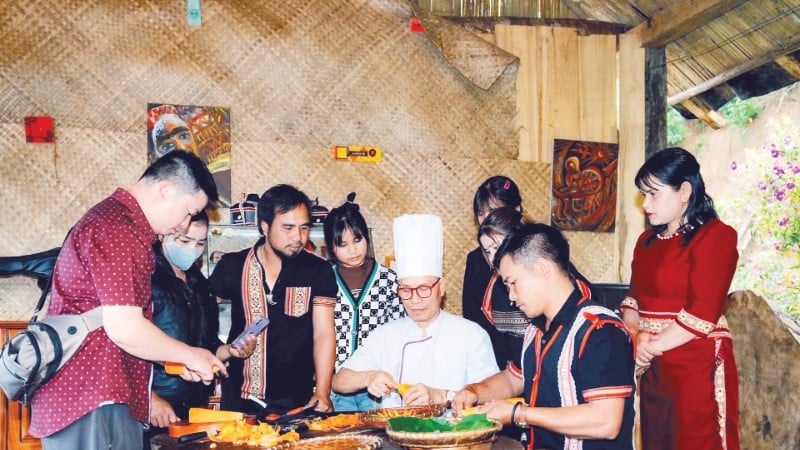
In the wooden house named Hiem A Nac, the hostess Y Ha welcomes guests with a smile and a steaming, fragrant cup of coffee. Every action she takes, from roasting and grinding to brewing and the way she offers a cup, radiates pride in the coffee beans she herself has grown.
Ms. Y Ha recounted: “The busiest time for guests is usually the weekend. They enjoy eating sticky rice cooked in bamboo tubes, grilled pork, drinking rice wine, and listening to the sound of gongs at night. Some people offer suggestions, others praise me, which motivates me to learn even harder to better serve our guests.”
The family of Ms. A Nấc and her husband is one of the earliest homestay households in the village, starting in 2023. With initial capital from savings and a social policy loan, the couple renovated over 700m² of garden land into a resort. They made maximum use of readily available materials such as wood, bamboo, reeds, and stones, creating a space rich in the culture of Mơ Nâm (a branch of the Xơ Đăng ethnic minority), with a glowing red fireplace, gongs, and rattan baskets hanging on the walls, and rice wine neatly stacked in the corner of the house.
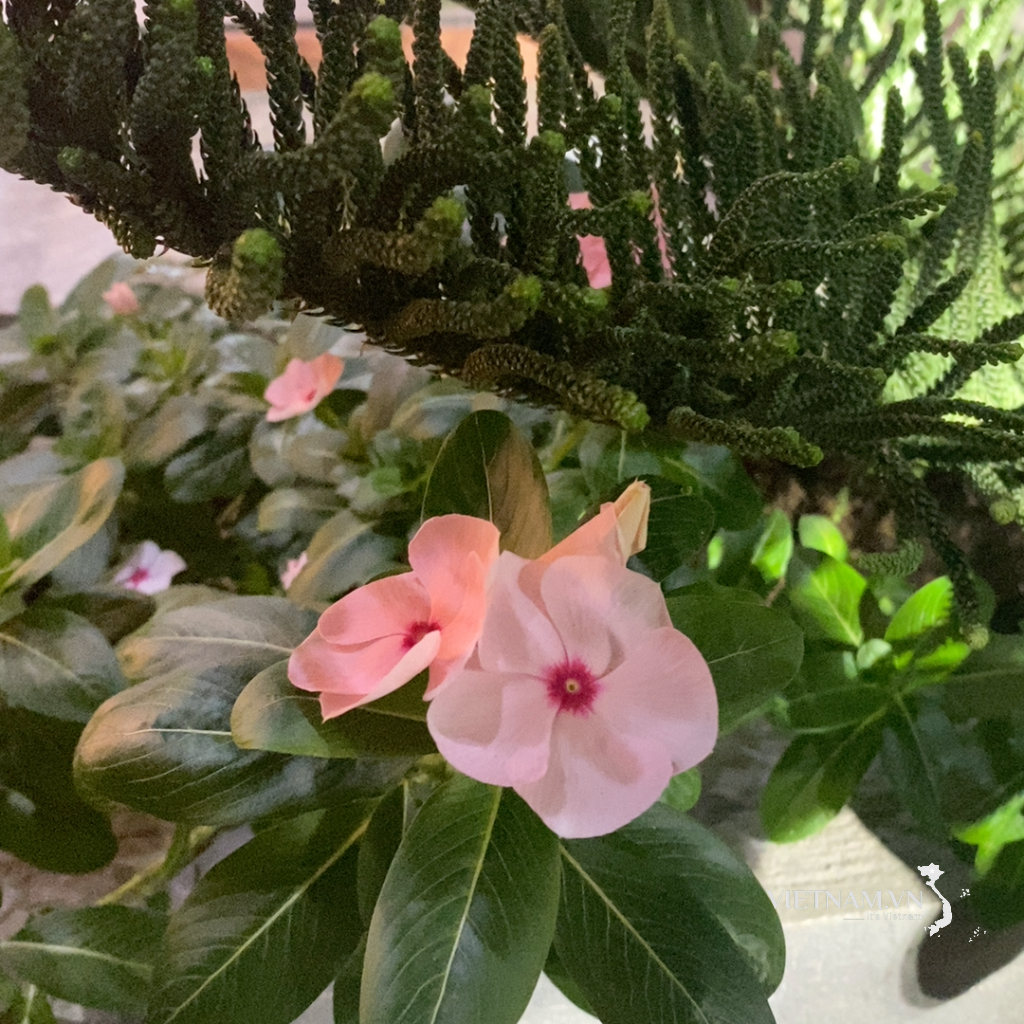
Y Ha's neighbor is Y The, the Party Secretary of Kon Chenh village, who also opened a homestay to welcome guests at the beginning of 2025. Y The said: “Kon Chenh village is the long-standing home of the Mo Nam people. In the Mo Nam language, Kon Chenh means 'village of rhododendron flowers'. The village has preserved many beautiful traditional cultural features, festivals, and folk knowledge such as celebrating the new rice harvest, offering water, sowing rice seedlings, gong music, Xoang dance, folk singing…”
Y The's house has also been beautifully renovated with a garden of wooden sculptures amidst fragrant purple rhododendron bushes. Since the whole village united to beautify the landscape to welcome tourists, Kon Chênh has always been clean and tidy, even though many households are still struggling and do not have spacious houses. Living at the beginning of the village, Ms. Y Tuan is considered a positive "nucleus" of community tourism in Kon Chênh. The 37-year-old woman is busy both receiving guests and planting a new crop of vegetables.
Since opening her homestay in 2024, Y Tuan has welcomed many groups of guests from Da Nang, Gia Lai, Hanoi , Ho Chi Minh City, and even Chinese, Russian, and American tourists: “What guests like most is being able to personally pick vegetables in the garden, weed, and prepare meals right there. I do things in a truly 'homegrown' way, so they find it very interesting.” Y Tuan is also renowned as an excellent chef in the village, skilled in preparing a variety of dishes from traditional to innovative. She also acts as a middleman for purchasing and selling Angelica sinensis, a valuable local medicinal herb, creating additional livelihoods for the people.
The stories mentioned above are just a small glimpse into a larger picture: 110 households, nearly 90% of whom are Mơ Nâm ethnic people, are working together to build a community tourism village in the highlands. They preserve the traditional crafts of basket weaving, brocade weaving, and musical instrument making passed down from their ancestors, but these products now not only serve their daily lives but are also sold at local markets, the Măng Đen night economic zone, and are carried by tourists to all parts of the country.
Previously, the main source of income for the villagers was rice, potatoes, and cassava. Now, thanks to cold-climate coffee, homestays, and experiential services, many families earn 10-12 million VND per month, leading to a more stable and comfortable life. Currently, there are 8 households in the village operating homestays.
In Kon Chênh, visitors have the opportunity to relax in the fresh, cool air of the highlands and enjoy the characteristic Mơ Nâm cuisine with stream fish, pork, buffalo meat, wild vegetables, cassava leaves, and upland rice. Those who love physical activity can participate in coffee harvesting, trekking to explore the nearby forest and waterfalls, or simply sit and listen to old man A Lễ playing the tà vẩu (a type of flute-like instrument), or watch old man A Nuông weaving baskets or teaching the children to play gongs…
The dream of sustainable tourism.
In Kon Chênh, the roads around the village are still winding, with many sections slippery during the rainy season, and unreliable phone and internet signals are also a limitation. The Mơ Nâm people are friendly and hospitable, but they lack the skills to approach and serve tourists.
The cultural space of gong music and traditional festivals is very unique, but if not properly guided and organized, the risk of commercialization is unavoidable. These are practical issues that localities must identify and overcome to develop sustainable tourism, creating livelihoods while preserving the essence of long-standing culture.
Thankfully, Kon Chênh has a proactive and dynamic younger generation like Y Tuan, Y The, A Nac… and also a generation of elderly people who are knowledgeable and passionate about preserving and passing on ethnic culture. In the late afternoon, by the fire, Meritorious Artisan A Le (born in 1956) embraces his ta vau (a traditional Vietnamese wind instrument) and plays melodious tunes.
The cultural space of gong music and traditional festivals is very unique, but if not properly guided and organized, the risk of commercialization is unavoidable. These are practical issues that localities must identify and overcome to develop sustainable tourism, creating livelihoods while preserving the essence of long-standing culture.
He shared, "It would be very sad if no one in the Mơ Nâm people knew how to make or play the tà vẩu instrument anymore." In recent years, as Kon Chênh village has become popular with tourists and they visit frequently, the sounds of tà vẩu, gongs, and folk songs have been heard more often.
And of course, we cannot fail to mention one advantage – a unique feature of Kon Chênh coffee village that invites tourists to explore: the rich aroma and sweet-bitter taste of pure coffee beans grown for 3-4 years. Each harvest season, the locals carefully select ripe cherries, soaking them in water to choose the firmest, plumpest beans.
Located at an altitude of 1,200m above sea level, the suitable soil conditions combined with meticulous care have created a brand of cold-climate coffee favored by tourists from near and far. In recent years, 21 households have partnered with the cooperative to develop a 12-hectare raw material area, with a target of planting an additional 30 hectares by 2025.
The village's community tourism model is well-organized, dividing into occupational groups such as: accommodation group, food supply group, weaving group, and gong and drum performance group. This division ensures everyone has a role, earns income, and supports each other. Villagers actively participate in training courses on hospitality and service skills, and promote their services on social media, thereby gradually developing more diverse and professional services.
Most recently, at the end of August, Hue Tourism College opened a training course on homestay management and operation, providing guidance and issuing professional certificates in homestay management and operation to households in Kon Chênh village. The People's Committee of Mang Den commune issued a plan for the development of Kon Chênh community tourism village for the period 2025-2030, aiming to build it into a cultural and culinary space, a unique destination for coffee and festivals, linked to the consumption of local agricultural products.
Developing the economy through tourism requires patience and determination. During our visit, the roads in the village were still in disarray due to construction, making travel difficult. But the locals believe that once the road is completed, Kon Chênh will welcome more tourist groups. "We want tourists to come here not only to enjoy coffee, but also to experience the spirit of Mơ Nâm through cultural tourism, cuisine, and the traditional gong and dance," said Y The, Secretary of the Kon Chênh Village Party Branch.
Source: https://nhandan.vn/chuyen-lang-ca-phe-lam-du-lich-post921718.html


![[Photo] Conference on the transfer and reception of Party organizations and Party members between the Party Committee of the Government and the Party Committees of the Central Party Agencies](https://vphoto.vietnam.vn/thumb/1200x675/vietnam/resource/IMAGE/2026/04/01/1775036784472_ndo_br_bnd-2620-jpg.webp)
![[Photo] Conference announcing the Politburo's Decision on organizational and personnel matters](https://vphoto.vietnam.vn/thumb/1200x675/vietnam/resource/IMAGE/2026/04/01/1775017881825_bnd-2410-1472-jpg.webp)









































![[Photo] Prime Minister Pham Minh Chinh receives the Ambassador of the Russian Federation to Vietnam](https://vphoto.vietnam.vn/thumb/402x226/vietnam/resource/IMAGE/2026/04/01/1775046774818_anh-man-hinh-2026-04-01-luc-19-32-33.png)


















Comment (0)