

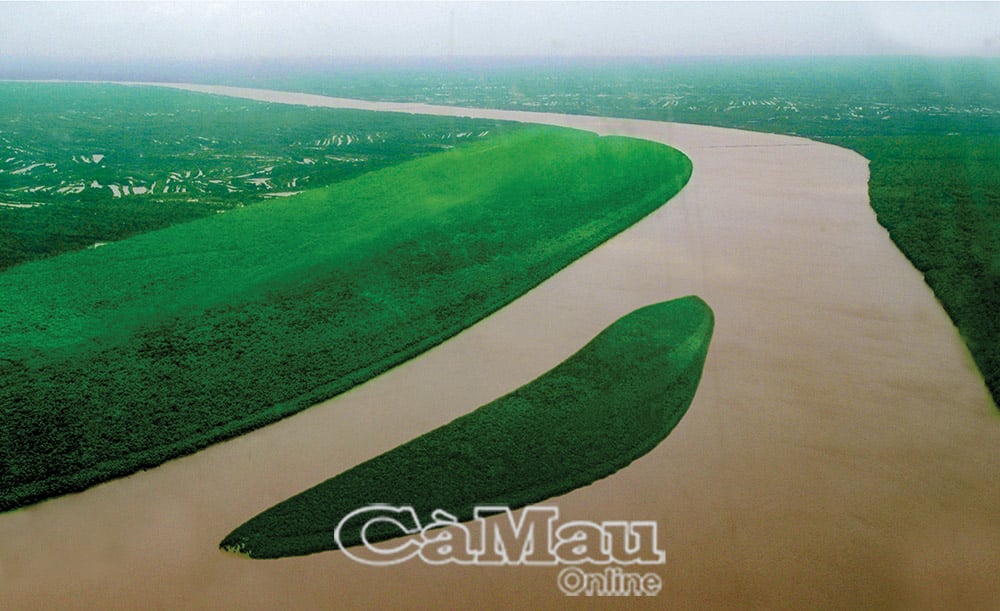
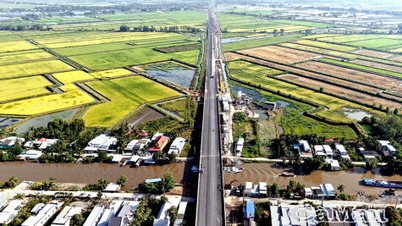
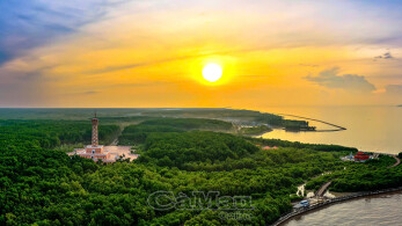
Ca Mau is a vast expanse of rivers and waterways. Photo: THANH DUNG
It's not the brackish, murky water with the pungent smell of silt. It's not the murky water rushing through canals and ditches. The water that the people of Ca Mau painstakingly seek is fresh water – water to drink, to live, and to sustain life on this mangrove land.
The afternoon sun casts its slanted rays on the roof of Mr. Sau Thuong's (Le Van Thuong) house in Khanh An commune, U Minh Ha region. The small pond in front of the house shimmers in the late afternoon sunlight, its surface as still as an old, time-worn mirror. Mr. Sau Thuong looks out at the pond and reminisces: "My wife and I have been attached to this pond for decades. Back then, the pond not only raised fish but also sustained life. When we were thirsty, we'd go down to the pond to fetch water; if it was acidic or salty, we'd filter it through a large earthenware jar. During the dry season, the water shortage was terrible."
Mrs. Nguyen Thi Phu, the wife of Mr. Sau Thuong, was hunched over washing vegetables in a chipped earthenware pot as she continued, "Back then, we were very poor. When we moved out on our own, our parents gave us a few ponds and some earthenware jars and containers for rainwater. The glazed earthenware containers, brought from the province, cost as much as several sacks of rice. Families with many containers were considered to have more than enough to eat and wear."
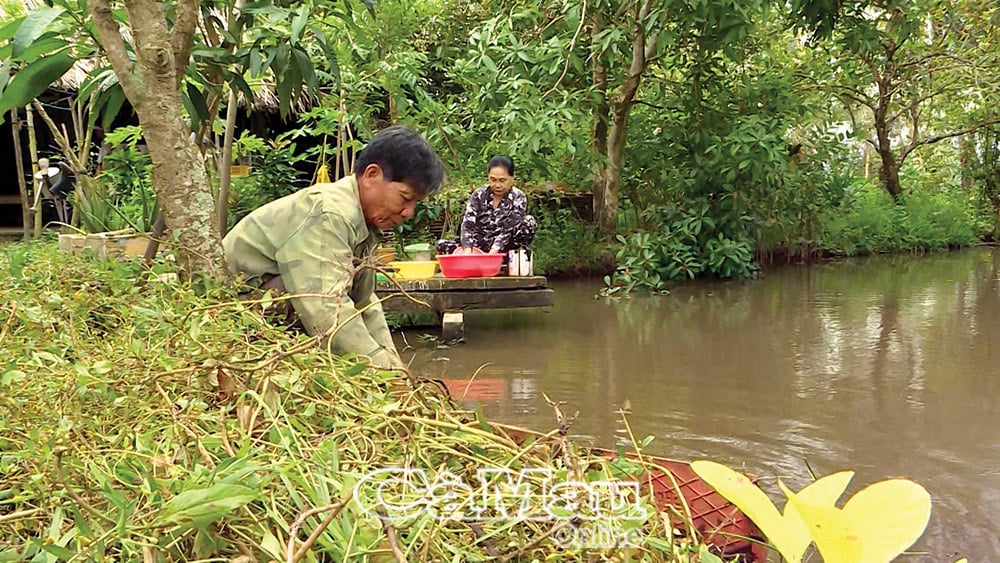
Mr. and Mrs. Sau Thuong.
In those days, the most precious thing in the U Minh Ha region wasn't gold or silver, but... fresh water.
The Ca Mau region is surrounded by the sea on three sides. The sea sustains fish, shrimp, and even mangrove and melaleuca forests. But it is also this salty seawater that seeps into the land, penetrating deep into the underground water sources, making the only way to find fresh water to drill hundreds of meters deep.
***
Before 1975, only the Ca Mau town government had a Water Supply Department responsible for providing fresh water to people in the market area. People in the countryside, however, relied on the weather. If the weather was merciful, it would rain; if it was unkind, it would cause drought and extreme dryness. Every drop of rainwater collected was a gift from the earth. The water jars and ponds carried the burden of survival.
Peace was restored. Rice paddies replaced the primeval forests. Ponds gradually dried up. Pesticides and chemical fertilizers seeped into every surface water source. The people of Ca Mau once again toiled in search of fresh water. And then, the "water tree" appeared like a miracle, saving them from their long-standing thirst.
Recalling the story of the water wells, Mr. Tran Tan Thanh, from the Center for Rural Water Supply and Sanitation in Ca Mau province, reminisced: “The UNICEF-funded program was implemented throughout rural areas. From 1999 to 2009, more than 140,000 water wells were built, drawing hundreds of thousands of cubic meters of water from the ground every day. Everyone was happy. Freshwater from the ground seemed to flow endlessly.”
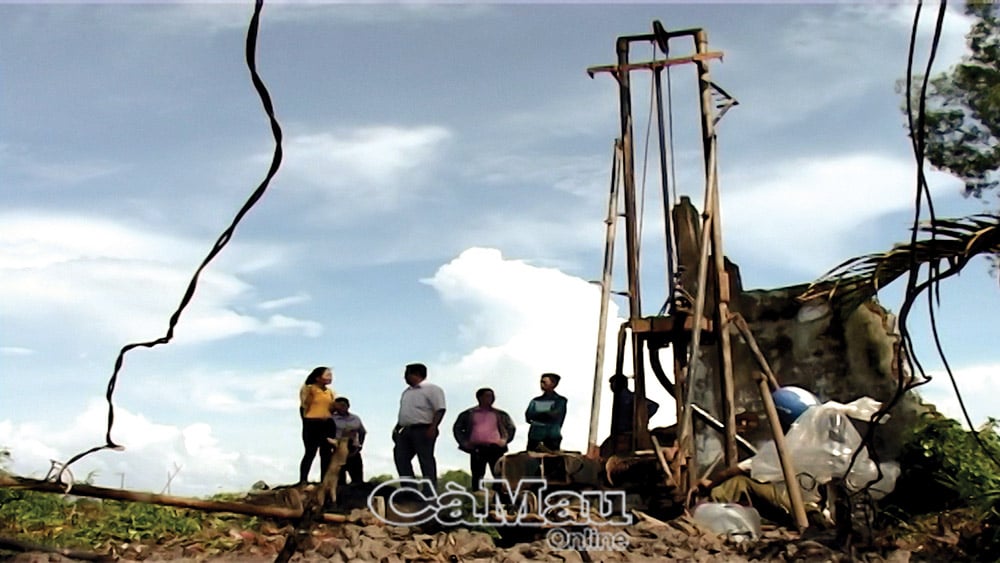
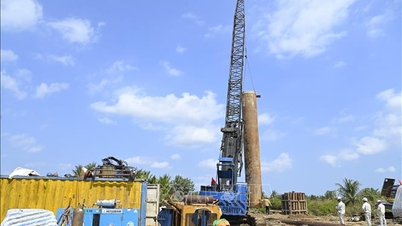
Drilling wells to extract groundwater in Ca Mau.
Gazing out at the vast fields where groundwater flows beneath, Mr. Thanh recalled: "Back then, people were overjoyed. Having a well meant less worry and hardship for the family; children no longer had to carry cans to collect rainwater, and the elderly no longer had to bend over to scoop up basins of brackish, acidic pond water."
Water wells quickly became a lifesaver for the entire region of saline, acidic soil. Many families pooled their money, even borrowing, just to have a well drilled right in their yard. The business of drilling wells thus flourished, becoming a "fashionable profession" in this vast, water-rich area.
Over time, well drilling became a family tradition; people acquired the necessary equipment, and every household erected drilling rigs. As long as they had money, they would drill, to any depth they desired. Mr. Lam Minh Dil (from Khanh Lam commune), a veteran well driller, recounted: “In the past, you could find fresh water just by drilling a hundred meters. I went drilling like it was my daily routine, sometimes even working through the night. Well drilling wasn't just about making money; people considered us their saviors. Whenever a household was thirsty, they'd call us to drill wells, and they'd have drinking water and water for daily use. The villagers were so happy.”
Hundreds, then thousands of wells sprung up like mushrooms after the rain. People believed that the earth was vast, the groundwater abundant, and that they could extract as much as they wanted without ever running out.
Mr. Thanh mused, his voice softening: "Back then, nobody thought about the consequences. We were just happy to have fresh water. But looking back now, the groundwater level has dropped significantly; in many places, we have to drill 200 or 300 meters to find water. The earth's crust isn't an inexhaustible reservoir."
The widespread use of drilled wells has led to serious consequences. The situation in Dat Mui commune serves as a clear example. Twenty years ago, every household in the area drilled their own well, but after a while, the water became unsafe and saline. Ten years later, the government drilled wells to connect to the network, but the problem persisted; the water level gradually decreased, and pumps could no longer be used. Now, all the wells have to be abandoned, and a new clean water supply system must be invested in.
Mr. Tran Van Be, a resident of Dat Mui commune, lamented: “The groundwater level is dropping deeper and deeper every day. Twenty years ago, we could drill a hundred meters and find fresh water. Twenty years later, the depth has doubled, and people have to pump water with motors instead of hand pumps like before. Even the motors aren't working properly, so the government has to invest in a water supply system so that people can have clean water to use.”
Not only in Dat Mui, but according to statistics from the Department of Agriculture and Environment, the entire province currently has more than 3,000 drilled wells that are unable to produce water. "Now, even drilling 200 meters doesn't guarantee finding fresh water. The water level has dropped significantly; to pump water, you need a motor. All the old wells are abandoned," said Mr. Nguyen Thanh Man, from Nguyen Phich commune.
In Bien Bach commune, more than 1,400 households on both sides of the Trem River suffer from a chronic water shortage. Every drilling team that comes has been unable to find a solution. The deeper they drill, the more contaminated the water becomes with alum and salt. The people have had to revert to the methods of their ancestors: storing rainwater in jars and ponds. But rainwater only lasts for two or three months during the dry season, after which they have to buy every drop of water from elsewhere.
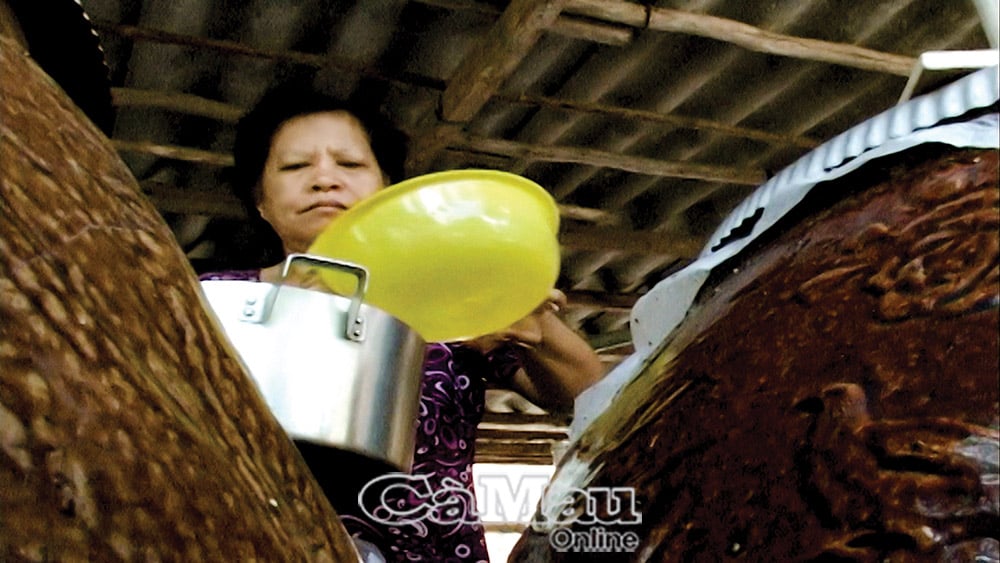
The White Sea is thirsty.
Simple-minded people believe that the amount of rain equals the amount of water the earth accumulates, but scientific research has shown that reality is not so simple. The project "Strengthening Groundwater Protection in Vietnam," implemented by the Vietnamese Ministry of Natural Resources and Environment (now the Ministry of Agriculture and Environment ) and the Institute of Geological Sciences and Resources of the Federal Republic of Germany, has demonstrated the seriousness of the problem.
Andreas Renck, head of the German expert team, emphasized: "Groundwater in Ca Mau dates back 20,000-24,000 years, when water from upstream flowed down to this peninsula and gradually seeped into the ground. But currently, the regeneration process has almost ceased."
Dr. Anke Steinel, a hydrogeologist, further explained: "The surface of Ca Mau has a very thick layer of clay. Rainwater has difficulty infiltrating and only flows through canals and ditches to the sea. Therefore, groundwater is almost an unrecoverable resource."
However, every day, the ground is still being depleted by more than 200,000 large and small wells. According to statistics from the Department of Agriculture and Environment, people extract more than a million cubic meters of groundwater every day.
Ms. Duong Thi Ngoc Tuyen, Head of the Water Resources Management and Environmental Monitoring Department, expressed her concern: "If exploitation continues beyond the permitted limits, and the static water level drops below 35 meters, pumping will no longer be possible. At that point, subsidence and landslides will become even more serious."
Dr. Anke Steinel stated, "If we continue exploiting groundwater at this rate, it won't be long before it's completely depleted."
Statistics from the Department of Agriculture and Environment clearly state: "In just 5 years (2019-2024), Ca Mau experienced more than 2,000 landslides and subsidence points, submerging 25,000 m² of riverside land, collapsing 500 houses, and damaging more than 200 km of roads." The once peaceful land of Ca Mau now seems to be cracking day by day.
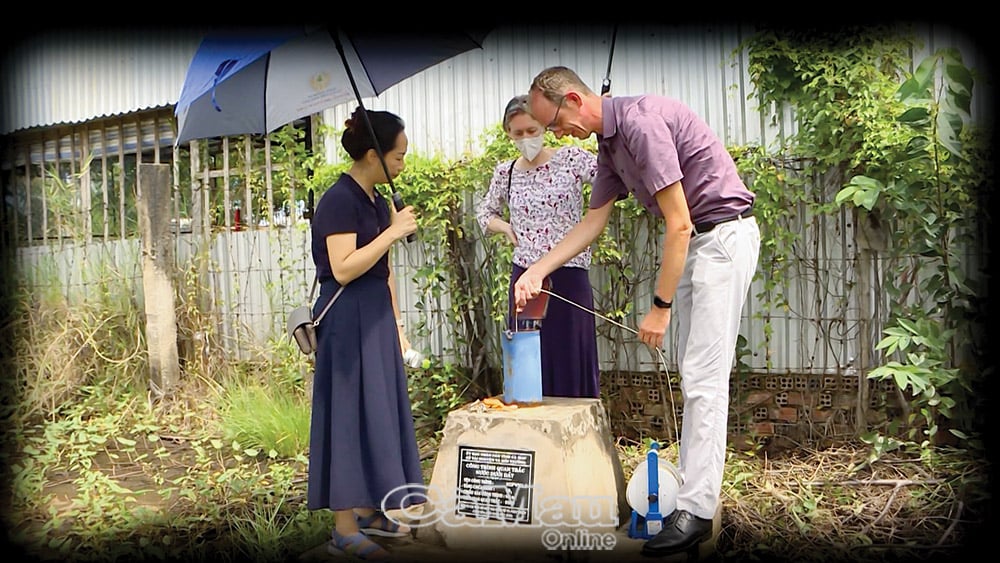
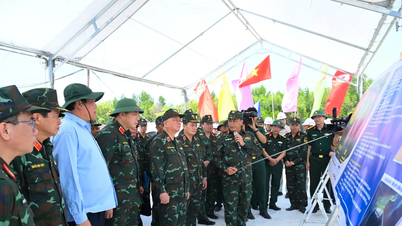
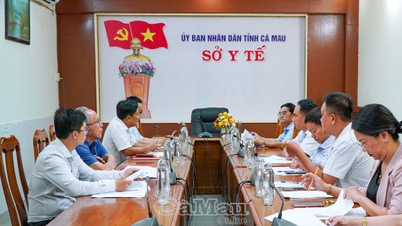
Several research projects on groundwater exploitation and protection are being carried out in Ca Mau province.
***
Late in the afternoon, I returned to Mr. Sau Thuong's house. The small pond silently reflected the setting sun. Mr. Sau Thuong was still sitting there, his eyes distant: "I'm old now, I don't worry about myself anymore. I only worry that someday the children will be thirsty, and this land will no longer be there for them to live on."
Out there, the drilling rigs continue their journey, their drill bits still plunging deeper into Mother Earth. The water channels are being drilled deeper and deeper. But somewhere, a warning is echoing from the land, from the water, from nature itself, which is cracking...
Nguyen Hoang Le
Source: https://baocamau.vn/chuyen-tim-nuoc-a116511.html





























































Comment (0)