



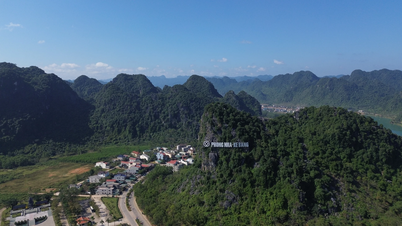
Phjia Mon is a mountain located northwest of Na Sam town, Van Lang district (formerly), now in Hamlet 3, Na Sam commune. Its towering cliffs resemble a fortress wall, casting their reflection on the Ky Cung River. Highway 4 follows the foot of the mountain towards historical landmarks such as Bo Cung and Lung Vai. The mountain is also known by its Chinese name, Dien Tran Son, given by the Governor of Lang Son, Ngo Thi Si (1726-1780). It is one of the famous limestone mountains in Lang Son due to its ancient caves, even though the mountain is not very high, with its highest peak only about 100 meters above Highway 4A.
When I was a child, every time I crossed the bridge to go up the Bo Cung slope to play with my friends, I would tilt my head back to admire the "Immortal's Tablet" on the cliff. It was a flat, slanted rock arch jutting out from the mountainside, leaning towards the road. In the middle of this flat rock arch was a rectangular, perfectly square, smooth-surfaced stele with seven rows of Chinese characters carved vertically. Because the stele was 30 meters above the ground and had weathered the elements for years, all that was visible were the Chinese characters carved into the rock; the people of Na Sam couldn't read what they were or what they meant. The people of Na Sam called it the "Immortal's Tablet" because they believed only immortals or Buddhas could have flattened the rock arch like that, creating a slanted stele, and carved Chinese characters into the rock!
Later, when cultural preservation and museum work received more attention, experts were seen climbing the Na Sam stele, meticulously cleaning and re-carving each character, then copying and translating it. It was then discovered that this was the Dien Tran Son stele, recording the 1779 border patrol through Na Sam by Governor Ngo Thi Si, along with a four-line poem. The content of the Dien Tran Son stele was translated by Professor Hoang Giap (Institute of Han-Nom Studies) as follows:
Transcription: In the winter of the year of Canh Hung, in the year of Ky Hoi, I served the border army, on the first day of summer, I gathered all the troops for naval battle tactics, ascended the mountain pass, and in the lake camp, I wrote a small law.
The mountains are as clear as the vast waters.
No trace of heroes remains
Let's just say we've met by chance and become close friends.
Holding the esteemed official's sword, he remained seated.
Layman Nhi Thanh Ngo Thi Si wrote this purification letter.
Translation: In the last month of winter of the year of Ky Hoi (1779), following orders from above, he went on a border patrol. On his return, he boarded a boat at the foot of the mountain and practiced naval warfare. He went up the mountain to inspect the area, and on that occasion, he named the mountain Dien Tran Son. He rested for one night before returning to the military camp, leaving behind a four-line poem:
The mountains are a deep green, like drawn eyebrows; the water sparkles as if oiled.
No trace can be found of the heroes who once passed through this place.
This clumsy fellow stumbled upon this beautiful scene by chance and became a close friend.
The wine flask, the lute, the poetry bag, the sword, the crown—they all linger with me, reluctant to leave this scene.
The poem was translated by Associate Professor-Doctor Tran Thi Bang Thanh as follows:
"The green mountains you paint, the water is like oil."
The hero's old footprints are nowhere to be seen.
A clumsy traveler is fortunate enough to find a soulmate.
"The sword and the lute are reluctant to part ways."
Ngo Doc, obeying orders from above, went on a border patrol. Upon returning, he moored his boat below the mountain, indicating he must have traveled by boat along the Ky Cung River all the way to the border with China. This demonstrates that the section of the Ky Cung River flowing through Na Sam was quite large and had a lot of water; the water level must have reached the foot of Phjie Mon mountain, near where the stone stele stands today. Otherwise, how could the ancients have carved the stone and inscribed the stele like that?
Besides patrolling, Governor Ngo also commanded naval warfare training on the river, while he himself went up the mountain to inspect the area. This further demonstrates how deep and wide the Ky Cung River was in the past.
Further back, in the 13th century, the Ky Cung River was already subtly mentioned in history, associated with the war against the Song dynasty by the Tran kings. The Complete Annals of Dai Viet recorded: “In the year of Ky Hoi, the 8th year (1239)… The king personally went to attack the Vinh An and Vinh Binh camps of the Song dynasty along the land route, then passed through the provinces of Kham and Liem… leaving large ships in the territory, only traveling by small boats…” According to Hoang Xuan Han, the Vinh Binh camp included parts of Tu Minh and Bang Tuong provinces, part of Tu Lang, and part of the land on the north bank of the Ky Cung River. Associate Professor, Doctor Vuong Toan explained, “After suppressing these two camps, King Tran Thai Tong and his army returned by water from Guangdong to Guangxi via Ninh Giang, through Binh Nhi pass into the Ky Cung River to Na Sam and then to Lang Son.”
Later, the Ky Cung River remained an important transportation hub, making Na Sam town a bustling area with boats and ships. This was at the end of the 19th and beginning of the 20th centuries, when the French invested in building the Hanoi -Lang Son to Dong Dang railway line. Afterward , "a 17 km section was built from Dong Dang to Na Cham, connecting to the navigable section of the Ky Cung River. This section was put into operation on November 15, 1921" ("Public Works and Transportation Projects of Indochina" - translated by engineer Nguyen Trong Giai - 2nd edition - Hanoi Transport Publishing House, 1998).
The book "Van Lang: Land and People" by Dr. Hoang Van Pao and the book "Na Sam - A Border Town" published in 2010 by the Party Committee and People's Committee of Na Sam town both record: "There was a period when the Long Chau (China) - Na Sam river route, about 50 km long, was exploited. On days with high tides, large boats (three-plank boats with a tonnage of 3 tons) could reach Ban Tich. The number of boats operating in Lang Son province in 1922 was recorded as 918 boats of all types, of which 8 were of the tonnage type from 0.6 tons to 6 tons."
Even now, the water level of the Ky Cung River in the section passing through Na Sam is very low; during the dry season, looking down from the Dien Tran mountain area, there are many places where one can wade across. One can only imagine that in the late 18th century, the Na Sam River, with its vast expanse of water, after several bends, flowed parallel to the Dien Tran-Phjie Mon mountains all the way to Binh Do before changing direction and flowing into China. And the patrol boats, warships, and merchant ships that once sailed up and down here, once anchored at the foot of this mountain, leaving behind a "Treasure Tablet" with its characters still perfectly preserved, deeply carved into the stone.
Right next to the stele, there is a deep crack running diagonally from the mountaintop to the foot of the mountain. The crack is very sharp, cutting deep into the rock, like a sword stroke, made by a giant wielding a colossal sword with extraordinary strength, inscribing a sacred oath between heaven and earth.
There are three legends about this crack, including the story of "Two Brothers" and "Two Sisters" to explain the mountain's name, Háng Slẹc (Rạch Market). But I lean more towards the story of "The Giant Sword Scar," which tells of a brave warrior who fought against the invaders from the North. Only in the posture of a valiant, majestic warrior, burning with patriotism and seething with hatred for foreign invaders, could he wield his powerful arm and engrave a vow of life and death for his country amidst the vast expanse of heaven and earth.
Speaking of ancient caves, Phjia Mòn has many scattered caves from the foot of the mountain to the middle of the mountain, some even reaching almost to the summit. When I was little, I used to follow my older siblings to burn car tires as torches to explore the small caves near the foot of the mountain. When we came out, each of us had blackened noses and got a beating. There's the rather large Pac A cave; during the 1979 border war, before evacuating to Hoi Hoan, my family and several other families from Zone 4 brought blankets and bedding into the cave, sharing the space in the rock crevices to avoid shelling. This cave runs through the mountain, winding its way all the way to the road leading to Ban Hu.
Near the mountaintop, there's a cave with a small entrance but a wide interior. For years, rumors circulated that it was the hiding place of ancient treasures, perhaps belonging to the Chinese. Many young people in the town, driven by curiosity and a daring spirit, tried to climb up to investigate, and rumors spread that the cave contained many coffins and skeletons, seemingly those of ancient people…
To debunk those rumors, on December 3, 2022, the People's Committee of Van Lang District, in coordination with the Department of Culture , Sports and Tourism of Lang Son Province and the Vietnam Institute of Archaeology, conducted a survey of the Phja Mon cave. The initial survey results showed:
“The Phja Mòn cave is located in the heart of the rocky mountain range on National Highway 4A in Na Sầm town, with an altitude of over 70m from the ground. After a field survey, with the support of the Hanoi Cave Hanging Club, the working group proceeded to enter the Phja Mòn cave. According to observations, there are 15 coffins inside the cave, of which 3 are still intact, and many pottery fragments and decorative items were also discovered…”
According to experts, the ancient coffins and artifacts discovered in the cave date back to the 17th or 18th centuries. The results of the assessment by the Vietnam Institute of Archaeology are currently pending.”
Phjia Mòn - the Diễn Trận mountain in my hometown - hides many secrets and mysterious stories, which can only be partially revealed through the research and assessment of the scientific community. And who knows, perhaps even more secrets and mysterious stories will be discovered then?
Source: https://baolangson.vn/con-day-vet-kiem-lung-troi-5067052.html


































































Comment (0)