" The economy in 2026, as well as the construction industry in general, looks more promising than in 2025," predicted Mr. Dinh Hong Ky, Vice Chairman of the Ho Chi Minh City Business Association (Huba), at an online seminar organized by Saigon Business Magazine and the Vietnam Institute of Innovation on January 14th.
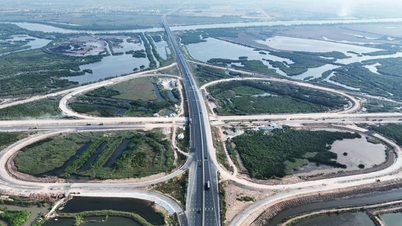
Mr. Ky is also the Chairman of Secoin, a company specializing in construction materials, so his belief in this "bright future" also stems from the government 's target of disbursing nearly one trillion dong in public investment capital this year, an increase of more than 10% compared to 2025.
Previously, at the conference on January 9th, the Prime Minister requested ministries, sectors, and localities to complete the target of disbursing 100% of public investment capital for 2025 by January 31st and immediately begin disbursing the planned capital for 2026.
According to Vice Chairman Huba, with a stronger pace and scale than last year, public investment in 2026 will create "quite good momentum for the economy." "As a result, both urban and industrial real estate will warm up," Mr. Ky optimistically stated.
Some experts and organizations also see public investment as a cornerstone for growth this year. Nguyen Xuan Thanh, Senior Lecturer at the Fulbright School of Public Policy and Management, believes it is a sure driver.
"With a scale of nearly 8% of GDP, public investment this year is very large, not only serving as a driving force for 2025 but potentially extending to 2030," Mr. Thanh commented.
The European Chamber of Commerce in Vietnam (EuroCham) shares this view. In its recent Business Confidence Index (BCI) report, EuroCham expects that over the next 12-18 months, infrastructure development and public investment will be key drivers, particularly for construction, trade, logistics, and consumer-oriented industries.

Construction site of Long Thanh Airport. Photo: Quynh Tran
Economist Tran Dinh Thien analyzed that the advantage of public investment is the large amount of fiscal policy space remaining. "The public debt-to-GDP ratio is only about 35%, so this advantage can be leveraged to create conditions for promoting growth not only in the short term but also in the long term," he said.


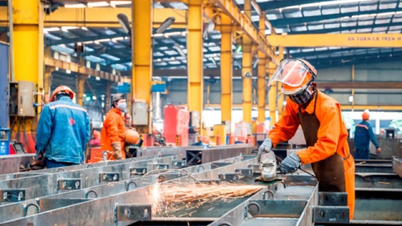
Besides strong seed capital, exports and consumption maintain positive prospects despite uncertainties. By 2025, exports are projected to reach a record value of over $475 billion, an increase of 17%.
Global trade is expected to remain unpredictable, but HSBC assesses that Vietnam has an advantage in terms of products with high consumer demand in the era of artificial intelligence (AI), such as electronics. At the same time, market share for some items in the US is also improving.
Professor Tran Ngoc Anh of Indiana University and founder of the Vietnam Initiative Network predicts that following the recent confrontation between the White House and Federal Reserve Chairman Jerome Powell, interest rates may remain high and the USD will be strong, creating an export advantage for Vietnamese goods.
The downside is the potential for decreased demand for goods from the US and increased input costs for Vietnamese manufacturers. According to Mr. Nguyen Xuan Thanh, the solution could come from compensating for the trade deficit in other major markets, such as China.
Regarding consumption, total retail sales of goods and services in 2025 are estimated to increase by 9.2% compared to 2024, partly due to stable inflation and a strong recovery in tourism. The average CPI increase in 2025 is 3.31%, lower than the 3.63% of 2024. International visitors are expected to reach a record high of nearly 21.2 million, generating revenue of $40 billion, equivalent to 7% of GDP.
These two factors are expected to remain favorable in 2026, contributing to strengthening domestic consumption. Mr. Nguyen Xuan Thanh assessed that inflation is not a concern because gasoline and oil prices are projected to continue falling. Meanwhile, the unknown factor lies in consumer confidence, which affects purchasing power. Sentiment could improve if tourism and exports are favorable, helping to create more jobs in both the service and manufacturing sectors.
As a proactive solution, Mr. Thanh recommended continuing to expand welfare benefits. "International experience shows that when social welfare benefits are not expanded sufficiently, people tend to be defensive and save instead of spending," he cited as an example.
In 2026, the government aims for GDP growth of 10% or higher. International financial institutions forecast a range of 6-7.5%. HSBC believes that to achieve the targeted double-digit growth rate, the Vietnamese economy needs a major boost, including superior trade, significant investment, and strong consumer spending.
According to Mr. Tran Dinh Thien, the positive aspect is the shift in development thinking and policy-making over the past year, creating a better environment for businesses. Instead of issuing resolutions to address individual issues as before, Vietnam is implementing a synchronized system, bringing confidence in comprehensive change, similar to 1986.
Notably, the resolution focuses on the private sector, efforts to remove decades-old institutional bottlenecks, and the development of science and technology. "Investment in science and technology is experiencing a major breakthrough, from around 0.5-0.6% of GDP in previous years, projected to reach approximately 3% this year, a six-fold increase," Mr. Thien pointed out.



He recommended that businesses become more proactive, grasping core technologies to avoid losing their global foothold and capitalize on the opportunities presented by institutional changes. "Businesses shouldn't just cling to land but should look at the vast 'space of opportunity' from digital transformation and new policies to create new value," he said.
Similarly, Mr. Dinh Hong Ky encouraged businesses to accelerate digital transformation, green transformation, and traceability to overcome the technical barriers of the international market. At the same time, businesses should increase policy dialogue on planning, legal frameworks, and new standards to proactively adapt to an uncertain world.
"Following Resolution 68 on the private economy and other major policy decisions, I've noticed a positive sign: the voices of businesses are being heard better," Mr. Ky said.
According to vnexpress.net
Source: https://baophutho.vn/cua-sang-cho-kinh-te-nam-2026-245828.htm



![[Image] National conference summarizing one year of operation of the overall organizational model of the political system, the three-tiered government model.](https://vphoto.vietnam.vn/thumb/1200x675/vietnam/resource/IMAGE/2026/07/01/1782882811691_ndo_br_1-jpg.webp)