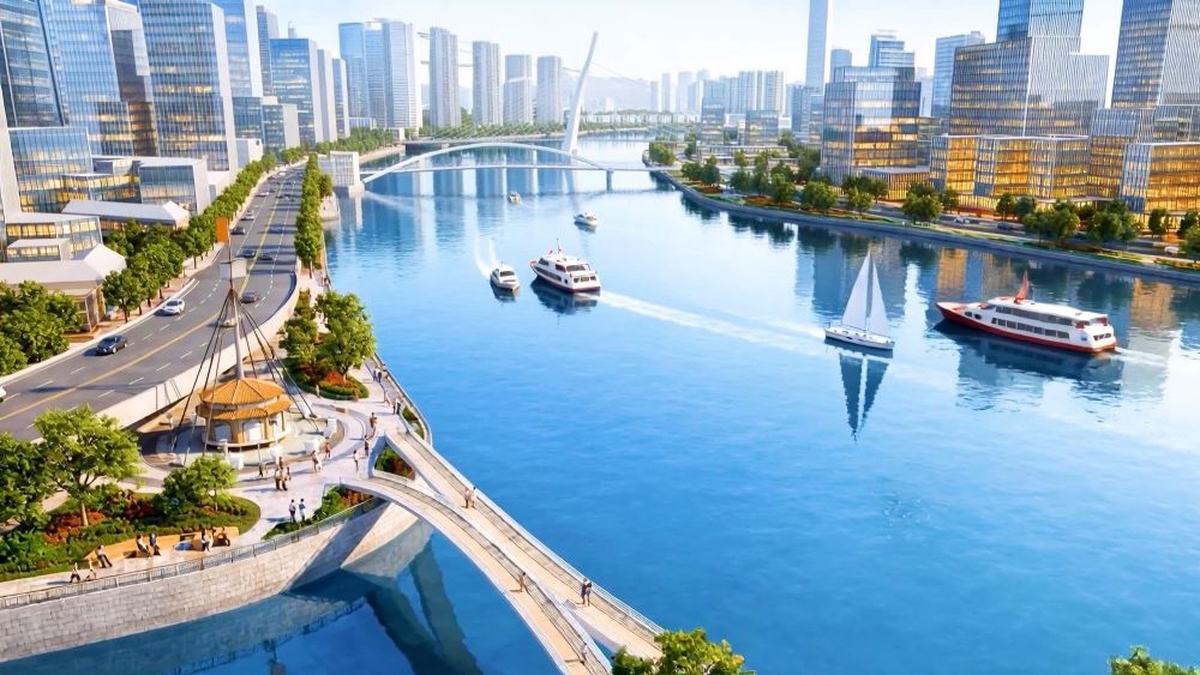
According to Dr. Nguyen Van Dinh, Vice President of the Vietnam Real Estate Association, the formation of metro lines following a radial fan-shaped model connecting areas with significant potential such as Hoa Lac and Dong Anh will create a ripple effect of economic growth along spatial axes. Simultaneously, it is linked to population decentralization and attracting people to live and work in these new growth centers. From a real estate market perspective, Dr. Dinh believes that TOD (Transit-Oriented Development) areas or transportation hubs will shape the demand for housing, jobs, and services. This is the main driving force of the real estate market. A positive aspect is that with abundant supply, the market will evolve according to actual demand, avoiding artificial shortages or exploitation.
According to Associate Professor Dr. Nguyen Hong Thai, Vice President of the Vietnam Railway Transport Economics Association, as the metro network expands, Hanoi 's development space will also expand in a multi-polar direction. The west, with Hoa Lac and Hoai Duc (formerly), will continue to develop into a center for innovation, high technology, and education and training. The north, with Dong Anh, Me Linh, and Soc Son (formerly), will form centers for logistics, high-tech industries, and services connected to Noi Bai International Airport. The east, with Long Bien and Gia Lam, will become a new growth pole for trade, services, and modern urban development. Meanwhile, the south, with Thanh Tri, Thuong Tin, and Phu Xuyen, will strongly develop industry and logistics.
"The metro will create new growth corridors and new development hubs, contributing to a more balanced and sustainable redistribution of population and resources. Importantly, Hanoi will no longer develop according to the 'all roads lead to the center' model, but will gradually form a multi-centered urban structure with closely linked development hubs connected by a modern public transport system," Mr. Thai shared.
Developing "15-minute cities"
According to Dr. Nguyen Van Dinh, the TOD (Transit-Oriented Development) urban model along future metro lines is also a model urban type that many countries have successfully developed. This model creates the concept of a "15-minute city," where all services and needs of residents are met very quickly and fully. Believing that "Hanoi's choice of this model is entirely appropriate," Dr. Nguyen Van Dinh points out lessons learned from many countries showing that service and commercial cities are one of the pillars driving development and growth.
Addressing concerns that the implementation process might be prolonged, similar to previous metro lines, Mr. Dinh stated that Hanoi has made thorough preparations through its planning and the Capital City Law to address bottlenecks related to land acquisition, compensation, and resources. In fact, Hanoi is ready to activate multi-purpose projects and commence large-scale urban development projects to meet the needs of infrastructure development. The city, along with major enterprises, is creating large-scale, high-quality urban areas to provide residents with new homes that are significantly better than their previous residences.


"The city is also taking steps to boost economic growth to generate revenue and mobilize resources, including the participation and collaboration of businesses. The challenges Hanoi has set may not be complete, but it has initially identified bottlenecks and obstacles and has solutions to overcome them. The spirit of daring to see and act with high determination will help Hanoi find solutions and realize its goals," assessed the Vice Chairman of the Vietnam Real Estate Association.
Five urban railway lines are expected to be completed by 2030.
Line 1 is approximately 81 km long, connecting Hung Vuong Stadium - Railway Industrial Zone - Ngoc Hoi - Hanoi Station - Yen Vien - Thu Lam Multi-Purpose Urban Area - Noi Bai Airport. The total investment is approximately 389,527 billion VND.
Line 2 is approximately 56.5 km long, connecting Noi Bai Airport - Tran Hung Dao - Thuong Dinh - Hung Vuong Stadium. The total investment is approximately 271,708 billion VND.
Route 8 is approximately 91 km long, connecting Hoa Lac - Son Dong - Mai Dich - Ring Road 3 - Linh Nam - Duong Xa. Of this, about 66 km is within Hanoi's territory, with a total investment of approximately 317,393 billion VND.
Route 10 is approximately 43 km long, connecting Co Loa - Vo Chi Cong - Ring Road 3 - Ring Road 2.5 - Times City urban area. The total investment is approximately 206,786 billion VND.



Line 14 is approximately 32 km long, of which about 27 km is within Hanoi's territory, connecting Thang Long Bridge - Hong Ha - Ocean Park, with a total investment of approximately 129,842 billion VND for the section within Hanoi.
Source: https://thanhnien.vn/cuc-tang-truong-moi-cho-ha-noi-185260623222421821.htm


![[Image] National conference summarizing one year of operation of the overall organizational model of the political system, the three-tiered government model.](https://vphoto.vietnam.vn/thumb/1200x675/vietnam/resource/IMAGE/2026/07/01/1782882811691_ndo_br_1-jpg.webp)