

Eighty years ago, the Yalta Conference took place, marking not only the end of World War II but also the beginning of a bipolar world order, with the United States and the Soviet Union as the two leading powers.
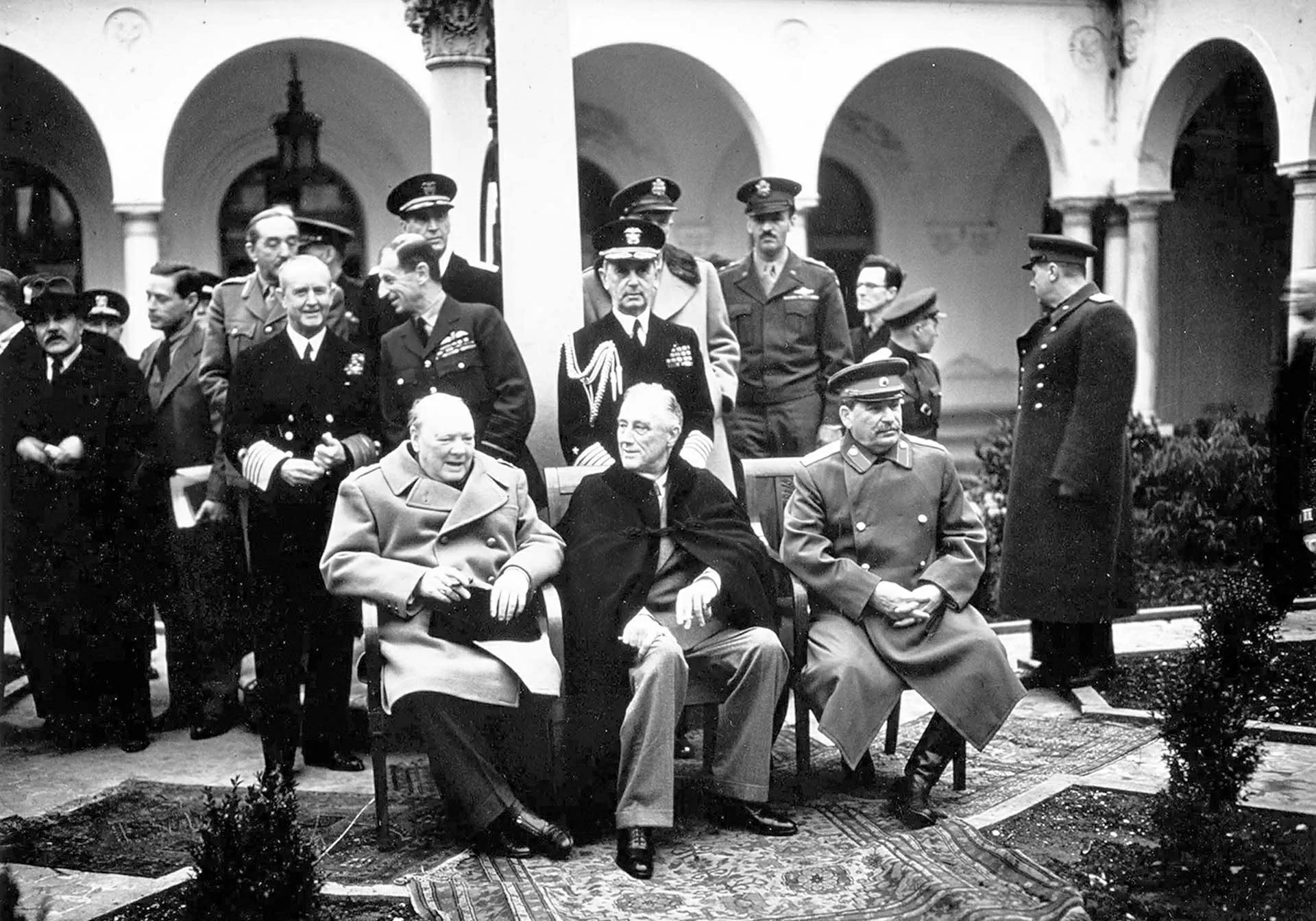 |
| Top row from left: British Prime Minister Winston Churchill, US President Franklin Roosevelt, and General Secretary of the Communist Party of the Soviet Union and Chairman of the Council of Ministers Joseph Stalin at the Yalta Conference, 1945. (Source: US National Archives and Records Administration). |
The Yalta Conference, held from February 4-11, 1945, at the Yalta resort on the Crimean Peninsula, brought together the leaders of the three Allied powers in World War II (the "Big 3"): General Secretary of the Communist Party of the Soviet Union and Chairman of the Council of Ministers Joseph Stalin, US President Franklin D. Roosevelt, and British Prime Minister Winston Churchill.
The meeting took place as World War II entered its final stages. The Allied forces had achieved significant victories in Europe, and the collapse of the Axis powers (Germany, Japan, Italy) was only a matter of time. However, major challenges remained, including reorganizing the world, dividing the spoils of victory, and establishing mechanisms for lasting peace after the war.
Key agreements
According to the Office of the Historian at the U.S. Department of State, the Yalta Conference made crucial decisions regarding the future course of World War II and the post-war world.
The joint communiqué issued on the final day of the conference (February 11, 1945), published by the Office of the Historian, clearly affirmed the demise of Nazi Germany. One of the most important agreements of the conference was the division of Germany into four zones controlled by the major powers: the United States, Great Britain, France, and the Soviet Union. The administration and control of these zones were coordinated through the Central Control Commission, based in Berlin, composed of the commanders-in-chief of the three powers.
The leaders agreed on the need to eradicate fascism completely, fully disarm Germany, destroy its defense-related industrial facilities, limit its ability to recover its military strength, punish war criminals, and compel Germany to reparations for war damages.
The US and Britain generally agreed that future governments of Eastern European countries bordering the Soviet Union should be "friendly" to that regime, while the Soviet Union pledged to allow free elections in all territories liberated from Nazi Germany.
Meanwhile, according to the article "How Churchill, Roosevelt, and Stalin Planned to End World War II?" published on the website of the Royal War Museum (iwm.org.uk), the future of Poland was a particular focus of the Yalta Conference.
Specifically, the leaders of the "Big 3" agreed that the Soviet Union's border with Poland would be moved westward to the Curzon Line, a boundary proposed after World War I. The outcome of these discussions led to an agreement on the conditions for establishing a new Polish provisional government in a manner that would be recognized by the three powers.
Furthermore, the Yalta Conference marked a crucial step in the establishment of the United Nations (UN). The leaders initially agreed on the UN Charter, as well as the organizational structure and veto power of the Security Council, which then had five permanent members.
In the Asian region, according to the Agreement on the Soviet Union's Participation in the War Against Japan, published by the U.S. State Department's Office of Historians, the three countries signed a memorandum in which the Soviet Union committed to participating in the fight against Japanese militarism under conditions including: maintaining the status quo in Outer Mongolia (or the People's Republic of Mongolia), returning to the Soviet Union its rights in the Far East prior to the Russo-Japanese War (1904-1905) and the Kuril Islands.
A foundation for peace?
The conference press release stated that the Yalta Conference reaffirmed the shared determination of the "Big 3" to maintain and strengthen post-war world peace, providing "assurance that all people in all lands can live full lives in freedom, without fear and deprivation," although each leader came to the conference with their own ideas for rebuilding the post-war order in Europe.
According to an article titled "The End of World War II and the Partition of Europe" published by the Center for European Studies (CES) at the University of North Carolina, US President Roosevelt wanted Soviet assistance in the fight against militaristic Japan and participation in the UN. British Prime Minister Churchill urged free elections and the establishment of democratic governments in Central and Eastern Europe, particularly Poland.
Meanwhile, General Secretary Stalin wanted the Soviet Union to expand its influence in Eastern and Central Europe, considering it a crucial element in the federal state's defense strategy. His stance was so firm that the then US Secretary of State from 1945-1947, James F. Byrnes (1882-1972), remarked: "The question is not what we will let the Russians do, but what we can persuade them to do."
For that reason, the Yalta Conference took place in a tense and fiercely contested atmosphere. However, the final decisions were made after an agreement and due process between the two superpowers, the Soviet Union and the United States.
In this new order, the Soviet Union successfully defended the existence and development of the socialist state, recovered territories lost in the Russo-Japanese War (1904-1905), and expanded its influence in Europe and Asia, building a security perimeter around the country. Meanwhile, in this new order, the United States gained dominance, exerting profound influence over Western European powers and Japan, controlling international affairs, and gradually realizing its ambition of global hegemony.
According to the Office of the Historian, the initial reaction to the Yalta Agreements was one of celebration. President Roosevelt, like many other Americans, saw it as evidence that the wartime spirit of cooperation between the United States and the Soviet Union would be maintained in the postwar period.
Time magazine then asserted that: "Any doubts about the ability of the 'Big 3' to cooperate in peace as well as war seem to have been dispelled," while former Foreign Secretary James F. Byrnes commented: "The wave of Anglo-Soviet-American friendship has reached new heights."
Former US Secretary of State Henry Kissinger (1923-2023) praised Yalta as an excellent diplomatic strategy by Allied leaders, particularly President Roosevelt, despite its complexities. According to him, Yalta was the result of practical and necessary cooperation to ensure post-war stability.
Yalta's success lies in the fact that the three superpowers can coexist and manage major issues while still maintaining their distinct interests.
In his book *The United States and the Origins of the Cold War, 1941-1947*, John Lewis Gaddis, a Cold War expert and current Professor of Military and Naval History at Yale University (USA), argues that the Yalta Conference was a crucial step in maintaining cooperation among the Allied powers as the war neared its end.
However, the U.S. State Department's Office of Historians acknowledges that this "allied sentiment" did not last long. With the death of President Roosevelt on April 12, 1945, Harry S. Truman became the 33rd president of the United States, and by the end of April 1945, the new administration was in conflict with the Soviet Union over its influence in Eastern Europe and the UN.
From this point, fearing a lack of cooperation from the Soviet Union, many Americans began to criticize President Roosevelt's handling of the Yalta negotiations. To this day, many even accuse him of "handing over" Eastern Europe to the Soviet Union, despite the fact that the Soviet Union made significant concessions.
The British historian AJP Taylor (1906-1990) stated in his work *English History 1914-1945* that the Yalta Conference left behind “a divided Europe and an unstable world”.
Professor Gaddis shares this view, arguing that the decision to allow the Soviet Union to expand its influence in Eastern Europe facilitated the formation of the "Iron Curtain," which separated Central and Eastern Europe from the rest of the continent, as well as the beginning of the Cold War in 1947.
On the Russian side, in an interview with the Russian news site Top War in 2015, Soviet historian and diplomat Valentin Falin (1926-2018) assessed that the Yalta Conference was the best opportunity for nations since ancient times.
He quoted U.S. President Roosevelt's address to Congress on March 1, 1945, regarding the Yalta Agreement between the U.S., Great Britain, and the Soviet Union: "It cannot be a peace of great powers or of small powers. It must be a peace based on the common efforts of the whole world." However, according to Falin, the world described by President Roosevelt did not meet the expectations of the opposing factions in Washington, leading to the risk that "cooperation between the Soviet Union and the United States could be broken…".
Even General Secretary Stalin himself warned of this issue at the Yalta Conference when he declared: “We cannot allow dangerous differences to occur... But ten years will pass, or perhaps less. A new generation will emerge, who have not experienced everything we have experienced, and may see many issues differently than we do.”
And clearly, the Allies failed to protect the relationship forged at the Yalta Conference until the very end, as just two years later, the Cold War broke out between the two superpowers, the United States and the Soviet Union.
Source: https://baoquocte.vn/hoi-nghi-yalta-cuoc-gap-go-quyet-dinh-van-menh-the-gioi-303400.html










































![[Photo gallery] Nhon Trach is ready to transform into a modern and civilized city.](https://vphoto.vietnam.vn/thumb/402x226/vietnam/resource/IMAGE/2026/04/02/1775104005524_hinh_1_20260402085339.jpeg)

![[Photo gallery] Dong Phu aims for modern and sustainable urban development.](https://vphoto.vietnam.vn/thumb/402x226/vietnam/resource/IMAGE/2026/04/02/1775104023925_111_20260402104322.jpeg)













Comment (0)