

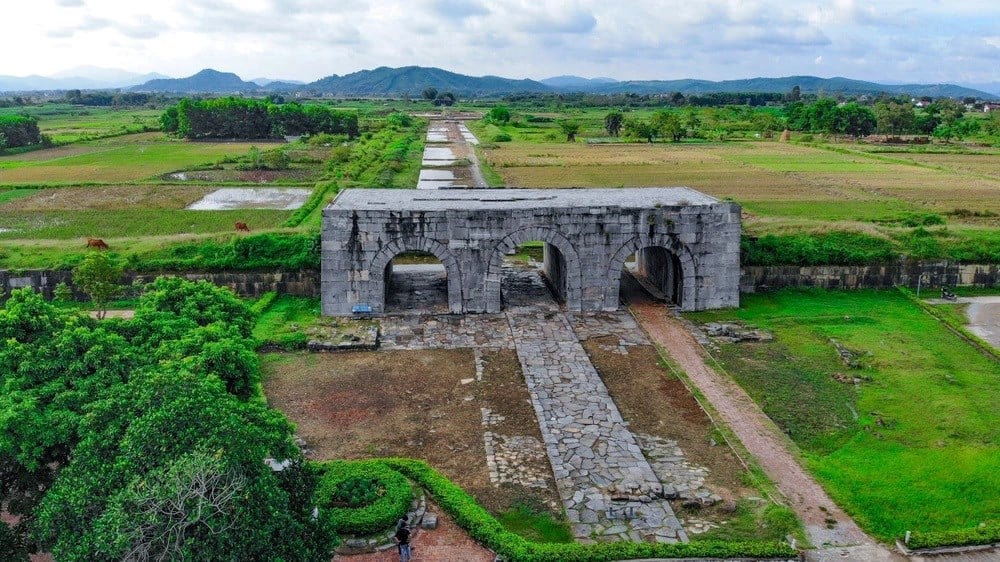
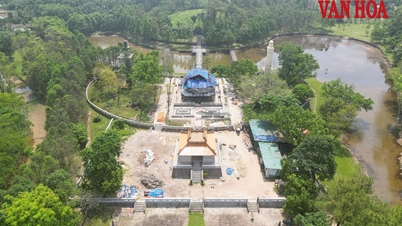
Ho Citadel – a World Cultural Heritage site, a symbol of the reformist spirit and creativity of the ancient Vietnamese people. Photo: Provided by the Ho Citadel Heritage Conservation Center.
In May 2017, Conclusion No. 82-KL/TU was issued by the Standing Committee of the Thanh Hoa Provincial Party Committee, laying the strategic foundation for a long-term, sustained journey: Strengthening the Party's leadership over the work of preserving and promoting the cultural heritage values of Thanh Hoa province, 2017–2025.
Heritage "comes alive" through strategic vision.
This was not a fleeting movement, nor did it remain merely propaganda slogans; this conclusion was quickly concretized through a series of programs, plans, resolutions, and especially the synchronized involvement of the entire political system.
In reality, heritage conservation in Thanh Hoa has always faced significant challenges: a large number of relics but scattered distribution; many sites in serious disrepair; limited investment resources; and ineffective social mobilization… However, with strategic vision and strong determination, the period from 2017 to 2025 has become an unprecedented turning point.
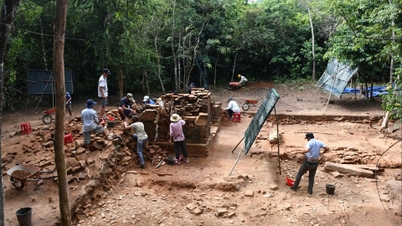
Over 469 historical sites have been preserved, restored, and renovated, achieving 147% of the plan. Some places that were once overgrown with moss and dilapidated now welcome thousands of visitors for sightseeing, learning, and religious ceremonies.
There are things that seemed destined to fade into the past, but now they shine brightly under the nighttime lights, as if people are rekindling memories for a place.
Beyond just physical structures, the planning, demarcation, and zoning for the protection of historical sites are also carried out systematically and scientifically. World Heritage sites such as the Ho Dynasty Citadel, the Lam Kinh National Special Monument, Con Moong Cave, Trieu Tuong Mausoleum, Trinh Palace, and the Lung Nhai Oath Ceremony are no longer just names in documents, but are now tangible through detailed planning and long-term investment projects.
At the institutional level, the province has issued a series of plans and directives to perfect the legal framework for heritage protection. In particular, Directive No. 19/CT-UBND on strengthening the management, preservation, restoration, and promotion of the value of historical and cultural relics and scenic spots in the province has truly become a "legal shield," preventing the damage and distortion in the restoration of relics, a persistent and troubling issue in many localities for many years.
Above all, the greatest shift has come from awareness. Local officials have a better understanding of the role of heritage in local development; people are beginning to feel proud when mentioning their village temples and festivals; and students are seeking out historical sites for extracurricular learning. Heritage is no longer something of the "past," but is present, vibrant, and closely intertwined with the contemporary spirit.
"We are not just preserving the old bricks, but restoring a whole depth of memory for today's generation," a representative from the Department of Culture, Sports and Tourism shared during a survey at Lam Kinh, a site once associated with the powerful Le Dynasty.
Preserving the soul of Thanh Hoa province through every gong sound and song.
If the bricks and stones are the "body" of the past, then lullabies, folk songs, flute melodies, gong sounds, and traditional costumes are the "soul," the essence, fragile yet enduring, flowing through generations.
The period from 2017 to 2025 also marks a significant step forward for Thanh Hoa in identifying and restoring its intangible cultural heritage, the underlying current that nourishes the cultural depth of the region.
719 intangible cultural heritage items have been fully inventoried in all 26 districts, towns, and cities. This includes all 7 categories as stipulated by law: from ethnic languages and scripts; customs and rituals; traditional crafts; folk knowledge to traditional festivals…
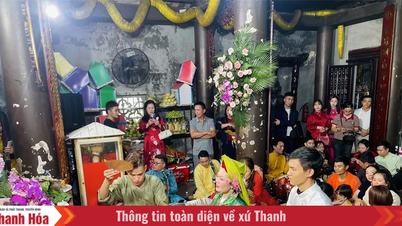
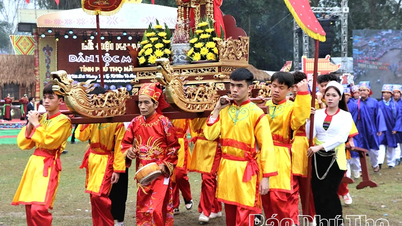
From major festivals like Muong Xia, Pon Poong, Le Hoan Temple, Ba Trieu Temple... to folk performances such as Ngu Tro Vien Khe, Xuong Dao Duyen, Tro Chieng, Sac Bua singing… all have been documented, digitized, restored, or included in the National List of Intangible Cultural Heritage.
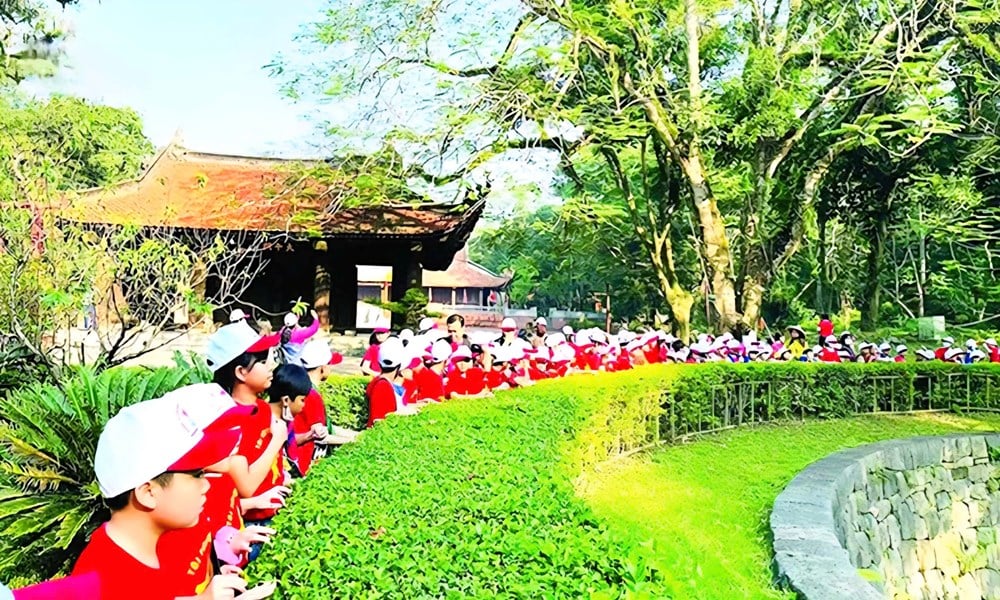
Educating the younger generation about heritage: Thanh Hoa's way of passing on cultural traditions through hands-on experiences at historical sites. Photo: VHDS
Behind those numbers lies the sweat and tireless dedication of folk artisans, people without formal qualifications who are the "professors of memory" in their villages.
Some artisans, some over 80 years old, still diligently teach the Thai bamboo flute to the younger generation. Others travel to remote villages to rediscover the long-forgotten Muong folk songs. At times, an entire team of cultural officials has had to trek through forests, climb steep slopes, and eat and sleep with the villagers to ensure the festival is revived on its traditional day.
A Thai ethnic artist once said emotionally, "Before I die, I only wish to see my descendants perform the bamboo pole dance like our ancestors did. Now that I've seen it, I feel at peace."
The province has also boldly implemented long-term plans for the restoration of festivals, the development of tourism linked to the identity of ethnic minorities, and the preservation of the languages, costumes, and traditional customs of the people.
That's how Thanh Hoa doesn't let its culture remain only in books, but brings it to life in everyday life, in every village festival, and in every cultural exchange event in the hamlets.
In particular, incorporating heritage education into schools, organizing hundreds of experiential learning sessions for students at historical sites, and developing extracurricular programs linked to national culture have awakened a sense of pride in the younger generation, the force that will determine the future of heritage.
Eight years is a long journey. But heritage, with its enduring and timeless nature, demands a longer-term vision. Thanh Hoa province is continuing to propose specific mechanisms, prioritizing budget allocation and the socialization of resources, promoting the application of digitalization, and investing systematically in cultural professionals, so that what is preserved today will be a valuable asset for the future.
"We don't want our children and grandchildren to only see our heritage through books. We must ensure that they live within our heritage, are proud of it, and know how to preserve it as an integral part of their being," a young cultural official confided. This statement is not just an expectation, but a goal. Because a nation can only go far when it knows how to set foot on the heritage of its ancestors.
(To be continued)
Source: https://baovanhoa.vn/van-hoa/bai-1-danh-thuc-hon-xu-thanh-tu-di-san-158730.html























![[Photo] Prime Minister Pham Minh Chinh receives the Chinese Ambassador to Vietnam](https://vphoto.vietnam.vn/thumb/1200x675/vietnam/resource/IMAGE/2026/04/05/1775397481797_ndo_br_dsc-5512-jpg.webp)









































Comment (0)