

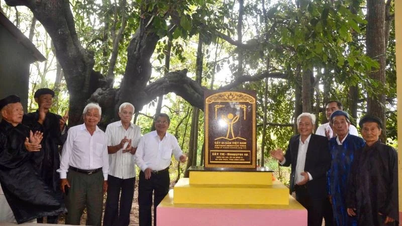
The Ho Van family church is a traditional architectural structure with three bays, a gate, pillars, a screen, inlaid carvings of dragons and clouds, porcelain tiles, and a ceremonial hall. It was built in the year Quy Dau, the 3rd year of the Bao Dai reign (1933).
During the two wars of resistance against French colonialism and American imperialism, the church was destroyed by American aircraft and warships. The Ho family and the people of the commune moved the church's earth, stones, and wood to fill in the Ly Hoa bridge, creating an underground tunnel for vehicles to pass through. After the war, there were several minor renovations, and in 2025, the restoration and renovation project was completed on a large scale. The church is located on a high, airy plot of land in the middle of the village, facing north, and serves as a place of worship and ceremonial rites for the descendants of the Ho Van family.
 |
| The head of the Ho Van clan performs the ritual of offering sacrifices on the full moon of the first lunar month of the year of the Horse 2026 - Photo: T.D.H |
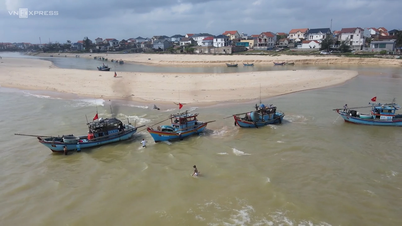
The Dong Trach area was formerly a fishing village. The lives of the people here in general, and the descendants of the Ho Van family in particular, were mainly tied to fishing and seafood harvesting. With difficult transportation and livelihoods heavily dependent on the sea, the lives of the people were precarious.
However, above all, many families and clans in the village still highly value education. The Ho Van clan is a prime example of a tradition of studiousness, achieving high academic success, with many members making significant contributions to the country and their homeland, bringing honor to the clan.
According to the family's genealogy, the Ho Van family ancestral temple is not only a place of worship for the founding ancestor Ho Van Giao, one of the ten families from Nghe Tinh who pioneered this land during the reign of Le Than Tong (Quy Mui, 1643), and the family's scholarly ancestors, but also a place of worship for ancestors who made significant contributions in various fields of social life, and were granted titles of merit by emperors such as Minh Mang, Tu Duc, Thanh Thai, Khai Dinh, and Bao Dai.
First and foremost, we must mention the first and only person from the village who passed the doctoral examination and was appointed to an official position. The book " Quang Binh Biographical Records" by Nguyen Tu states: "He was born in 1815 in Quy Duc commune, Bo Trach district. He passed the Bachelor's examination in the year Canh Ty (1840), and the Doctoral examination in the year Tan Suu, during the reign of Thieu Tri (1841). He served as an official up to the position of District Chief."
Besides their tradition of academic achievement in studies, examinations, and being appointed to important positions by the imperial court, the Ho Van family also made significant contributions to the field of transportation, especially maritime transport, notably including: Ho Van Thanh, Ho Van Tai, Ho Van Thua, Ho Van Hai, Ho Van Ray, Ho Van Doi...
Mr. Ho Van Thanh was a descendant of the Ho Van family with many achievements in maritime transport. He possessed strong organizational skills, a deep understanding of waterways, and extensive experience in successful seafaring. He was dedicated to his work, commanding many imperial fleets to successfully complete their missions. On September 17th, the first year of Minh Mang's reign (1820), he was granted the title of Thanh Tin Marquis and promoted to the rank of Captain, commanding two water transport fleets, Truong Da and Thuan Hai: "Granting Truong Da the convenient Captain Ho Van Thanh, belonging to Ha Bac commune, Thuan Co village, Bo Chanh district, Quang Binh prefecture."
"During the past period, you have always devoted your intellect and wholeheartedly worked in transporting goods by river and sea, achieving many meritorious deeds. In recognition of your contributions, I hereby confer upon you the title of Thanh Tin Marquis and promote you to the rank of Captain, commanding two fleets of waterway transport, Truong Da and Thuan Hai. You must obey orders to command your crew members to perform their assigned duties well. Neglecting your responsibilities will result in punishment according to military law." (Based on the translation of the imperial decrees, preserved at the Ho Van family ancestral temple, former Duc Trach commune, now Dong Trach commune, by Mr. Truong Quang Phuc, Chairman of the Han Nom Club of the former Quang Binh province).
Mr. Ho Van Thua was a patriotic member of the Ho Van family. From his student days, he voluntarily joined the army to serve the royal court. Due to his significant contributions, he was granted the rank of Tong Cuu Pham Van Giai by Emperor Thanh Thai: "Considering that student Ho Van Thua, from Quy Duc village, Ha Bac commune, Bo Trach district, Quang Trach prefecture, Quang Binh province, has served the army of Quang Binh province, diligently working and making many contributions. After considering his merits, the court approves the awarding of the rank of Tong Cuu Pham Van Giai. This certificate is hereby issued for you to implement and abide by. The 15th day of the third month, Thanh Thai 2nd year (1890)."
He was not only dedicated to his duties, but also known for his benevolent heart and constant concern for the people's well-being. He voluntarily donated money and rice to help the poor. His noble spirit was rewarded by the Thanh Thai dynasty with a royal decree: "Considering that he is a learned man, voluntarily joined the army, has made many contributions, and now demonstrates a chivalrous spirit by donating to help the poor, the court rewards him with the rank of Tòng Cửu phẩm Văn giai. February 6th (leap year) of the 2nd year of Thanh Thai (1890)."
The Ho Van family church also worships figures such as Ho Van Hai, the eldest son of Doctor Ho Van Tri, who was appointed by the 27th year of Tu Duc's reign (1874) to the position of Tong Cuu Pham Thu Lai.
Mr. Ho Van Ray, a descendant of a family living during the late Nguyen Dynasty, was appointed Tri Bo Thon by the Bao Dai court in the 6th year (1931). Mr. Ho Van Doi was appointed Tong Cuu Pham Van Giai by the Bao Dai court in the 19th year (1944), and many others as well.
Through generations, the Ho Van family has continued the tradition of academic achievement, dedication, and service to the country. Rarely has a family had so many descendants who, across generations, have contributed their efforts, intellect, and talent to the nation and their homeland. Today, the descendants of the Ho Van family continue this noble tradition, always looking towards their ancestral temple and roots to strive in their work. The Ho Van family boasts many successful and accomplished individuals, including PhDs, high-ranking officials in the military and businesses, educators, and managers... bringing honor to a historical site by the Dong Trach seaport – the Ho Van family temple.
Ta Dinh Ha
Source: https://baoquangtri.vn/van-hoa/202603/dau-annha-tho-ho-ho-van-6b53dc6/

![[Photo] Memorable moments at the 10th Vietnam-China Border Defense Friendship Exchange](https://vphoto.vietnam.vn/thumb/1200x675/vietnam/resource/IMAGE/2026/03/20/1773986226876_giao-luu-bien-gioi-vntq-lan-10-ben-tq-9737-4225-jpg.webp)























































Comment (0)