

This is not just about drinking tea daily, but also a spiritual and tranquil experience, as well as the enjoyment of tasting and savoring the flavor of the tea.

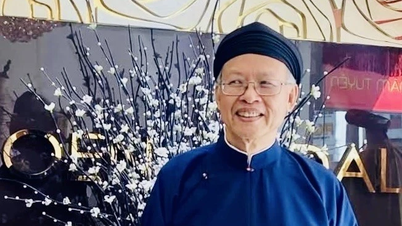
The extended family of artisan Ngo Van Xiem produces lotus-infused tea at their family facility. Photo: Internet
Perhaps that's why tea drinking carries such profound values and meanings. It creates a connection between humans and nature. Tea drinking is a way for people to enjoy the flavors of nature and appreciate their surroundings.
With such profound meaning, the tea to be enjoyed must be a special kind, and naturally, its price is far from "ordinary." Once, I had the pleasure of tasting Bach Diep lotus tea. It was New Year's Day, and I visited and wished a happy new year to the lotus-infused tea artisan Ngo Van Xiem. In his house, which also serves as a showroom and sales outlet for lotus-infused tea, and as the production facility for Hien Xiem lotus tea – a house overlooking West Lake on Quang Khanh Street (Quang An Ward, Tay Ho District) – artisan Ngo Van Xiem invited me to sit down and poured me a cup of hot tea. I thanked him and slowly sipped. The delicate aroma of the lotus flower blended with the unique fragrance of Tan Cuong tea from Thai Nguyen . After hearing me talk about the pleasure of "tea appreciation," artisan Ngo Van Xiem added: "Enjoying lotus tea is not for the thirsty." I understood his profound meaning, because when enjoying Bach Diep lotus tea, one must drink slowly to appreciate its elegance amidst the spring season.
The New Year's conversation focused on lotus tea. Mr. Ngo Van Xiem explained: "It's called Quang An lotus tea because this lotus-infused tea is produced by artisans from Quang Ba village (Quang An ward). It's also called Bach Diep lotus tea because Tan Cuong Thai Nguyen tea is infused by artisans in Bach Diep lotus flowers. This is a type of lotus grown in Dam Tri Lake, Quang An ward." He then affirmed: "Only Bach Diep lotus grown in Dam Tri Lake is the best. This is a precious lotus variety with a pink color, and because it 'drinks' the water of Dam Tri Lake, it has a delicate fragrance. Infusing Tan Cuong tea in Bach Diep lotus flowers creates a gentle aroma that doesn't overpower the natural fragrance of Tan Cuong tea."
The story becomes even more interesting when artisan Ngo Van Xiem reveals that his family has been practicing the art of infusing tea with lotus flowers for five generations. Currently, all three of his children and their wives are involved in this craft. His grandchildren also actively help out after school. As Mr. Xiem puts it, this is how the grandchildren continue the family tradition.
The tea production facility of artisan Ngo Van Xiem's family has the brand name "Hien Xiem Lotus Tea" - a combination of the names of him and his wife. Both husband and wife are recognized as artisans specializing in lotus-infused tea. Currently, in Quang An ward, there are not many families practicing this craft. Notable artisans include Nguyen Thi Dan (who passed away a few months ago at over 100 years old), Dam Thi Oanh, Ngo Thi Phan, and others.
Enthralled by the story of infusing and brewing lotus tea, artisan Ngo Van Xiem shared that every year, his family orders tea from a family with a "traditional" tea-growing tradition in Tan Cuong commune, Thai Nguyen city. The tea from this family is of good quality, grown according to VietGAP standards, making it very safe and "clean".
Thanks to the use of high-quality tea and unique tea-infusing techniques, in December 2024, the Quang An lotus tea-infusing craft was included in the list of National Intangible Cultural Heritage. Mr. Siem excitedly said: "Everyone in our Quang Ba village is proud and reminds each other to preserve and pass on this craft to future generations."
Holding a cup of Hundred-Petal Lotus Tea in my hand, the fragrance lingered, so I asked Mr. Xiêm how to brew it. He explained: "After Tân Cương tea is infused in a Hundred-Petal lotus flower, it must not be rinsed before brewing. That is, the tea leaves should not be rinsed before being put into the teapot because they are already clean. The tea must be brewed in a Bát Tràng ceramic teapot to ensure a more delicious flavor than brewing it in a stoneware or porcelain teapot."
When brewing, the teapot and ceramic cups should be rinsed with boiling water. The amount of tea leaves in the teapot depends on the drinker's taste and the number of people drinking, ensuring the tea is neither too weak nor too strong. Then, pour in 90°C boiling water. The first infusion should only cover the tea leaves, and after 1-2 minutes, allow the leaves to steep before adding more water. The amount of water should also be sufficient for the number of people drinking. When pouring the tea, pour it into each cup in turn, ensuring even distribution and that the tea in each cup is evenly distributed, with no cup having a stronger or weaker flavor than the others.
I nodded in agreement with this way of pouring tea because, traditionally, whenever guests came to visit, the host would pour tea for the guests first, and then for themselves. While that method seemed respectful, it wasn't ideal because the first cup was usually weak and the last was usually strong. I'd often been treated as a valued guest, and had to drink weak tea repeatedly without daring to complain to the host. I was afraid of offending them.
Whether it was the Quang An lotus tea or the Bach Diep lotus tea, the first day of the new year passed leisurely. I stood up, thanked Mr. Siem, and said goodbye. On the way home, the aroma of lotus tea lingered, sweet and fragrant, a specialty flavor of Tay Ho, Hanoi .
Source: https://hanoimoi.vn/dau-nam-thuong-tra-sen-bach-diep-692730.html















![[Photo] Prime Minister Pham Minh Chinh receives the Chinese Ambassador to Vietnam](https://vphoto.vietnam.vn/thumb/1200x675/vietnam/resource/IMAGE/2026/04/05/1775397481797_ndo_br_dsc-5512-jpg.webp)





























































Comment (0)