

Decree 66, issued recently, further affirms the humane goal of ensuring equitable access to education for children in disadvantaged areas.
The core of Decree 66 lies in providing direct support to ensure students can live and study comfortably at school. Each eligible student receives 936,000 VND per month for food, 15 kg of rice, and accommodation allowance if the school cannot provide housing. In addition, they are provided with essential personal items and school supplies, ensuring minimum living conditions for students studying far from home. Educational institutions are also allocated funds to organize meals and manage boarding students, thereby creating a foundation for maintaining student numbers and improving the quality of teaching and learning.
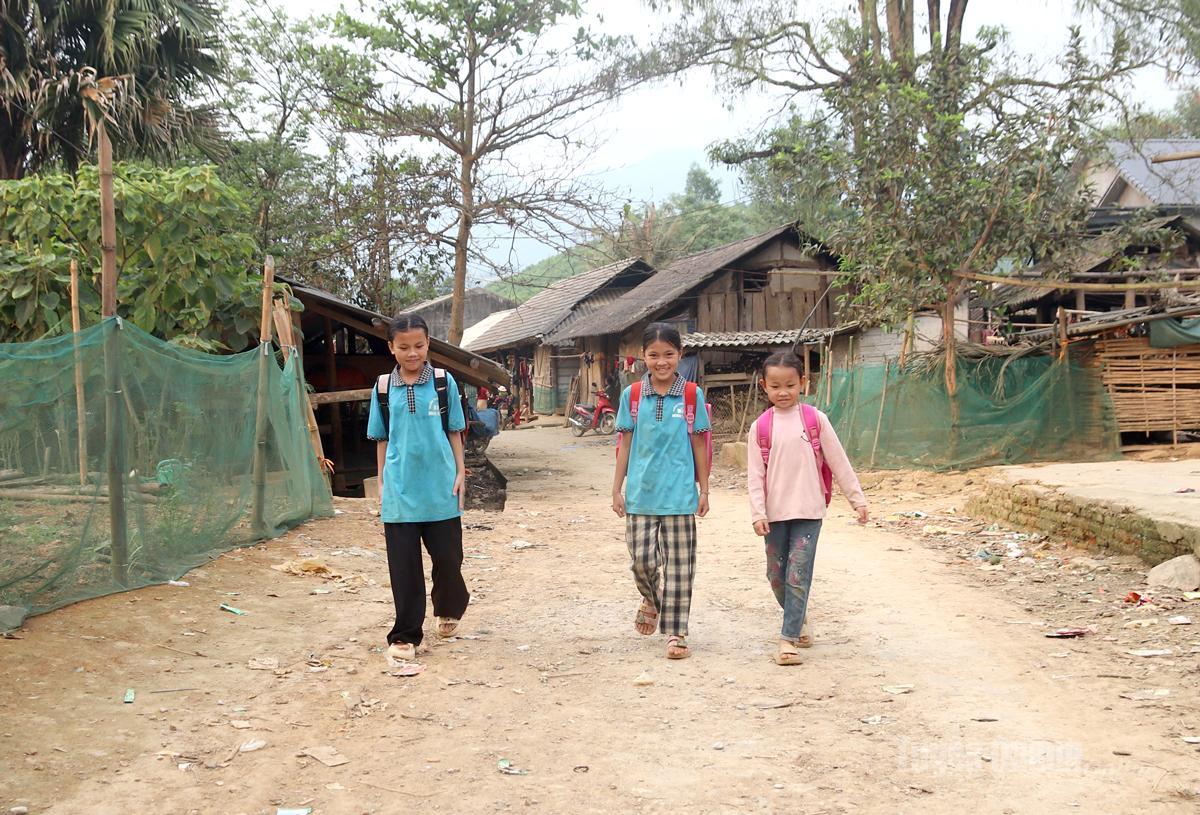 |
| Not meeting the geographical distance requirements for boarding school status, many students in Binh Xa commune still have to travel back and forth four times a day. |
According to Decree 66, the distance for determining whether a student is eligible for boarding school is stipulated at the following benchmarks: 4 km or more from home to school for primary school students, 7 km for secondary school students, and 10 km for high school students. At the same time, the Decree also allows for flexibility by permitting consideration of cases with difficult terrain and particularly challenging transportation conditions, such as crossing rivers, streams, mountain passes, or landslide-prone areas, even if the distance threshold is not met.
Based on that policy framework, on September 24, 2025, the Provincial People's Committee issued Decision 87, "regulating the distance and geographical area used to determine students and trainees who cannot travel to and from school within the same day; and the list of personal supplies and school supplies provided to students in ethnic boarding schools and general education institutions authorized to educate ethnic boarding students in Tuyen Quang province." Accordingly, the province proactively lowered the distance threshold to 2 km for primary school students, 3 km for junior high school students, and 5 km for high school students. Compared to the central government's thresholds of 4, 7, and 10 km, this is a highly practical adjustment, helping the policy to be closer to the actual travel conditions in mountainous areas, where each kilometer is measured not only by geographical length but also by slope, isolation, and risks on the way to school.
Double pressure
In the 2025-2026 school year, the province will have 692 general education institutions with nearly 500,000 students. Of these, 35,279 students in 227 ethnic minority boarding schools have been and are currently benefiting from policies under Decree 66. In the first semester alone, 104,665 students received support including over 6,300 tons of rice and 398 billion VND for food and accommodation. This is a significant resource contributing to maintaining student enrollment and reducing the burden of livelihood for many families in mountainous areas.
However, as the policy was implemented with specific criteria, difficulties began to emerge: The rigid benchmarks regarding distance and geographical area, while necessary to ensure transparency, could not fully encompass the unique travel conditions of mountainous regions. Mr. Tran Minh Tuyen, Principal of Yen Lam Ethnic Boarding Junior High School (Yen Phu commune), said: At the beginning of the school year, the school had 98 students eligible for benefits under Decree 66. However, after the implementation of Decision No. 50, dated January 9, 2026, of the Provincial People's Committee on "approving the list of villages in ethnic minority and mountainous areas, especially difficult villages; communes in ethnic minority and mountainous areas, communes in areas I, II, III, giai đoạn 2026 - 2030 in Tuyen Quang province," most of the school's boarding students no longer belong to especially difficult villages, resulting in students here no longer meeting the eligibility criteria for support policies under Decree 66. After a review, the school only has 4 students who meet the criteria for boarding benefits.
 |
| Hoang Thi Thuong (second from right), Party Secretary and Head of Hamlet 6, Minh Tien, Binh Xa Commune, goes to each house to encourage parents to send their children to school. |
Minh Tien Ethnic Boarding Primary and Secondary School (Binh Xa commune) has 98.4% of its students from ethnic minority groups, with the Mong ethnic group accounting for 44.4% of the total student population. According to Principal Le Trong Giang, at the beginning of the school year, the school had 211 boarding students, representing 22.4% of the total student population. However, after comparing the "gap" and "poverty alleviation" criteria, the list was reduced to only 47 students eligible for boarding school benefits (accounting for 5%).
Nestled amidst the steep slopes, Minh Tien Hamlet 6 (Binh Xa Commune) is home to 154 Mong ethnic minority households, accounting for over 65% of the hamlet's population. All Mong households are classified as poor or near-poor. The pressure is further compounded by the fact that 100 primary school students in the hamlet are no longer eligible for the boarding school program. Ms. Thao Thi Trang lamented, “Just at the beginning of the school year, my family had to borrow nearly 1 million dong to buy books and school supplies for my two children – a considerable sum for those who work in the fields.” Ms. Hang Thi Din added, “My husband and I leave early in the morning and leave late at night, leaving no time to drop off or pick up our three young children, so they have to walk to school on their own. Once, my child came home, took a nap, and forgot to go to class.”
No one should be left behind.
Inadequacies in policy implementation are creating significant pressure on the education system. In reality, declining attendance rates, longer commutes to school, and the disappearance of school lunch programs all raise serious questions about the ability to retain students. In this context, the urgent need is not only to enforce policies but also to promptly address these gaps, ensuring that no student is left behind on their educational journey.
At Minh Tien Ethnic Boarding Primary and Secondary School, the attendance rate has decreased progressively: from 96.8% (mid-September 2025), down to 95.7% (end of October), and currently at 94.7%. On average, there are up to 50 empty seats in the classroom each day. This downward curve is not simply a set of numbers, but a warning sign of the risk of educational disruption.
The reasons for students dropping out of school are partly due to the loss of the support of the boarding school policy, and partly due to inherent difficulties: parents are busy earning a living and don't have time to pick up and drop off their children; young children have to accompany adults to the fields; educational awareness is limited; or simply, their immature steps are not strong enough to overcome the daily slopes. To keep students in Binh Xa, a student mobilization team, headed by the Vice Chairman of the Commune People's Committee, was established with the participation of teachers, village heads, and representatives of local organizations. At the schools, teachers not only teach but also "maintain the classes," even becoming the students' drivers. Some teachers, like Mr. Dao Ngoc Di of Minh Tien Ethnic Boarding Primary and Secondary School, quietly provide free transportation every day just to prevent their students from dropping out.
At Yen Lam Ethnic Boarding Junior High School, to maintain student enrollment, the school has had to consider a socialized approach to providing meals for students attending the school. The minimum contribution is approximately 878,600 VND per student per month (excluding breakfast), which is reduced to 776,000 VND if students provide their own rice – a significant amount for many families. Even so, only 23 students can register to stay at the school; the rest, due to their families' financial constraints, are forced to commute daily, facing safety risks and disruptions to their studies.
According to Nguyen Van Uoc, Secretary of the Party Committee of Yen Phu commune: "The entire commune has more than 500 students affected by no longer being eligible for the boarding school policy, with over 400 of them being preschoolers. In the short term, the local authorities can mobilize social resources to provide rice, and also solicit additional vegetables and fuel from the people, but in the long term, this is not a sustainable solution."
Based on this reality, Deputy Director of the Department of Education and Training Bui Quang Tri stated: “The Department has advised the Provincial People's Committee to propose the issuance of a Resolution of the Provincial People's Council stipulating policies to support boarding students and students from poor households who are not eligible under Government Decree 66.” This proposal not only supplements existing policies but also demonstrates flexible and practical management thinking. When the general policy framework cannot fully cover everything, local resources will become an important “buffer” to fill the gaps.
The journey of bringing literacy to remote areas is still fraught with challenges, but if policies are flexible and humane enough, no dream will have to be cut short just because of the distance to school.
Text and photos: Thu Phuong
Ensure no student is left behind.
 |
| Ms. Vu Thi Giang Deputy Head of the Culture and Social Affairs Committee, Provincial People's Council |
At its first session, the People's Council of Tuyen Quang province, 20th term, 2026-2031, considered, discussed, and approved a Resolution stipulating support policies for boarding students and students from poor households not eligible under Government Decree No. 66/2025/ND-CP at public general education institutions in the province.
This is a very humane policy, decided upon by the Provincial People's Council at its First Session, providing timely additional support for students not yet eligible under Decree No. 66/2025/ND-CP to ensure that no student is left behind. The resolution demonstrates the province's deep concern for students from poor households, ethnic minority communities, and disadvantaged areas; helping them to study with peace of mind, reducing the burden on their families, maintaining student enrollment, and improving the quality of education in schools in disadvantaged areas; contributing to the successful achievement of the province's sustainable poverty reduction and human resource development goals.
Proactively support students.
 |
| Ms. Pham Thi Ha Deputy Principal of Ha Giang Ethnic Boarding High School |
Based on my observations, I've noticed that teachers, especially those in ethnic minority boarding schools, not only teach but also take on many other responsibilities outside of their teaching duties to maintain student enrollment and retain students. In cases where students don't qualify for boarding school benefits due to distance restrictions, they are forced to commute daily, which presents significant challenges and safety risks.
Faced with this reality, many teachers have proactively supported students by providing transportation through dangerous routes, supervising them during lunchtime, and visiting their homes to encourage them to attend class, especially those at risk of dropping out. At the same time, teachers have also connected with and solicited support for books, clothing, and school supplies to alleviate students' difficulties; they have also taken advantage of extra time to provide free tutoring and remedial instruction for students who are struggling academically or have missed school due to transportation difficulties.
I believe that, in order to reduce the workload for teachers and ensure students' right to education, flexible adjustments are needed in the policy implementation process. Besides the distance criterion, other factors such as travel conditions, family circumstances, and geographical characteristics should also be considered. At the same time, schools and local authorities should be given more autonomy in reviewing and proposing truly disadvantaged cases.
I would like to have boarding accommodation.
 |
| Nguyen Bao Khanh Class 6A, Nang Kha Ethnic Boarding Primary and Secondary School |
My house is more than 4 km from the school, and during storms, getting to school is quite difficult and often disrupts my studies. I hope for a school with boarding facilities so that when the weather is unusual, I can stay there and not have to travel so hard, and my family will be more at ease. Currently, commuting twice a day is quite tiring for my studies, but despite the long distance and the difficulties my family faces, I am determined to study hard to become a good child, a good student, and a useful citizen for society.
Consider the specific target group.
 |
| Mr. Le Duc Anh Dong Trang village, Hung Loi commune |
My house is nestled on a hillside in a small village primarily inhabited by the Hmong ethnic group. It's only about 1.5 km from my house to my child's school. It sounds close, but the winding mountain paths are steep and difficult to navigate. Here, people are used to walking, and my wife and I don't know how to ride a motorbike, so taking our child to and from school isn't easy. Because we haven't reached the 2 km mark required for boarding school support, my child walks home every lunchtime. In this remote village, parents often leave for work early in the morning, and sometimes they can't get back in time. My child then has to eat lunch at a neighbor's house. I feel sorry for my child, who is exhausted from walking home on hot summer afternoons or slippery rainy days, making it difficult for them to concentrate in class. The provincial government is very concerned about our community, but we only hope that the authorities can be more flexible in considering the terrain of these remote villages so that children of ethnic minorities can study with peace of mind and have convenient access to school.
Source: https://baotuyenquang.com.vn/van-hoa/giao-duc/202604/de-hoc-tro-yen-tam-bam-lop-e7c6f24/


























































































Comment (0)