

Knowing we wanted to learn about the ma la, Mr. Nghiep enthusiastically told us about the traditional musical instrument of his people. Born and raised in the village, Mr. Nghiep was familiar with the sound of the ma la and life in the mountains and forests from a young age. Therefore, he was very fond of playing the ma la. As a child, whenever there was a village festival, he would often go to watch the elders and village chiefs play the ma la. The image of the artisans in traditional costumes always captivated him with their steady steps, graceful hands, and the sounds they produced of the mountains, waterfalls, and wild animals.
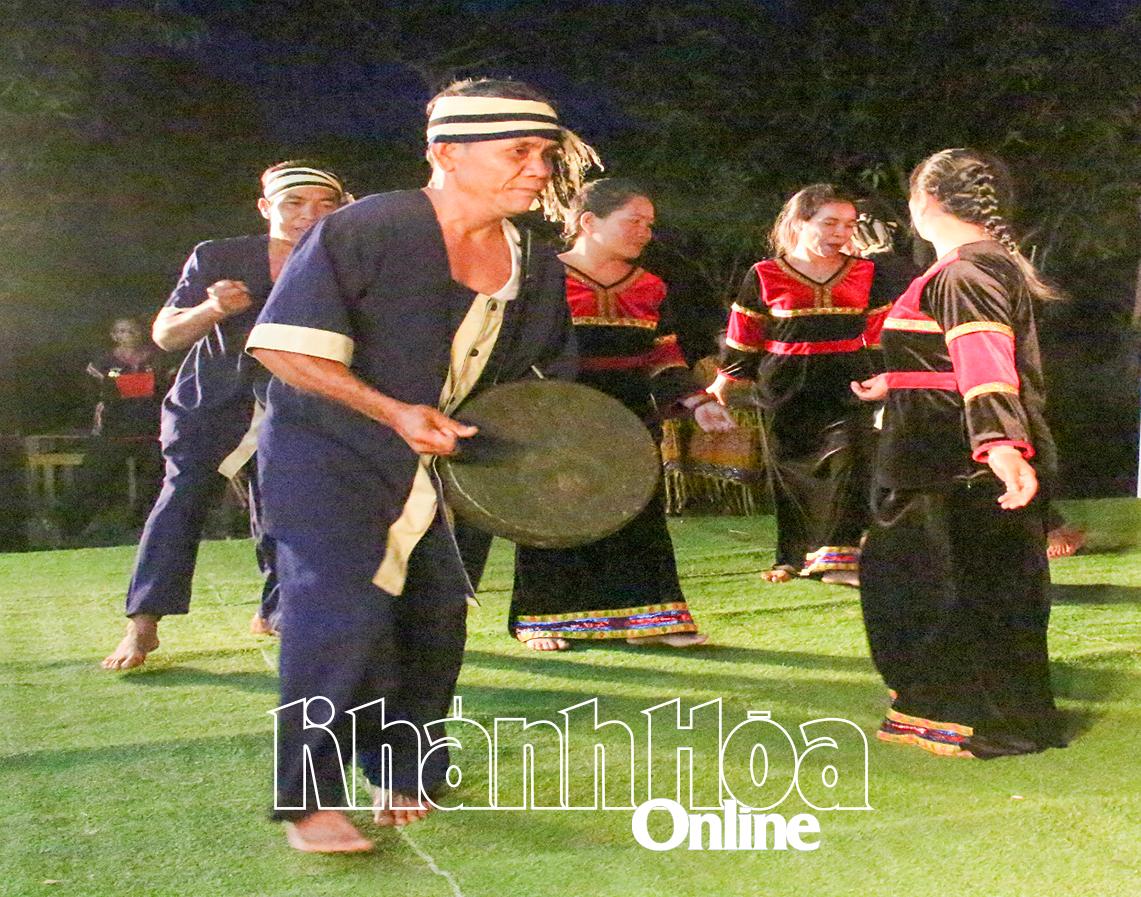 |
| Mr. Cao Van Nghiep performs on the ma la instrument. |
The more he watched, the more fascinated and enthralled he became, and his greatest desire at that time was to learn how to play the gong. Whenever the village elders were resting, he would often approach them to learn. Seeing his enthusiasm, the adults and elders in the village diligently taught him how to play the gong. Thanks to this, by the age of 15 or 16, Mr. Nghiep had mastered playing the gong and was able to join the village's gong team.
With his masterful skills in playing the ma la (a type of gong), Mr. Nghiep has performed in many places over the years, introducing tourists and locals to the traditional culture of his ethnic group. Originally a police officer in the district, since retiring, his joy has been intertwined with the ma la instrument. He dedicates much of his time to researching the instrument and the traditional melodies of the Raglai people. According to him, the sound of the ma la mimics the sounds of nature, carrying the essence of the mountains and forests, while the melodies originate from the daily lives of the people, such as: the song celebrating the new rice harvest, gathering wild vegetables, celebrating weddings, etc.
The Raglai people's ma la musical instrument possesses many unique characteristics. A set of ma la must consist of three or more pieces to be considered a musical instrument, because according to their beliefs, a set of three represents all the members of the family: mother, father, and child. Each piece in the ma la set has a different position and role. Another special aspect of the Raglai's ma la playing is that they don't use mallets; instead, they strike the pieces with their hands. Perhaps this is why the sound of the ma la is so resonant, like the breath and heartbeat of a person, sometimes deep and full of emotion, other times lively and echoing across the fields during festivals. Overall, however, the sound produced by the ma la is gentle and soft. The ma la is also combined with other musical instruments such as the sarakhen gourd horn and the sagor drum, creating a resonant sound that expresses a wide range of emotions.
Mr. Nghiep shared that, in the past, the ma la was a sacred and extremely precious musical instrument to the Raglai people. The sound of the ma la was indispensable in the traditional festivals of the ethnic group and in important life events. However, nowadays, the sound of the ma la is becoming less common in the life of the Raglai community. Therefore, preserving and promoting the ma la has been a long-standing concern of Mr. Nghiep. In recent times, Khanh Vinh district has implemented specific projects and activities to preserve and promote the traditional cultural values of ethnic minorities. These include providing ma la sets to the community, establishing folk culture clubs, and opening classes to teach the use of the ma la. Mr. Nghiep has also been invited to teach students how to play the ma la. He is very happy and strives to teach students, especially the younger generation, to contribute to transmitting, preserving, and promoting the cultural values of his ethnic community, so that the sound of the ma la will forever resonate in the mountains and forests.
MAI GIANG
Source: https://baokhanhhoa.vn/van-hoa/202504/de-tieng-ma-la-mai-ngan-vang-5403fd7/
![[Photo] Prime Minister Pham Minh Chinh receives the Director of RMIT University Melbourne (Australia)](https://vphoto.vietnam.vn/thumb/1200x675/vietnam/resource/IMAGE/2026/04/02/1775142120087_thiet-ke-chua-co-ten-2026-04-02t214220784-png.webp)





















































Comment (0)