

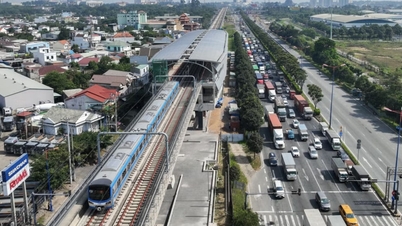
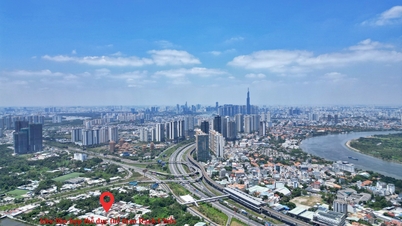
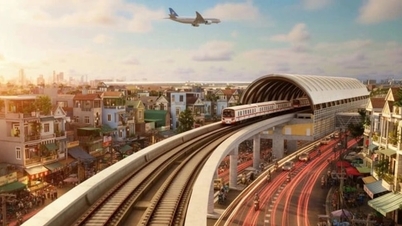
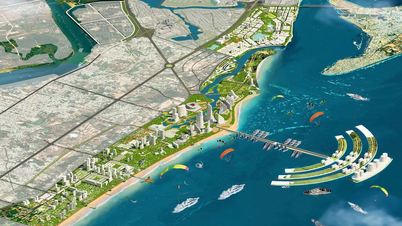
If Metro Line 2 is identified as the "backbone" to alleviate traffic pressure at the northwestern gateway, then the Can Gio Bridge will form a direct connection axis between this peninsula and the city center. Along with the Phu My 2 Bridge, the new bridge and road infrastructure will expand development space to the south, facilitating the restructuring of urban, industrial, and logistics functional areas.
To the east, the existing Metro Line 1 (Ben Thanh - Suoi Tien) will be upgraded by connecting with the Rach Chiec National Sports Complex - a multi-functional center serving large-scale sporting events, as well as developing services, conferences, and exhibitions for the city.
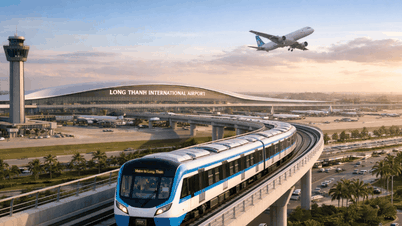
From a spatial perspective, with strategic projects being implemented simultaneously, all three directions—Northwest, East, and South—of Ho Chi Minh City are expanding, creating a satellite network (for the central core) while connecting the outskirts with the Southeast region. In terms of function, the bridges (Phu My 2, Can Gio) and roads (Metro) not only address road transport infrastructure but also contribute to completing the logistics network. Once the connecting routes from the South through Dong Nai to Long Thanh Airport are formed, the air transport and logistics network will be completed. This is without even mentioning the development of the maritime economy and seaports from Can Gio to Ba Ria - Vung Tau.
The Rach Chiec National Sports Complex project, in particular, plays a "balancing" role in Ho Chi Minh City's development strategy. Alongside large-scale transportation infrastructure projects, the synchronized investment in sports and high-quality services demonstrates the city's increased focus on the intangible values of a modern urban environment.
In the context of tourism development, especially MICE (Meetings, Incentives, Conferences, and Exhibitions) tourism, a world-class sports complex is essential preparation, creating a foundation for Ho Chi Minh City to participate more deeply in the international event chain.
These projects also clearly reflect the positive impact of the specific mechanisms and policies enacted by the National Assembly for Ho Chi Minh City in recent years. This breakthrough in mechanisms has created room for the city to be more proactive in mobilizing resources, organizing investment, and implementing infrastructure.
While Metro Line 1 was primarily funded by ODA (Official Development Assistance), the shift to using state budget funds for Metro Line 2 has helped resolve many procedural, land clearance, and funding issues, contributing to faster progress. At the same time, the participation of strategic investors and domestic private corporations in key transportation infrastructure projects demonstrates that the policy of developing the private sector is gradually being put into practice.
Even more remarkably, in addition to the four strategic projects mentioned above, on January 15th, a new "path" will be formed in the northern part of the city – the path of science and technology, of the knowledge economy and innovation. This is the Science and Technology City model, with its "headquarters" located right at the Becamex Group – formerly the new city of Binh Duong. The approach of placing the "brain of science, technology, and innovation" within a large-scale high-tech production zone in the northern and northwestern parts of the city demonstrates practicality and a priority on products that serve society.
When this center is surrounded by a system of next-generation science and technology industrial parks such as Riverside, Lai Hung, Cay Truong, and VSIP III, the cycle from research and development (R&D), testing, transfer to production and commercialization will be shortened to the maximum extent. This is a fundamental difference compared to models of science and technology development separated from production space, which are revealing many limitations in creating added value and disseminating technology.
Clearly, an increasingly distinct "division of roles" is taking shape: the central area continues to play the role of a financial center, high-end services, culture, and innovation hub; the northern area assumes the role of a research and development nucleus, training high-quality human resources, and innovation linked to high-tech manufacturing; while the strategic transportation infrastructure system is gradually covering the East-Southeast directions, creating a foundation for the balanced, sustainable, and long-term development of Ho Chi Minh City.
Source: https://www.sggp.org.vn/dinh-hinh-cau-truc-phat-trien-moi-post833311.html





















































































Comment (0)