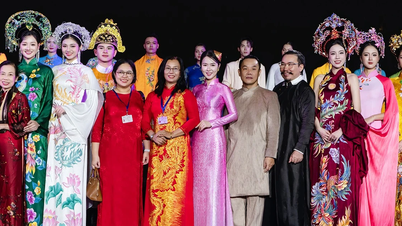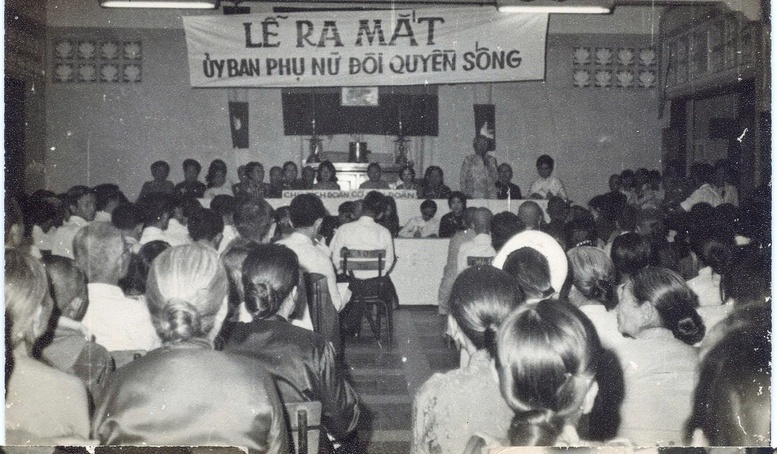
Launch ceremony of the "Women's Committee for the Right to Life".
The spirit of "serving sentient beings is offering to the Buddhas"
Venerable Nun Huynh Lien, whose real name was Nguyen Thi Tru, was born in 1923 in Phu My village, My Tho, Tien Giang province (now Dong Thap province), into a Buddhist peasant family. In 1943, at the age of 20, Nguyen Thi Tru entered the Buddhist monastery at Minh Su Buddhist Temple. Growing up in a country under French colonial rule, the young Nguyen Thi Tru could not remain indifferent to the daily hardships and suffering around her. In 1945, influenced by the revolutionary ideology of her uncle and responding to the call of President Ho Chi Minh , Nguyen Thi Tru joined the Viet Minh Front to seize power in her locality.
On April 1, 1947, Nguyen Thi Tru officially took her monastic vows at Linh Buu Temple with the Dharma name Huynh Lien. She received direct instruction from the Venerable Founder and was entrusted with the mission of guiding and leading the community of nuns. After the Founder's passing, she continued his aspirations, leading the community of nuns along the path of true Dharma. For over 40 years, she successfully established a system of 72 monasteries for the Vietnamese Buddhist nuns, gathering thousands of nuns and tens of thousands of followers.
In the 1960s, when the Ngo Dinh Diem regime implemented a brutal policy of discrimination and repression against Buddhism, Venerable Nun Huynh Lien, as the head of the Buddhist nuns' community, dedicated herself to the movement demanding religious freedom, civil rights, and democracy, spreading strongly throughout South Vietnam. Her vow became a guiding principle for an entire generation of dedicated nuns: "I vow to dedicate my entire life to the Dharma and to my homeland."
A turning point marking the comprehensive development of Venerable Nun Huynh Lien's patriotic activities was her participation in the founding and advisory role of the "Women Demanding the Right to Life" movement, chaired by lawyer Ngo Ba Thanh, launched at An Quang Pagoda on August 2, 1970, with its headquarters located at Ngoc Phuong Monastery (Go Vap). Under the abbess Huynh Lien's leadership, Ngoc Phuong Monastery became a "red address": a meeting place for patriotic organizations, a shelter for cadres, and a support base for relief efforts for the poor. The Women Demanding the Right to Life movement developed very rapidly after nearly a year of its establishment, gathering over 20 women's organizations, with Buddhist followers forming a crucial core force.
On October 18, 1970, Venerable Nun Huynh Lien made a significant impact by initiating the "Hair-Shaving for Peace" ceremony, using the hair of Buddhist nuns as a weapon of resistance against the war. Not stopping there, Venerable Nun Huynh Lien actively participated in vibrant activities and movements: from anti-American rallies to the announcement of the Ten-Point Declaration on Peace, expanding the united front, establishing branches of the movement in Can Tho and Tra Vinh, and connecting the strength of the entire Southwestern region of Vietnam.
Abbess Huynh Lien participated in building and leading organizations such as the People's Front for Peace, the Movement for the Right to Life of Orphans and Children Victims of War, and the Committee for the Improvement of Prison Conditions. She, along with the Ngoc Phuong Monastery system, was always a vanguard force in these organizations. In particular, she transformed the press into a sharp weapon through press conferences such as: "The People Demand Food and Clothing, Buddhism Demands Peace" and "Farmers Demand the Right to Life." Abbess Huynh Lien was one of the core members involved in the struggle to force the enemy to release lawyer Ngo Ba Thanh, and also coordinated with Catholic compatriots to denounce the US policy of aggression right at the Redemptorist Church; stood alongside students against the " militarization of schools"; and sided with workers at the Con O Battery Factory against exploitation. At the end of 1971, when the enemy brutally suppressed and imprisoned numerous leaders of the movement, the Abbess bravely took on the responsibility of continuing to steer the struggle.
During the period of 1971-1975, Ngoc Phuong Monastery was surrounded by barbed wire fences, guarded day and night by soldiers. Abbess Huynh Lien, undeterred by the danger, repeatedly crossed the barbed wire fences and gunfire to join other nuns in protest in front of the Saigon Opera House. The image of Abbess Huynh Lien leading the group, with young nuns holding hands to form a circle, shielding the mothers and wives of political prisoners from the intense pressure of the enemy, became an indomitable symbol of the solidarity and struggle of Vietnamese women in particular, and the Vietnamese nation in general. The people of Saigon were moved and honored Abbess Huynh Lien as "The Golden Lotus in the Red Fire."
In late 1974, facing a fierce siege of Ngoc Phuong Monastery aimed at confining and suppressing patriotic activities and eliminating the movement, the Venerable Nun decided to erect a makeshift pyre right in front of the monastery gate. This was a resolute message to the world: Buddhist nuns were ready to sacrifice themselves to protect justice and human rights. She also participated in organizing unique activities such as "Beggar Journalists' Day" and the "Reading the Newspaper to Tell My Compatriots" movement in Ben Thanh Market. All of this created a combined force that forced the enemy to concede to the legitimate demands of the people, contributing to the great victory of the nation on April 30, 1975.
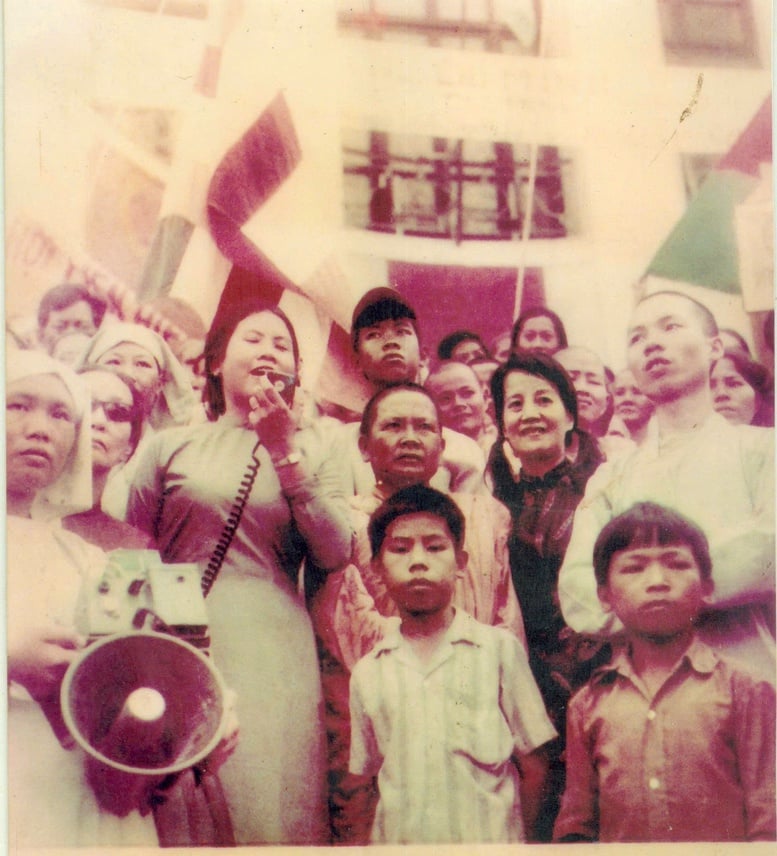
Abbess Huynh Lien (second row, second from the right) at the rally celebrating the Liberation of Southern Vietnam and the reunification of the country on May 1, 1975.
Abbess Huynh Lien was also a sensitive poetic soul and a learned translator, using her pen as a sharp weapon to both convey Buddhist philosophy to the common people and ignite the flame of patriotism in the hearts of every Vietnamese citizen. During the years of war, her poetry went beyond mere scriptures and became powerful calls to patriotism:
"When the enemy comes to the house, even women must fight."

The mirror of the Two Sisters sparkles like twinkling stars.
People today must fight against invasion.
We must achieve independence, just like our ancestors did."
She portrays the Vietnamese woman with the gentle, serene nature of a Buddhist heart and the indomitable spirit of a heroic nation:
"Vietnamese women are gentle but indomitable."
Living peacefully but resolutely resisting invasion.
The mother gave birth to a child who inherited the bloodline of heroes.
The mother taught the children to cultivate patriotism.
When the country was reunified, the pen of Venerable Nun Huynh Lien became a harmonious song of rebirth and altruism, encouraging monks, nuns, and Buddhists to participate in production and economic activities to become self-sufficient and contribute to the reconstruction of the nation.
"Holding a hoe in hand, chanting 'Nam Mô' (a Buddhist prayer)."
There is no separation between spirituality and worldly life.
Building a nation is also about building moral character.
"Let the lotus blossoms fill countless hearts with fragrance."

Representatives of Ngoc Phuong Monastery presented relics of Venerable Nun Huynh Lien to the Museum of the Vietnam Fatherland Front, October 2025.

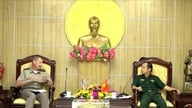
After 1975, Venerable Nun Huynh Lien was elected as a representative to the 6th National Assembly – the first National Assembly of a unified Vietnam.
Beyond her domestic activities, the Venerable Nun also carried Vietnam's message of peace to the world. She was sent to participate in many important international forums such as: the World Women's Congress in Berlin (German Democratic Republic), the World Congress of Religions for Peace in Moscow (former Soviet Union), and visited and strengthened friendship in Mongolia. At these forums, the image of the Vietnamese nun in her simple yellow robe became a bridge connecting the Vietnamese people's aspiration for peace with the world.
In addition to her responsibilities in Buddhist affairs, the Venerable Nun also held many other important positions such as: Member of the Central Committee of the Vietnam Fatherland Front (terms I and II), Member of the Central Executive Committee of the Vietnam Women's Union, Vice President of the Vietnam Fatherland Front Committee of Ho Chi Minh City, and Vice President of the Committee for World Peace in Ho Chi Minh City.
In every role she held, Venerable Nun Huynh Lien excelled in fulfilling her mission, serving as both a spiritual support for the nuns and a voice representing the interests of the people.
Venerable Nun Huynh Lien passed away on April 16, 1987, but her positive and humane spirit of "serving sentient beings is offering to the Buddhas" remains a guiding light for many generations of monks, nuns, Buddhists, and peace-loving people. Her life is a vivid manifestation of the aspiration for peace, tolerance, and the spirit of self-reliance and self-strength of the Vietnamese people and nation in the new era.
Thu Hoan
Source: https://baochinhphu.vn/doa-sen-vang-trong-lua-do-sai-gon-10226042610185877.htm