

On July 1st, Spain officially assumed the rotating presidency of the European Council (EC) for the next six months, amidst numerous domestic and regional challenges...
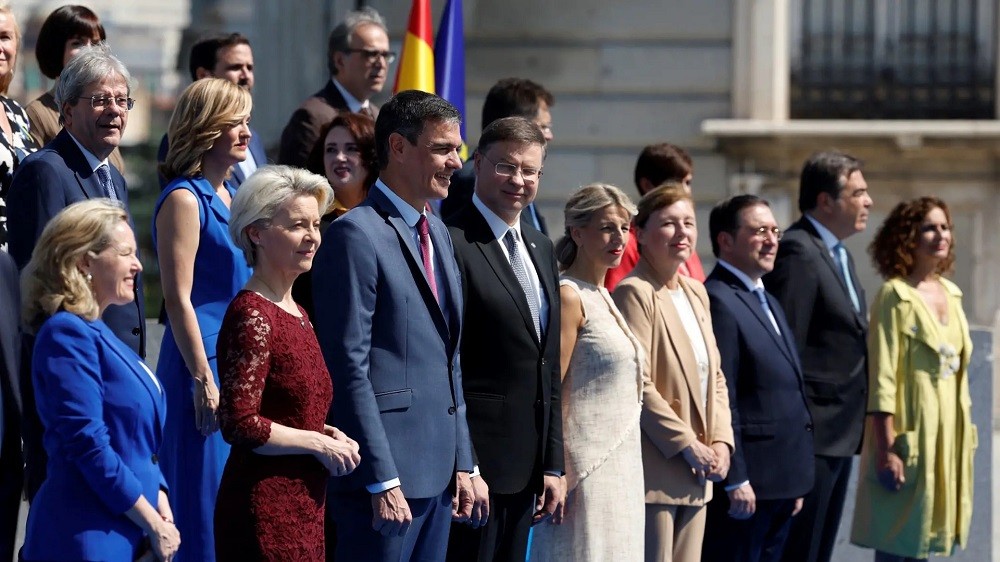 |
| Spanish Prime Minister Pedro Sanchez (top row, third from left) with members of the European Council (EC) in Madrid. (Source: EFE) |
Complex context
Spain assumes the rotating presidency of the European Commission amidst significant developments both domestically and regionally.
Domestically, Prime Minister Pedro Sanchez will face a general election at the end of July. As the leader asserted, "this is not the first time elections have taken place in a country holding the rotating presidency of the EC," including a change of government during this period.
In fact, in 2022, Emmanuel Macron held the rotating presidency of the EC while campaigning for the French presidency. Prior to that, the Czech Republic had witnessed significant government upheaval during its rotating presidency in 2009.
However, an election and the possibility of a government change early in the rotating presidency is a different story. Sanchez even delayed announcing his program to the European Parliament (EP) to focus on his election campaign. It is expected that either he or his successor will only appear to detail their agenda before the EP next September.
In this context, Spanish diplomats in the EU have repeatedly affirmed that regardless of the election results, the presiding country will still pursue its stated objectives as planned.
According to them, Madrid has spent months, even years, preparing for this occasion and is coordinating closely with Brussels and Budapest, the two rotating presidents of the bloc next year. In addition, Prime Minister Pedro Sanchez's People's Party (PP) still holds the advantage and is highly likely to win.
In the region, the European Union (EU) is facing many major challenges. The Russia-Ukraine conflict and its serious consequences are forcing the bloc to urgently address the difficult problems of security, economy, and energy.
Essentially, the EU has maintained a basic unity in its financial and military support for Kyiv, particularly in the counteroffensive by the Ukrainian Armed Forces (VSU). However, costly aid packages, Hungary's differing stance on Russia, Germany's caution regarding military aid, and the Eastern Bloc/Baltic attitude towards Ukrainian grain are challenging that unity to some extent.
| “This is not the first time elections have taken place in a country holding the rotating presidency of the EC. Changes in government (during this period) have also occurred before.” (Spanish Prime Minister Pedro Sanchez) |
Furthermore, finding a common, comprehensive, and effective European policy toward China will also be a complex task in the next six months. Previously, at the EU summit on June 30th, member states agreed on a "risk reduction" approach with Beijing. On the other hand, they affirmed they would continue to express their views on "hot" political issues with China, including calling on the Asian power to play a more proactive role regarding Ukraine.
That's not to mention a host of other issues that the EU and the country holding the EC presidency need to address soon, such as reviewing the mid-term budget for 2021-2027 and proposing new taxes, strengthening discussions on drafting laws related to artificial intelligence (AI) and cybersecurity, or proposing new initiatives on energy security, renewable energy, and addressing the projected increase in migration...
Strong domestically, firm internationally.
In this context, in terms of foreign policy, the country holding the EC presidency will maintain and promote the EU's current position, specifically on the Russia-Ukraine conflict and relations with China.
On the very first day of Spain's rotating presidency of the European Commission, Prime Minister Pedro Sanchez visited Ukraine, reaffirming the priority given to this issue. Speaking in Kyiv on June 1st with President Volodymyr Zelensky, he said: “The conflict in Ukraine will be one of our highest priorities during our presidency, focusing on ensuring a unified position among the members… Spain reaffirms its commitment to cooperate with Ukraine as it makes progress towards meeting the conditions for EU accession.”
Meanwhile, Spain enjoys good relations with China, and the two countries are currently celebrating the 50th anniversary of their diplomatic ties. Last March, Prime Minister Pedro Sanchez met with Chinese President Xi Jinping and attended the Boao Forum for Asia. Therefore, Madrid will leverage its good relationship with Beijing to promote the “risk reduction” approach mentioned by EC President Ursula von der Leyen at the end of June. Furthermore, Spain could become one of the driving forces encouraging China to play a more proactive role on the Ukraine issue.
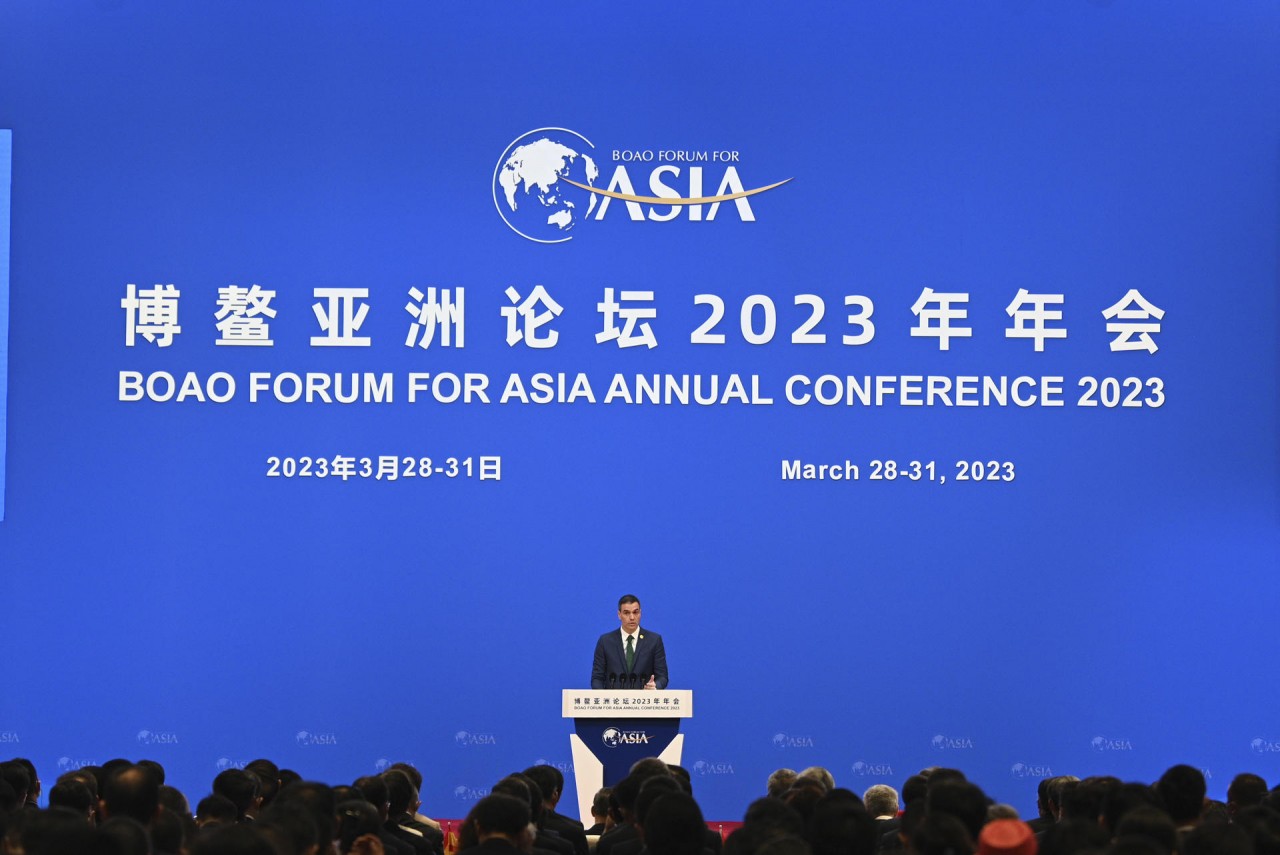 |
| Spanish Prime Minister Pedro Sanchez speaks at the Boao Forum for Asia in China at the end of March. (Source: Moncloa) |
Internally, Spain will strive to implement several reforms at the regional level. Senior researcher Federico Steinberg of the Royal Institute of Elcano (Spain) has outlined seven major priorities for Madrid, including: amending the public finance provisions in the Stability and Development Treaty; completing the Banking Union project; digitizing the Euro; conducting a mid-term review of the EU budget for 2021-2027; developing AI legislation; reforming the electricity market and implementing the Renewable Energy Directive; and expanding the concept of open strategic autonomy, strengthening relations with Latin American countries through the EU-Canadian Community of Latin American and Caribbean States (CELAC) summit in July, and even promoting a free trade agreement (FTA) with the Southern Market Community (Mercosur), Chile, and Mexico.
According to this scholar, Spain's goal at the EC over the next six months is to maintain the bloc's reform momentum of recent years, strengthen cohesion among members, deepen integration, and prepare the EU to confidently face increasing volatility and great power competition.
Source

![[Photo] National Assembly Chairman Tran Thanh Man working with the Standing Committee of the Law and Justice Committee](https://vphoto.vietnam.vn/thumb/1200x675/vietnam/resource/IMAGE/2026/05/21/1779378929214_ndo_br_1-4610-jpg.webp)


![[Photo] General Secretary and President To Lam presides over a working session with the Central Policy and Strategy Committee on the development of the materials industry.](https://vphoto.vietnam.vn/thumb/1200x675/vietnam/resource/IMAGE/2026/05/21/1779359935432_a3-bnd-3129-1412-jpg.webp)

























































Comment (0)