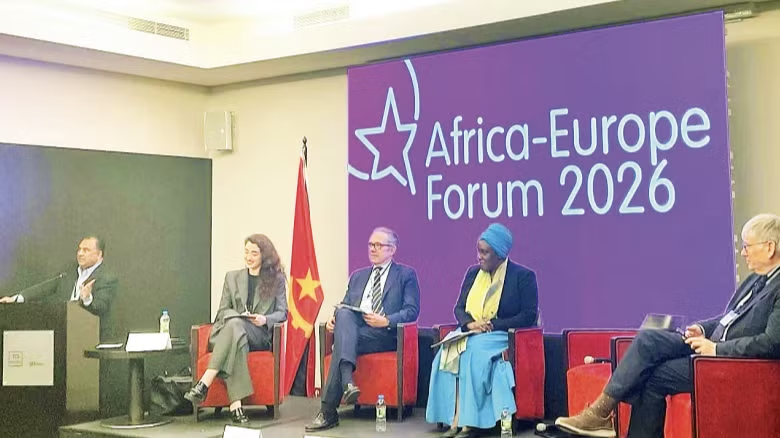
This highlights the need for enhanced cooperation between the two continents in digital governance .
A deepfake video of the President of Namibia, containing a speech condemning foreign exploitation of resources, went viral on social media in early June in several African and Caribbean countries, where knowledge of cybersecurity and awareness of the impact of AI-generated content remains low. The incident raised concerns about the ability to identify AI-generated content in a context where public understanding of this technology is limited.
Meanwhile, in Europe, where technology is booming, online manipulation is not immune. False claims spread online in 2025 that supermarket giant Lidl would cease operations due to economic pressures eroded consumer trust and negatively impacted the company's profits that year. Such incidents can cause serious damage to a company's reputation, erode public trust, and even result in financial losses.



Combating fake news is a pressing global issue. According to a report by the World Economic Forum (WEF), the global rate of deepfake content creation has skyrocketed by over 550% in just the last six years. These fake news campaigns cause approximately $39 billion in losses annually by reducing business market value and leading investors to make incorrect decisions, in addition to around $17 billion in losses from financial decisions based on inaccurate information.
According to the Brookings Institute, the AI market in Africa could reach nearly $20 billion by 2030, almost double its current size. To capitalize on this opportunity, the African Union has issued its 2024 Continental AI Strategy, while many countries such as Nigeria, Kenya, Ghana, and Rwanda are also developing their own AI strategies. Several countries, including Kenya, Nigeria, and South Africa, have enacted regulations to prevent the spread of misinformation through AI and cybercrime. However, experts believe that current regulations mainly focus on government oversight, while there is a lack of robust mechanisms to address disinformation campaigns carried out by private organizations or businesses. This is also a challenge facing many European countries.
Enhancing AI awareness in Africa not only helps unlock its economic potential but also strengthens institutions, improves governance capacity, and builds mechanisms for monitoring misinformation. Developing digital infrastructure will enable African nations to increase the value of their available resources and attract investment. Increased AI awareness in Africa also creates fertile ground for deeper economic cooperation with Europe.
Against this backdrop, the "Africa-Europe Digital Innovation Bridge 2.0" initiative, along with discussions on the European Union's long-term budget framework for 2028-2034, is expected to generate additional resources to promote technological cooperation, support digital transformation, and enhance the ability to respond to AI threats in both continents.
With a projected total budget of approximately €1.763 trillion, Europe has the opportunity to further develop a concrete plan to support the application of artificial intelligence in Africa. The reconsideration by policymakers in Europe and Africa of how to deepen technological cooperation, along with combating the shared threat of disinformation, will significantly contribute to the common prosperity of both continents.


Source: https://nhandan.vn/doi-pho-thach-thuc-tin-gia-post973749.html












![[GALLERY] Don't let AI lead you; will your trip still be your own?](https://vphoto.vietnam.vn/thumb/402x226/vietnam/resource/IMAGE/2026/07/06/1783303303112_tik-3-png.webp)