A WELL-PLANNED JOURNEY
In the last days of June, the atmosphere at the conservation facility in Tram Chim National Park became busier than usual. The animal enclosures were thoroughly cleaned, the water sources were carefully treated, and veterinary equipment was given a final check.

All efforts are directed towards ensuring the best possible conditions to welcome these "special friends" from Thailand to Dong Thap .
According to the plan, six red-crowned cranes, including two males and four females, approximately six months old, will be transported from Nakhon Ratchasima Zoo (Thailand) to Vietnam.
Immediately after completing the procedures at the airport, the cranes will be taken directly to Tram Chim National Park for quarantine and inspection as per regulations.
Thanks to the support of experts from the International Crane Foundation and experts from Thailand, the unit has gradually mastered the process of caring for red-crowned cranes. Currently, the first batch of 5 cranes are developing healthily and adapting well to the climate and living conditions at Tram Chim National Park. The weight of the individual animals ranged from 5.4 kg to 7.2 kg, meeting the requirements for each stage of development. Even more encouraging is that the cranes are gradually recovering their natural behaviors. The red color on its head became more pronounced, and its foraging, communication, flying, and movement activities became more frequent compared to when it was first acquired. DIRECTOR OF THE CENTER FOR CONSERVATION AND INTERNATIONAL COOPERATION |
To ensure the safety of the cranes throughout the transportation process, the People's Committee of Dong Thap province proactively coordinated with many relevant agencies and units.
Requests for assistance have been sent to the Customs Sub-Department of Region II, Tan Son Nhat International Airport, and other relevant agencies to facilitate customs clearance and transportation.


Because, for rare wild animals, the shorter the travel time, the lower the risk to their health.
Therefore, Dong Thap province also requested that specialized vehicles be allowed to access the cargo area, quickly transport the cranes onto vehicles with air conditioning, and maintain a stable environment before moving them to Tram Chim National Park.
The seamless coordination between the functional agencies of Dong Thap, the customs, aviation, animal quarantine, and conservation experts shows that bringing the red-crowned crane back is not just a story for Dong Thap alone, but a joint effort of many units working together to preserve biodiversity.
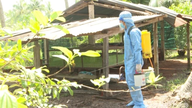
At Tram Chim National Park, preparations have been underway for several weeks. The enclosure system, including the young crane area, breeding area, semi-wild area, and veterinary isolation area, has been reviewed and completed. The isolation areas have been disinfected, sterilized, and the water sources treated according to professional procedures.
According to Mr. Dinh Huu Hoa, a technical staff member directly involved in caring for red-crowned cranes at the Tram Chim National Park Conservation Center, many specialized devices for monitoring, identifying individuals, providing first aid, and caring for the cranes have been fully prepared.
These specialized leg bands are provided by the International Crane Foundation to facilitate long-term management and monitoring.
In addition to preparing the infrastructure, the caretakers proactively improved the living environment to be as close to nature as possible. Many areas were supplemented with wild rice and reeds; at the same time, fish, snails, crickets, and native organisms were introduced to create a natural food source for the cranes.
"SWEET FRUITS" FROM PERSEVERANCE
The proactive approach of Tram Chim National Park in receiving the first flock of cranes did not stem from expectations, but was built upon the practical results achieved after more than a year of caring for them.

In April 2025, the first red-crowned cranes were brought from Thailand to Tram Chim National Park, attracting special attention from scientists and nature lovers. At that time, many people had high hopes, but not a few were worried about the red-crowned cranes' ability to adapt to the new conditions.
According to Mr. Dinh Huu Hoa, following recommendations from Thai experts, Tram Chim National Park has gradually reduced the proportion of industrial feed, replacing it with natural food sources such as small fish, crickets, froglets, rice worms, and water chestnuts, a type of food that was once associated with red-crowned cranes in their natural environment.
It's not just about changing their diet; it's also about helping the cranes gradually restore their survival instincts, relearn how to forage, and adapt to a semi-wild environment.
Notably, the first batch of cranes has now formed two paired couples and has been placed in a separate breeding area. According to the project's roadmap, from 2027-2028, these crane pairs could enter their breeding period and lay their first clutches of eggs right here at Tram Chim National Park.
For conservationists, this is a particularly significant signal. The ultimate goal is not just to nurture healthy individuals, but also to create a population capable of sustainable reproduction and development, and gradually re-establishing itself in the wild.
KEEP YOUR "PROMISE" TO NATURE

There was a time when flocks of red-crowned cranes appeared on the sedge grasslands of Tram Chim National Park every dry season, becoming a familiar sight in the Dong Thap Muoi region.
The absence of this rare bird species over the past years is not only a loss of biodiversity, but also a reminder of our responsibility to protect wetland ecosystems.
Therefore, the Red-crowned Crane Conservation and Development Project in Tram Chim National Park for the period 2022-2032 is not simply a program to conserve a rare bird species, but also an effort to restore the ecosystem, preserve natural values, and safeguard a part of Dong Thap's identity.
That journey was not easy; from habitat restoration and infrastructure preparation to human resource training, receiving, caring for, and restoring the natural habits of the cranes, it all required time, resources, and perseverance.
For over a year, conservationists have been quietly caring for each crane with utmost dedication.
Today, as Tram Chim continues to welcome new members, the hope that the red-crowned cranes will once again spread their wings across the skies of Dong Thap seems closer than ever.
MY LY
Source: https://baodongthap.vn/dong-thap-mien-dat-lanh-don-seu-tro-ve-a242430.html
![[Photo] General Secretary and President To Lam attends the Central Public Security Party Committee Conference](https://vphoto.vietnam.vn/thumb/1200x675/vietnam/resource/IMAGE/2026/06/24/1782302063612_a1-bnd-9302-9166-jpg.webp)

![[Photo] The 13th National Congress of the Youth Union conducts personnel work.](https://vphoto.vietnam.vn/thumb/1200x675/vietnam/resource/IMAGE/2026/06/24/1782299943080_ndo_br_1-6868-jpg.webp)
![[Photo] Opening Ceremony of the 13th National Congress of the Ho Chi Minh Communist Youth Union](https://vphoto.vietnam.vn/thumb/1200x675/vietnam/resource/IMAGE/2026/06/24/1782286753905_ndo_br_1-8510-jpg.webp)

![[Infographic] 9 groups of people whose basic salary will increase from July 1, 2026](https://vphoto.vietnam.vn/thumb/402x226/vietnam/resource/IMAGE/2026/06/24/1782293974496_infographic-9-nhom-doi-tuong-duoc-tang-luong-co-so-tu-1-7-202620260624040844.webp)