Telling cultural stories through paper.
The project idea originated from the team's project work and field surveys. While visiting various areas in Hanoi, such as the Old Quarter, cultural sites, and historical monuments, the team realized that Vietnam possesses many unique architectural and landscape values, but lacks innovative products that allow the public to access them in a technologically advanced way, suitable for modern life. From this gap, the team came up with the idea of recreating Vietnamese landmarks and cultural symbols using 3D paper-engraved lamps, combining AR and NFC technology to expand the experience via mobile phones.
Despite having many material options, the group decided to use paper as the primary material. Paper, though simple, possesses immense visual expressive power. When cut into multiple layers and combined with light, it creates a sense of depth, making viewers feel as if they are looking at a miniature 3D space rather than a flat surface. The bridge, tiled roof, street, or lake, recreated through multiple layers of paper, becomes a scene with varying depths and contrasts of light and shadow.
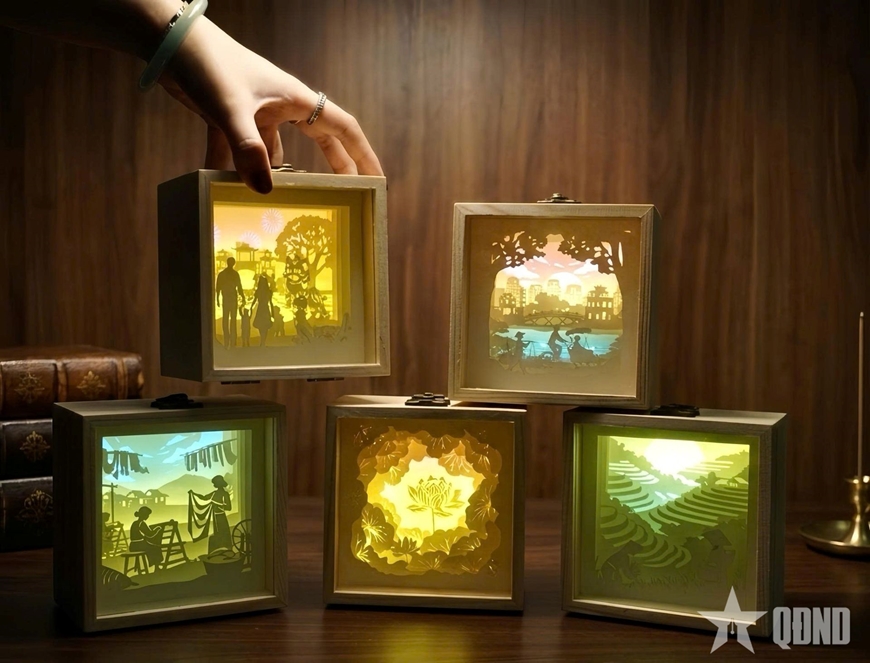 |
Vietnamese cultural elements are incorporated into the visual space byFPT University students. |
Beyond its technical aspects, paper also holds symbolic value. It's a familiar material in Vietnamese life, appearing in folk paintings, handicrafts, and many traditional products. Paper evokes a sense of simplicity, subtlety, and intimacy. Choosing the right paper also signifies maintaining a restrained, understated yet emotionally rich spirit.
This material forced the team to carefully select images. It was impossible to include every architectural detail in the model; instead, they had to choose the most distinctive features to express the "soul" of the landmark. This process helped create a concise product, avoiding visual clutter and ensuring aesthetic appeal.
Create a model on paper, expand it with technology.
The team started the project in January 2025, focusing on surveying landmarks, finding suitable imagery, and developing an overall concept. They then proceeded to design the layout, select distinctive details, create blueprints, and test multiple versions to optimize space, lighting, and color.


Alongside the design, the team integrated technology to enhance the viewer experience. Specifically, the product utilizes AR (augmented reality – when a phone is held up, a 3D video about the cultural story behind the product appears, superimposed on the real model) and NFC (simply touching the phone to the model opens a website to view related videos). Thanks to this, from a static paper model, viewers can interact and explore multiple layers of content directly on their phones, making the experience more vivid and intuitive.
The selection of landmarks was based on criteria such as cultural value and symbolism; visual recognizability; and suitability for a multi-layered design to create depth. Before creating the models, the team thoroughly researched the history and architecture of each landmark to ensure accuracy and avoid errors.
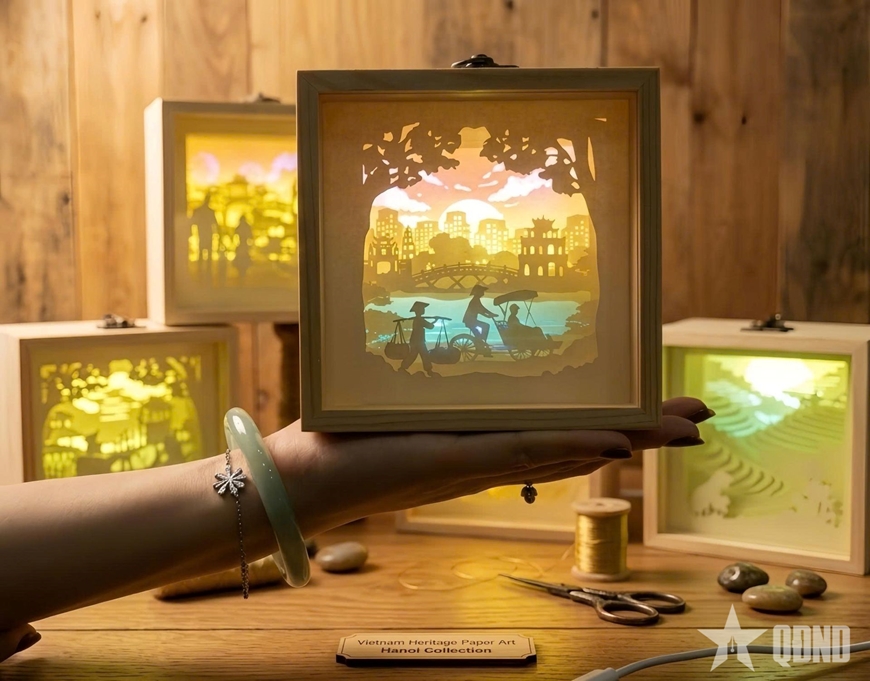 |
The Hanoi Old Quarter model is popular with many customers. |
Among the completed projects, the model of Hanoi's Old Quarter left the strongest impression. The design was constructed using a forward-to-backward composition. In the foreground are everyday scenes such as cyclo drivers, street vendors, and street activities – details that evoke the characteristic rhythm of life in the Old Quarter. The middle ground includes the water, a bridge, and familiar landmarks like the Turtle Tower and The Huc Bridge, making it easy for viewers to recognize the Hoan Kiem Lake area. In the background are modern buildings, creating a contrast between tradition and development. Above are the trees and the sky, helping to balance and soften the overall effect.
Lighting is a key element that makes the model so captivating. When the light source is placed behind it, the layers of paper appear in warm tones, creating the feeling of a slice of Hanoi at night. Even in a compact space, viewers can still perceive the cultural depth and the rhythm of urban life.
Challenges and future directions
According to Trinh Luu Ly, the design team leader, "A complete model can take from a few hours to a day, including design, layering, assembly, and lighting. The biggest challenge is maintaining distinctive details while ensuring a sturdy structure. Paper has limitations in terms of durability and complexity, so the team had to keep it minimalist without losing its identity."
 |
Customers experience the products displayed at Lotte Mall West Lake Hanoi. Vietnam encourages US businesses to expand investment in high technology.On the morning of June 26th, at the Government Headquarters, Deputy Prime Minister Ho Quoc Dung received Mr. Jeff Place, Supply Chain Director of Coherent Group (USA). During the meeting, the Deputy Prime Minister affirmed that Vietnam encourages US businesses to expand investment, especially in high-tech, innovation, and semiconductor industries.  Encourage U.S. businesses to expand investment in high-tech sectors.Deputy Prime Minister Ho Quoc Dung said that Vietnam welcomes US businesses to continue expanding their operations in Vietnam, especially in high-tech industries and sectors with high added value.  Vietnam and the United States strengthen cooperation in addressing the consequences of war.VTV.vn - On June 22, General Secretary and President To Lam received Acting Secretary of the US Navy Hung Cao. |
Currently, the group uses art paper of suitable thickness and is researching more environmentally friendly materials such as recycled paper. According to the group, using paper also sends a message that simple materials can still create creative value if utilized correctly.
In the future, the group hopes to expand the collection to include more traditional landmarks and festivals, while also developing more digital content through AR. Through "Vietnamese Paper Soul," they want to convey the message that traditional culture is not distant. When viewed from a creative perspective and combined with technology, culture can become more vibrant and accessible to the younger generation. From thin layers of paper, a grand story unfolds. The story of how young people continue and renew tradition using the language of their time.
Source: https://www.qdnd.vn/van-hoa/doi-song/dua-van-hoa-viet-vao-khong-gian-giay-1031334
![[Photo] "Hanoi Lotus Festival" honors the lotus flower that has been associated with Vietnam for thousands of years.](https://vphoto.vietnam.vn/thumb/1200x675/vietnam/resource/IMAGE/2026/06/27/1782516943048_sen-ha-noi-2026-minh-duy-1-jpg.webp)




![[Photo] "Hanoi Lotus Festival" honors the lotus flower that has been associated with Vietnam for thousands of years.](https://vphoto.vietnam.vn/thumb/402x226/vietnam/resource/IMAGE/2026/06/27/1782516943048_sen-ha-noi-2026-minh-duy-1-jpg.webp)