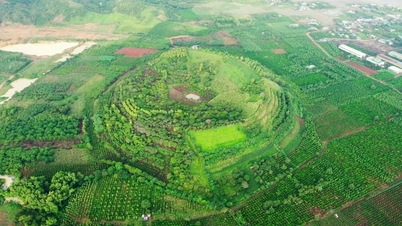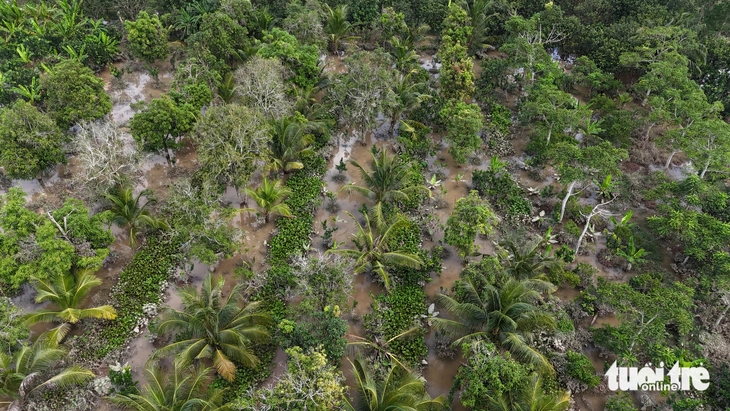
Landslides on Thanh Long sandbank flooded 15 hectares of fruit orchards, directly affecting the production and daily lives of local households - Photo: HOAI THUONG
Because it's not just a story about dealing with a landslide on a sandbar, but also a problem of how to manage resources in the context of climate change, sediment depletion, infrastructure development pressure, and the need to implement the Politburo 's major policy on preventing and combating subsidence, landslides, flooding, drought, and saltwater intrusion in the Mekong Delta, as outlined in Conclusion No. 26.
Decisions based on practical experience?
The conversion of Thanh Long islet, located on the Co Chien River in Quoi Thien commune, Vinh Long province, from a natural sandbar into a sand mine for exploitation is attracting considerable public attention.
There have been many conflicting opinions. Supporters argue that the authorities' decision stems from the reality of continuous landslides in the area, and that "trying to prevent" them would be costly and wasteful. Therefore, they believe it's better to follow the natural course and also allow for the extraction of sand to supplement the scarce construction materials on the market.
Over the years, the Mekong Delta has continuously faced increasingly serious erosion. The Tien and Hau rivers have developed many deep whirlpools, their course has changed, and landslides frequently occur, sweeping away houses and property of the people.
Meanwhile, the demand for construction and leveling sand to serve key transportation projects in the region is increasing very rapidly.
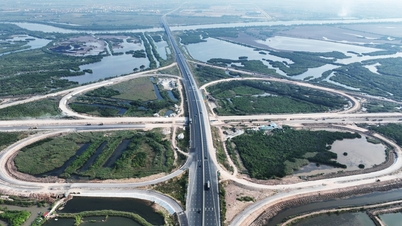
The expressways under construction in the western region require a huge amount of sand for leveling. Limited supply and high sand prices are causing difficulties for many localities in finding the necessary materials for the projects.
In this context, utilizing the sand from Thanh Long sand dune can be seen as a temporary solution to both address the landslide area and contribute to supplementing the supply of construction materials.
But the question is, is this the optimal solution for the long-term future of the delta? Scientists call subsidence and erosion the "river thirst, water scarcity" phenomenon. This is the inevitable consequence of a series of cumulative negative causes.
The delta is starving for alluvial soil.
The worrying thing is that the Mekong Delta is no longer in its natural state as it once was. The hydroelectric system upstream of the Mekong has drastically reduced the amount of sediment reaching the delta. Prolonged sand mining has caused many sections of the riverbed to dry up.



Landslides are occurring more frequently, on a larger scale, and are becoming more difficult to predict. The delta is gradually losing the very material that once formed this fertile region.
In this state, any intervention in the riverbed needs careful consideration. Because sandbars, islets, or floodplains in the Mekong River system are not simply landmasses rising from the river. They are part of a natural dynamic structure, contributing to the dispersion of flow, retention of sediment, and relative stability of the riverbed morphology.
Of course, not all sandbars need to be preserved at all costs. Some sandbars may continue to erode or disappear naturally. But what is concerning is that this disappearance is no longer entirely "natural," but is influenced by a combination of factors: lack of sediment, sand mining, climate change, and pressure from infrastructure development.
That is why many experts fear that if we continue to view the eroding sandbars as a "resource of sand that can be exploited," the delta could fall into a vicious cycle of sand shortage - increased exploitation - river imbalance - more severe erosion, and then further exploitation to address the problem.
The biggest paradox facing the Mekong Delta today is that it is lacking the very materials that created it.
"Following nature's will" cannot be just a slogan.
It is noteworthy that the story of Thanh Long islet unfolds against the backdrop of the central government setting very high demands for sustainable development in the Mekong Delta.
The previous Government Resolution 120 and the more recent Politburo Conclusion 26 both emphasize the spirit of "harmonizing with nature," proactively adapting to climate change, drought, saltwater intrusion, subsidence, and landslides. The core principle of these policies is that development must go hand in hand with protecting the natural structure and ecological security of the delta.
"Following nature's natural order" doesn't mean avoiding intervention in nature, but rather intervening with a fuller understanding of the ecosystem's carrying capacity.
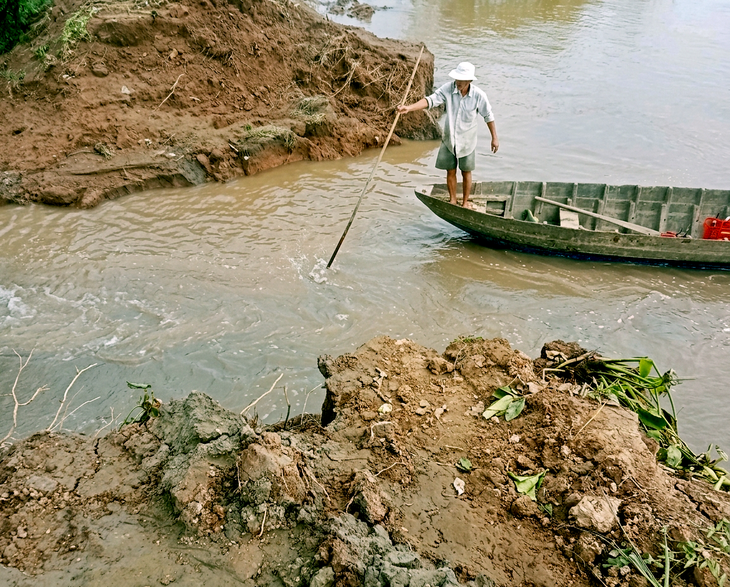
Thanh Long islet continues to erode - Photo: HOAI THUONG
Regarding Thanh Long islet, the most important thing right now is perhaps not to debate right or wrong in an absolute sense, but to clarify the scientific basis for the decision to exploit it.
Have hydrodynamic assessment models been developed? How would lowering or removing the sandbar impact flow, erosion, and the surrounding ecosystem? Is this the optimal choice or merely a viable short-term solution?
More importantly, this story shows that the Mekong Delta urgently needs a new approach to river resources. It's no longer feasible to manage sand resources solely based on the needs of individual projects or localities. The delta needs a regional sand resource strategy with interconnected data, assessments of exploitation carrying capacity, and an independent scientific review mechanism for major interventions in the river system.



Many countries around the world have paid a heavy price for long-term overexploitation of river resources. The current trend is to restore ecosystems, "giving way to the river" instead of continuing to exploit the remaining natural resources.
The Mekong Delta certainly needs infrastructure development. But the delta also needs to preserve its ecological foundations in order to survive and thrive in the future.
The message conveyed in Conclusion 26 is not only about responding to landslides or climate change with engineering solutions, but also about the need to change development thinking: from exploitation to conservation, from passive response to proactive governance, and from localized treatment to a whole-region ecosystem approach.
Thanh Long Island may continue to change according to the river's course. But more importantly, after each such decision, will the Mekong Delta move closer to a truly sustainable and "nature-friendly" development model?
This is not just a story for Vinh Long alone, but a major question for the entire future of the Mekong Delta today.
Source: https://tuoitre.vn/dung-de-dong-bang-an-chinh-minh-20260605231650688.htm

![[Image] National conference summarizing one year of operation of the overall organizational model of the political system, the three-tiered government model.](https://vphoto.vietnam.vn/thumb/1200x675/vietnam/resource/IMAGE/2026/07/01/1782882811691_ndo_br_1-jpg.webp)