


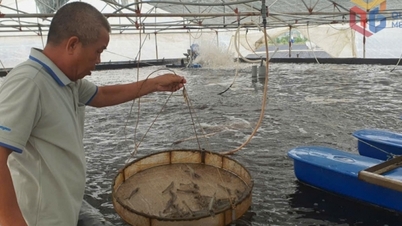
The Sin Ho Highland Fisheries Cooperative (Ma Sao Phin village, Sin Ho commune) currently has a large quantity of sturgeon that cannot be sold due to low prices.
A somber atmosphere prevails in the sturgeon farming area of the Sin Ho Highland Aquaculture Cooperative (Ma Sao Phin village, Sin Ho commune). Dozens of fish ponds are ready for sale, but there is no market. With an investment of over 10 billion VND, the cooperative supplies over 100 tons of commercial sturgeon annually, providing stable employment for 6 local workers. Mr. Phi Van Cuong, the cooperative's director, said: "Currently, we still have 50 tons of sturgeon that we cannot sell. The cost of maintaining the feed alone is over 10 million VND per day, not including labor and other unforeseen expenses. We have had to reduce the amount of feed for the fish from 3 meals to 1 meal per day."
What worries Mr. Cuong and many other cold-water fish farmers in the province is the paradox of the market. Sturgeon raised in Lai Chau is highly regarded for its quality, with firmer, more flavorful meat than sturgeon imported from across the border. However, due to the lack of clear differentiation in origin, the products are treated equally in terms of price. Consumers find it difficult to distinguish, while farmers suffer losses, being forced to accept lower prices and struggling to compete. "We only hope that relevant authorities will soon implement measures to trace the origin, clearly distinguish quality, and determine prices. When consumers understand and make smart choices, domestically produced sturgeon will have a chance to be on the tables of families, restaurants, and hotels," Mr. Cuong hoped.
In Chu Va 8 village (Binh Lu commune), there are over 200 households raising sturgeon. Previously, many trucks came and went to buy sturgeon, and the people were busy with related tasks. Now, the price of sturgeon has dropped to around 100,000 VND/kg, and the buying and selling atmosphere remains very sluggish. This has led large-scale fish farmers to only feed their fish sparingly, hoping that prices will rise in the coming days. Some small-scale farmers have had to sell off their fish at 70,000 VND/kg to cover feed costs and interest on bank loans taken out for investment.
Ms. Nguyen Thi Ha's family in Chu Va 8 village invested in raising over 20,000 sturgeon fingerlings in 15 tanks. Every year, when the fish reached a weight of 1.7 kg or more, traders would come to buy them at prices exceeding 200,000 VND/kg. Now, about 15 tons of fish remain in the tanks, past their marketable age. Ms. Ha confided: “My family, like other households in the area, saw the potential for investing in sturgeon farming, so we boldly borrowed money from the bank and relatives to invest. This profession has helped my family escape poverty. But when we expanded the scale and increased the number of fish raised, the selling price dropped too low. Now, I not only have the money from the old loan but I'm also having to borrow more from the bank to maintain the remaining sturgeon stock. I hope the local government and relevant provincial agencies will soon find solutions to help sturgeon farmers extend their loan terms or offer preferential interest rates, as well as clearly distinguish between products raised within the province and those imported from elsewhere.”
According to statistics from the Provincial Department of Livestock and Veterinary Medicine, the province currently has approximately 197 establishments with over 1,290 cold-water fish farming tanks. Cumulative production is estimated at 330 tons by August 2025, with a projected target of 590 tons by the end of 2025. Most of the planned cold-water fish farming areas, especially for sturgeon, are located in highland areas with cool climates and inhabited by ethnic minorities. Sturgeon farming has helped many households escape poverty in recent years. However, sturgeon prices are continuously falling, the market is unstable, and the cost of feed and fish disease treatment is increasing. Meanwhile, Lai Chau sturgeon is mainly consumed domestically and lacks a collective brand or geographical indication. Most farming households operate independently and in a fragmented manner, depending on traders. There is no deep processing chain or long-term supply contract, causing many households that invested billions of dong to face hardship and the risk of losing everything.
Faced with a surplus of sturgeon and a sharp drop in prices, provincial authorities have begun taking action. Mr. Nguyen Thanh Dong, Deputy Director of the Department of Agriculture and Environment, stated that the Department is directing specialized units to urgently inspect and reassess the entire situation; coordinate the calculation and balancing of production costs to propose consumption plans if necessary. In addition, they are strengthening inspection and control of the origin of sturgeon fry and commercial fish, and ensuring traceability. They are advising farms to select high-quality fry, apply comprehensive disease prevention and treatment measures, and choose feed suitable for each stage of farming to reduce production costs. They are also recommending the use of social media platforms to promote and introduce products, expand distribution channels, combine wholesale and retail sales, and balance product costs with market prices to avoid prolonging the farming period when the fish are ready for harvest. These are necessary steps to help stabilize production and consumption in the context of a volatile market.
Source: https://baolaichau.vn/kinh-te/gia-ca-tam-lien-tuc-giam-641320



















































































Comment (0)