The journey of preserving and spreading
In 1966, while the country was still engaged in the war against the US, the Vietnam Fine Arts Museum was officially established. This event marked the birth of the first specialized art museum on a national scale, and simultaneously demonstrated a profound cultural mindset: under any circumstances, art must be preserved as a core part of national identity. Looking back today, the establishment of an art museum amidst wartime was not simply a cultural management decision, but a choice of symbolic significance. The country may face bombs and bullets, but the artistic memory of the nation cannot be broken.
The foundation for the Vietnam Fine Arts Museum was laid by painter and art researcher Nguyen Do Cung. For many years, he diligently researched, collected, and pursued the idea of building a national fine arts museum. With his profound understanding of the nation's visual heritage, he and his colleagues quietly built the first foundations for a place to preserve the values of Vietnamese fine arts. From that beginning, many generations of officials, experts, researchers, and staff of the Museum have continued to nurture it, making it the largest art treasure trove in the country.
Over six decades, the Vietnam Fine Arts Museum today manages more than 21,000 artifacts and artworks, reflecting the development of Vietnamese art from ancient times, folk art, the modern era, to the contemporary era. Each artifact and artwork possesses both artistic value and preserves a historical snapshot, an aesthetic mindset, and a part of the nation's spiritual memory. These could be ancient Buddha statues with the serene beauty of Ly-Tran dynasties' sculpture, folk paintings reflecting traditional cultural life, or modern paintings marking the great changes in the country during war and peace.
“Preserving the past is not about letting the past stand still, but about allowing artistic values to continue to engage in dialogue with today and inspire the future,” shared Dr. Nguyen Anh Minh, Director of the Vietnam Fine Arts Museum, regarding the overarching spirit throughout the museum's development. While the early years were a period of laying the foundation, the following decades have been a quiet but persistent journey of collecting, preserving, and promoting the value of national fine arts heritage.
Behind the familiar exhibition spaces lie less-seen but fundamental tasks: inventorying, scientific documentation, preservation, repair, and restoration of artifacts. In the field of fine arts, the materials used in artworks are incredibly diverse, ranging from lacquer, silk, and dó paper to wooden sculptures, bronze, and ceramics. Therefore, conservation requires deep expertise and almost absolute meticulousness. Many valuable works have been rescued and restored to prolong their lifespan, preserving their artistic essence and historical value. These silent efforts are what give a national museum its depth.
Besides its functions of preservation and display, the Vietnam Fine Arts Museum is gradually affirming its role as a center for fine arts research. Scientific works, thematic seminars, books, proceedings, and exhibition catalogs are regularly produced, supplementing important resources for researchers and art enthusiasts.

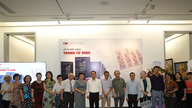
Over the years, the Museum has also become a familiar venue for academic gatherings, where artworks are admired with aesthetic emotion, interpreted, analyzed, and placed in broader contexts with national history and culture. Thus, the Vietnam Fine Arts Museum is no longer simply a place for storing artifacts, but has become a space for preserving cultural memory through the language of visual art.

Modern yet rich in character
Looking back over its 60-year journey, the period from 2016 to 2026 can be considered one of the most significant periods of innovation for the Vietnam Fine Arts Museum. In the context of digital transformation, international integration, and rapidly changing public needs for cultural access, the Museum has made significant strides, from its operational mindset to its community engagement. The understanding of the museum's role has also changed: preserving artifacts is no longer its sole function; museums need to become spaces for experience, education , and inspiration.
Over the past ten years or so, hundreds of exhibitions, thematic displays, seminars, art workshops, and educational programs have been organized. Exhibition spaces have been reorganized to be more scientifically sound, increasing interaction and allowing viewers to engage with art through multiple senses. Programs for families, students, and young people are increasingly appearing; Art Talk activities, creative experiences, and art workshops have helped to lift art out of the sense of distance that once existed among some segments of the public.
A noticeable change is that more young people are visiting the museum. From being seen as a relatively quiet space, focused on research, the Vietnam Fine Arts Museum is gradually becoming a cultural destination. According to museum statistics, the number of visitors has increased by more than 300% compared to about 5 years ago, with Vietnamese visitors accounting for about 50%. This is a sign that fine arts are getting closer to community life. "The most important point is not the number of visitors, but the fact that the public has begun to see the museum as an accessible cultural space where they can learn, experience, and find inspiration," Mr. Nguyen Anh Minh observed.
Another notable milestone in the past decade has been digital transformation. For many years, museums were often considered relatively "slow" in the face of technological advancements, but the Vietnam Fine Arts Museum has shown remarkable progress. In 2021, the iMuseum VFA multimedia audio guide application was launched, supporting multiple languages and allowing visitors to proactively access information about exhibits. This is a significant step in personalizing the visitor experience.
In 2023, the VAES online art exhibition space was launched, becoming the first online art exhibition model in Vietnam. With dozens of exhibitions already held, VAES opens up access without geographical or time limitations. Viewers anywhere can access artworks, visit exhibitions, and connect with Vietnamese art. Winning the Vietnam Digital Transformation Award twice for iMuseum VFA and VAES is recognition of their technological achievements and demonstrates a significant shift in mindset: Heritage needs to be disseminated through the new languages of the modern era.



At its 60th anniversary, the Vietnam Fine Arts Museum is embarking on a new chapter. The project to build a Center for Restoration, Renovation, and Contemporary Art Exhibition, scheduled to begin in 2026, reflects a long-term vision: preserving values passed down through generations while simultaneously opening up space for contemporary creativity. This is coupled with a focus on improving professional quality, continuing digital transformation, innovating exhibition content, expanding international cooperation, and developing high-quality human resources.
Six decades is a proud milestone for a cultural institution that has persistently preserved, developed, and renewed itself. Amidst the ever-changing pace of modern life, the Vietnam Fine Arts Museum quietly safeguards the artistic values of the nation, while simultaneously seeking to retell that heritage in a language more accessible to today's public.
As a result, art does not remain dormant in glass cases, but continues to be present in the emotions, thoughts, and spiritual lives of the community. This journey also shows that preserving heritage is only truly meaningful when the values of the past continue to be received, spread, and promoted in contemporary life.
Source: https://baovanhoa.vn/van-hoa/gin-giu-hon-dan-toc-lan-toa-gia-tri-nghe-thuat-239674.html

![[Photo] A phone-free summer afternoon at the village library](https://vphoto.vietnam.vn/thumb/1200x675/vietnam/resource/IMAGE/2026/06/27/1782551770949_anh-1-jpg.webp)

![[Photo] Thousands of people participate in a run to show their support for the campaign "Sharing a common determination to build drug-free communes, wards, and special zones".](https://vphoto.vietnam.vn/thumb/1200x675/vietnam/resource/IMAGE/2026/06/27/1782554475933_0673e2a3df7b5e25076a-8283-jpg.webp)