From childhood memories to the journey of preserving the craft.
In the middle of Chuong village (Thanh Oai commune, Hanoi ), the house of artisan Ta Thu Huong is always filled with the vibrant colors of countless conical hats. Some hats retain the rustic charm of traditional conical hats, while others are covered in silk, painted with landscapes, or adorned with motifs that reflect the rich cultural identity of Vietnam. This is the result of a journey spanning decades, beginning from the days when she learned hat-making from her mother.
Born into a family with generations of hat makers, she grew up surrounded by the rhythmic clicking of needles and stacks of hats filling their small house. From the age of seven or eight, she learned the craft from her mother. After school, she would sit beside her mother, meticulously practicing each stitch, and her love for the conical hat grew stronger with each passing year.
“My mother gently guided me through each step while I worked. I still remember her advice to pay attention to the stitching, because only with even stitches would the hat be beautiful. Even now, whenever I hold a needle, I still remember my mother's words,” shared artisan Ta Thu Huong.
 |
Artisan Ta Thu Huong with her conical hat products. |
Growing up, she continued to pursue the craft, but the path wasn't easy. 1998 became a significant milestone when she coincidentally met a foreign customer who loved conical hats and ordered nearly 10,000. It was an unprecedentedly large order, opening up new hope for her family and many other households in the village. However, joy quickly gave way to worry. The finished hats constantly became moldy during storage. Thousands of hats piled up in the warehouse, unable to be delivered to customers on time. Almost all the capital and hard work of her family and the villagers went down the drain.
Artisan Ta Thu Huong recalled: "At that time, I was so sad that I thought maybe I should just give up this profession. Looking at the hats stacked high in the warehouse, I could only sit there in silence." Just when things seemed hopeless, she received encouragement from her husband, the Craft Village Association, and the villagers in Chuong village.
That encouragement helped her decide to start over, gradually improving the production process and seeking new markets. Those efforts eventually paid off. Her family exported over 5,000 conical hats per month to many countries in Europe and Asia. From those initial orders, Chuong village hats gradually appeared in Japan, France, Russia, South Korea, Thailand, and many other countries. This success not only strengthened her resolve to stay committed to the craft but also motivated her to continue seeking new directions so that Chuong village conical hats could conquer even more markets.



Breathing new life into the conical hat.
Holding a newly finished conical hat in her hands, artisan Ta Thu Huong enthusiastically recounted each step of the craft. To complete a conical hat, the craftsman must go through many stages, from selecting leaves and sheaths, making the frame, and removing the rings; spinning, sewing, and brimming the hat; attaching the crown, applying oil, stuffing, and decorating... The hat leaves and sheaths are imported from the Huong Son forest ( Ha Tinh province), then carefully processed to transform them from green to glossy white.
The craftsman must also carefully select the inner and outer layers of leaves, ensuring they are uniform, and sew them skillfully so that the stitches are not visible, making the hat sufficiently protective against sun and rain. "Making hats doesn't follow any fixed molds or specifications. For a hat to be durable and beautiful, the craftsman must be very careful, skillful, and patient with every stitch," shared artisan Ta Thu Huong.
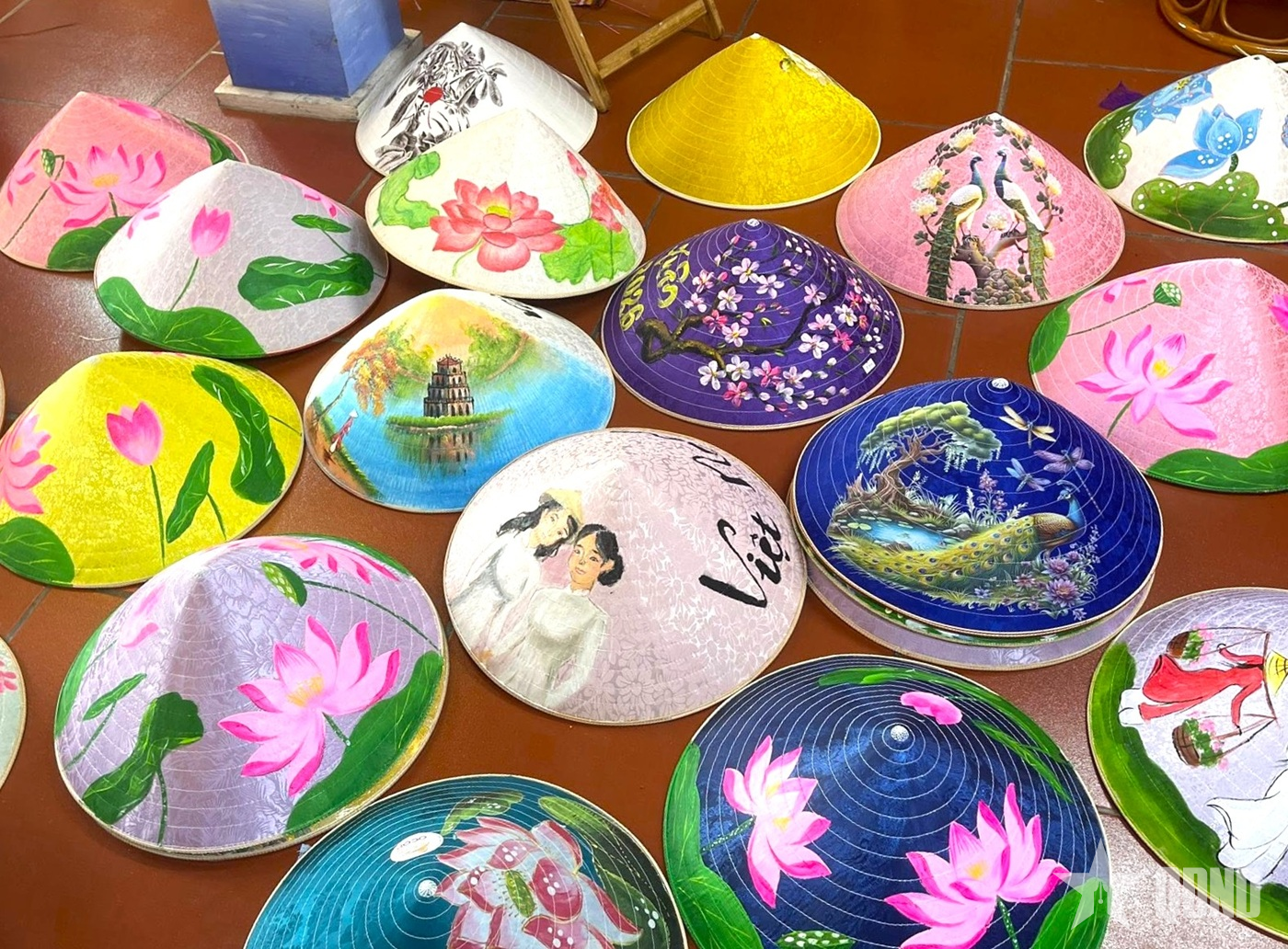 |
| The conical hats come in a variety of sizes, colors, and patterns at the workshop of artisan Ta Thu Huong. |
However, in response to the increasingly sophisticated tastes of consumers, alongside preserving the traditional conical hat, she began making hats combining various materials to create new products, enhancing the value of the hat. The hat frame is still made using the traditional handcrafted methods of Chuong village, but the outer layer of leaves can be replaced with silk in various colors. Some hats have a purple hue reminiscent of Hue, some are ivory white with lotus flower patterns, and some are striking turquoise with meticulously arranged patterns.
Not only are the materials varied, but many of the hats are also hand-painted with images of famous Vietnamese landmarks such as Ha Long Bay, the ancient capital of Hue, or scenes of the Northern Vietnamese countryside. Besides landscape paintings, the products are also embellished with lotus flowers, five-pointed stars, or the words "Vietnam," adding a touch of elegance while maintaining the hat's graceful appearance.
Artisan Ta Thu Huong expressed: "I want each conical hat to be not only a handcrafted product but also to tell a story about our country. When tourists take the hat home, they also carry a part of Vietnamese culture with them."
Innovation has helped her products reach a wider range of customers. Besides domestic customers, many organizations and institutions choose the hats as gifts for cultural and diplomatic events. Each year, approximately 60,000 hats from her facility are sold. To meet the growing demand, she has gradually expanded production. In addition to her main workshop at home, she has invested in more materials, a showroom, and a packaging system for export. Her facility also provides employment for local workers.
 |
| Artisan Ta Thu Huong (in the blue shirt) introduces the conical hats of Chuong village to international tourists. |
She also continued to develop the Bamboo and Rattan Hat Cooperative, which includes a craft village experience area, an exhibition area, a check-in point for tourists, a rest area, a parking lot, and an export packaging area. This place gradually became a destination for many domestic and international groups who want to learn about the hat-making craft of Chuong village.



At the same time, she also opened free vocational training classes for students and schools that wanted to learn about hat-making. According to her, passing on the craft is not simply about teaching how to sew hats, but also about helping young people understand the value of traditional handicrafts.
Artisan Ta Thu Huong shared: "If we only keep the craft to ourselves, it will gradually fade away. I hope that the more young people learn to make conical hats and love them, the more opportunities the craft village will have to develop."
For artisan Ta Thu Huong, each finished conical hat is not only the result of skillful hands but also the culmination of memories, love for her homeland, and the aspiration to preserve a traditional craft that has been passed down through many generations. She continues this journey, so that the conical hat from Chuong village not only remains a part of Vietnamese life but also carries the story of Vietnamese culture to friends around the world.
Source: https://www.qdnd.vn/van-hoa/doi-song/giu-hon-non-la-lang-chuong-1046771





![[Image] A look back at the capital's preparations for the century-long master plan.](https://vphoto.vietnam.vn/thumb/1200x675/vietnam/resource/IMAGE/2026/06/29/1782750453122_quy-hoach-100-nam-minh-duy-1-2118-jpg.webp)





































![[Photo] General Secretary and President To Lam works with the Party Committee of the Government on the work of preventing and combating storms, floods, extreme natural disasters and climate change.](https://vphoto.vietnam.vn/thumb/1200x675/vietnam/resource/IMAGE/2026/06/29/1782729441945_a1-bnd-0385-9454-jpg.webp)