

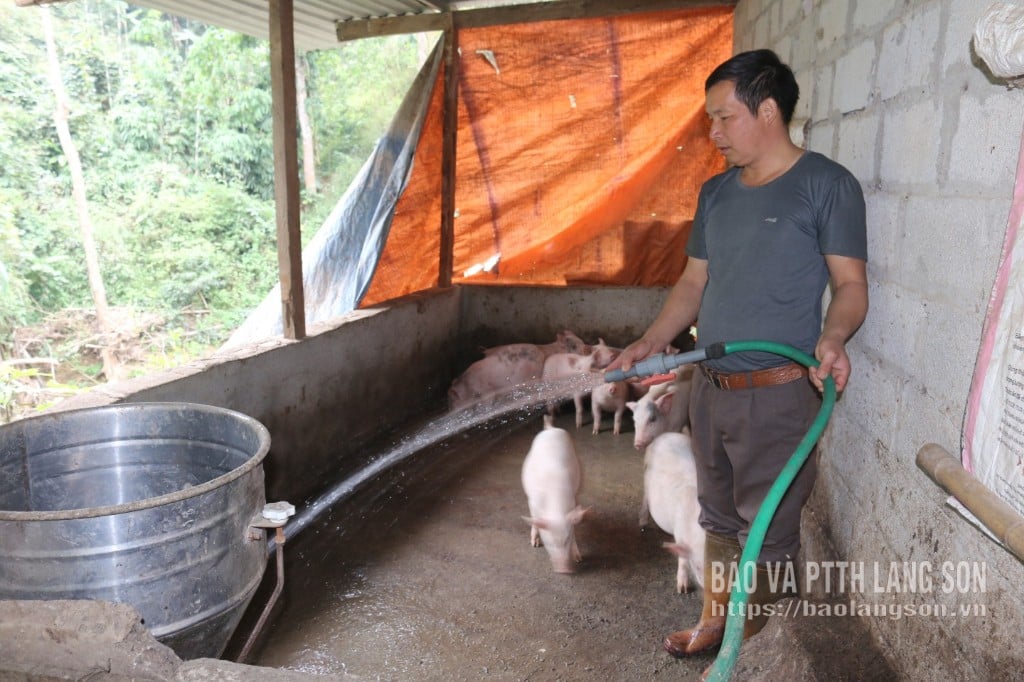
Mr. Hai was born in 1978 in Khon Hau village. In 2001, he got married, and in 2005, when he moved out to live separately, his family was classified as a poor household in Hoa Binh commune (now Van Quan commune). At that time, their house was small and cramped, their land for production was limited, and they mainly relied on small-scale farming and livestock raising, resulting in unstable income and many difficulties in life. Unwilling to accept poverty, Mr. Hai always pondered how to find a suitable way to improve his family's economic situation . Sharing about those early years full of hardship, Mr. Hai said: "When we moved out on our own, we lacked everything. Farming provided enough to eat, but there was no savings. I thought that if I didn't boldly change my approach, it would be very difficult to rise above it."
Accordingly, realizing that pig farming could utilize feed resources from rice and corn cultivation, after moving out on his own, Mr. Hai decided to invest in raising sows, initially on a scale of 2-3 sows. Despite the small number, he focused on care, hygiene in the pens, disease prevention, and gradually accumulated experience. In the early years, his family sold an average of about 30 piglets and 20 market pigs annually, providing a stable income. Thanks to this, the family's economic situation gradually improved.
By 2020, having accumulated capital and experience, Mr. Hai proactively expanded his pig farming operation to five breeding sows, a number he has maintained to this day. Instead of focusing on raising pigs for meat, he shifted his focus to primarily selling piglets. Mr. Hai stated: "Raising piglets, although the price per piglet isn't too high, is less risky and requires less care than raising pigs for meat. Importantly, it offers a quick return on investment and suits my family's circumstances. To ensure the pigs grow and develop well, I actively participate in training courses organized by the commune, and I also learn about safe farming practices through agricultural programs, books, and newspapers. I invested in building sturdy, compartmentalized pigpens to facilitate herd separation. The feed is clean, mainly consisting of cornmeal, rice grown by my family, and fermented rice residue. In particular, I regularly clean the pens, administer vaccinations periodically, and keep the pens cool in the summer and warm in the winter to ensure the pigs grow healthily."
Thanks to this method, his family's pig herd has never been affected by African swine fever in recent years. On average, he regularly sells over 100 piglets to the market each year, generating revenue of 120 million VND.
Besides developing livestock farming, Mr. Hai also invested in planting nearly 1 hectare of acacia forest. Thanks to applying the right techniques and good care, last year he harvested the forest and, after deducting expenses, earned a profit of about 80 million VND. According to Mr. Hai, combining multiple production models helps his family be more proactive in economic development because agriculture cannot rely on only one source of income. In some years, livestock farming faces difficulties, but the forest still compensates. Thanks to this, the family's economy is more stable.
In 2025, he plans to continue investing in raising 20 breeding bamboo rats, as this is the mating season for breeding, hoping to increase his income in the following years.
Thanks to effective economic development, careful saving, and sensible spending, by 2025, Mr. Hoang Van Hai had built a spacious new house of over 100 m². This is not only a material achievement but also a milestone affirming the persistent progress of a family that had been poor for many years. In the same year, his family officially escaped poverty and was commended as a typical example in implementing the National Target Program for Sustainable Poverty Reduction for a Vietnam where no one is left behind.
Commenting on Mr. Hai's economic development model, Mr. Lanh Van Hien, Head of the Economic Department of Van Quan commune, said: "Mr. Hoang Van Hai is a prime example of the will to overcome poverty in the locality. He proactively chose a suitable livestock farming model, knew how to expand production when conditions permitted, and combined it with forest planting to diversify his livelihood. This is an effective and sustainable model, a prime example to be replicated throughout the commune."
It is clear that Hai's family's journey out of poverty not only has economic significance but also spreads the spirit of self-reliance and self-improvement within the community, contributing to the effective achievement of sustainable poverty reduction goals in the locality.
Source: https://baolangson.vn/guong-sang-thoat-ngheo-o-khon-hau-5070917.html

![[Photo] Conference announcing the Politburo's Decision on organizational and personnel matters](https://vphoto.vietnam.vn/thumb/1200x675/vietnam/resource/IMAGE/2026/04/01/1775017881825_bnd-2410-1472-jpg.webp)
![[Photo] Conference on the transfer and reception of Party organizations and Party members between the Party Committee of the Government and the Party Committees of the Central Party Agencies](https://vphoto.vietnam.vn/thumb/1200x675/vietnam/resource/IMAGE/2026/04/01/1775036784472_ndo_br_bnd-2620-jpg.webp)





























![[Photo] Prime Minister Pham Minh Chinh receives the Ambassador of the Russian Federation to Vietnam](https://vphoto.vietnam.vn/thumb/402x226/vietnam/resource/IMAGE/2026/04/01/1775046774818_anh-man-hinh-2026-04-01-luc-19-32-33.png)












Comment (0)