

South Korean President Yoon Suk-Yeol declared martial law in a televised announcement on the evening of December 3rd, local time. So, what does South Korean law stipulate regarding the imposition of martial law in special circumstances?
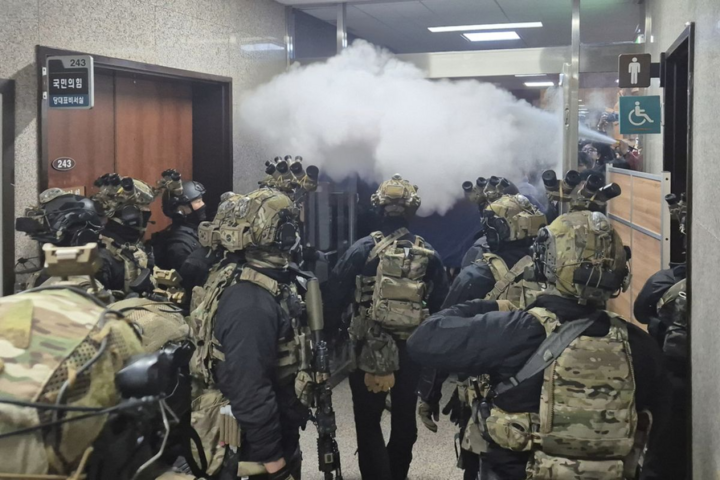
Parliament staff spray fire extinguishers to block soldiers from entering the main hall of the National Assembly in Seoul, early morning on December 4. (Photo: AP)
Martial law in South Korea typically involves suspending civilian government and imposing military law in major emergencies, such as serious armed conflict, granting the military greater authority in enacting and enforcing laws.
Article 77 of the Korean Constitution stipulates that the President may declare martial law when "it is necessary to respond to military requirements or to maintain public security and order through the mobilization of military forces during wartime, armed conflict, or similar national emergencies."
In his speech declaring martial law, President Yoon accused the opposition of paralyzing the government with "anti-state activities."
Shortly afterward, a six-point decree from the new martial law commander – Army Chief of Staff, General Park An-su – was issued. This decree prohibited political activities and parties, "false propaganda," strikes, and "gatherings that incite social unrest."
According to the Yonhap news agency, citing the military, activities of parliament and political parties will be banned, and protests, strikes, and other forms of public gatherings will be restricted.
In addition, the order placed all media outlets under martial law and required all medical personnel, including striking doctors, to return to work within 48 hours. Those who violated martial law could be arrested without a warrant, according to local news outlets.
The martial law commander, appointed by the President upon the recommendation of the Secretary of Defense from among active-duty generals, has the authority to take actions related to arrests, searches, and seizures, as well as control over speech, the press, and assembly. This commander has control over all administrative and judicial matters.
Under South Korean law, martial law can be lifted with the approval of a majority vote in the National Assembly.
In the events of the evening of December 3rd, 190 members of Parliament, dominated by the opposition, voted to overturn the decree. Following the vote, police and military forces quickly withdrew from the Parliament area.
At the same time, the opposition also called for impeachment proceedings against the President for declaring martial law.
Previously, Yoon's People Power Party and the opposition Democratic Party were at loggerheads over the 2025 budget. Last week, opposition lawmakers approved a plan to partially cut the budget from Yoon's proposed $479 billion budget.
The cuts include government reserves and budgets for the operations of the President's Office, the prosecutor's office, the police, and the state audit office.
In that context, the South Korean president criticized the opposition, which holds a majority in parliament, for "undermining the state."
Source: https://vtcnews.vn/han-quoc-thiet-quan-luat-the-nao-ar911295.html

![[Photo] General Secretary and President To Lam meets with National Assembly delegates from ethnic minorities.](https://vphoto.vietnam.vn/thumb/1200x675/vietnam/resource/IMAGE/2026/04/20/1776696701056_a1-bnd-8331-3342-jpg.webp)



![[Image] National Assembly discusses the implementation of the socio-economic development plan.](https://vphoto.vietnam.vn/thumb/1200x675/vietnam/resource/IMAGE/2026/04/20/1776696707422_ndo_br_img-20260420-185419-jpg.webp)














































































Comment (0)