

 |
| Citizens carry out land-related administrative procedures at the Dong Nai Provincial Land Registration Office - Bien Hoa branch. |
In response to this situation, the Ministry of Agriculture and Environment has directly worked to resolve the difficulties for the province.
There is still confusion regarding land prices and land clearance.
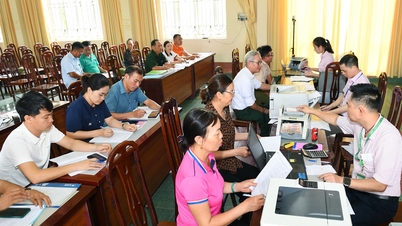
Since July 1st, the process of receiving and handling administrative procedures related to land at the commune level in Dong Nai province has been generally smooth. This result is thanks to the timely issuance of regulations on decentralization and delegation of authority by the central government and the implementation plan issued by the Provincial People's Committee. In addition, the Department of Agriculture and Environment has organized training sessions and assigned staff to provide direct support at the grassroots level.
However, due to the numerous procedures and large volume of documents in this field, coupled with insufficient personnel and infrastructure, and the fact that some regulations have not been adjusted in time, difficulties have arisen. Accordingly, determining specific land prices as a basis for calculating land rent, land use fees, and land-use conversion fees is challenging due to a lack of valuation consulting firms, and the application of various methods carries inherent risks. For example, valuing non-agricultural land (excluding residential land) based on prices collected from transfer contracts or land lease prices is almost unfeasible. Similarly, many projects, despite having received land allocation or lease decisions, lack land valuation consulting firms to collect land use fees and land rent as required by regulations.
Compensation, support, and resettlement work also faces obstacles. According to regulations, the People's Committee at the commune level is responsible for directing and organizing the implementation of compensation, support, and resettlement. However, currently, this task is carried out by the Provincial Land Fund Development Center under the management of the Provincial People's Committee; the commune cannot directly manage it. Furthermore, most communes have not established a public service unit to handle this, causing delays in land clearance.
Another issue relates to the specific land valuation council. The Chairman of the Commune People's Committee is the one who signs the decision to establish the council, whose members include the head of the district-level finance agency, but the district level no longer exists. The regulations have not been updated, so implementation is still confusing.
According to Le Nguyen Song Toan, Chairman of the Tan Trieu Ward People's Committee, in addition to the general difficulties faced by the entire province, the ward faces challenges related to land price regulations. Mr. Toan stated that the ward was established by merging three former communes and one former ward. Under current regulations, rural residential land from the former communes is converted to urban residential land, but there is a price difference between the two types of land. This leads to discrepancies when determining financial obligations, calculating land use fees, and even allocating land for resettlement. Furthermore, many roads are classified as rural residential land in the land price list, but their intended use is urban residential land.
"There needs to be additional transitional regulations on how to apply land price tables for localities that have adjusted land classifications after mergers to avoid confusion and inconsistent practices," Mr. Toan suggested.
Regarding organizational structure, representatives from the Trang Dai Ward People's Committee reported that the Department of Economy, Infrastructure, and Urban Planning is currently managing four areas: finance and planning, construction, industry and trade, and agriculture and environment, but has very limited staff and a shortage of specialized personnel, leading to overload. Therefore, the ward requested additional staff and a deputy head of department to meet management and operational requirements.
Adjustments will be made to ensure the system runs smoothly.
During an inspection and on-site working visit to communes and wards in Dong Nai province at the end of August, Deputy Minister of Agriculture and Environment Le Cong Thanh stated that the Ministry had established 10 working groups to assess the situation and directly address issues for localities in the initial phase of implementing the two-tiered local government system. The focus of this working group included three key issues: organizational restructuring; decentralization and delegation of power; and resolving administrative procedural obstacles.
 |
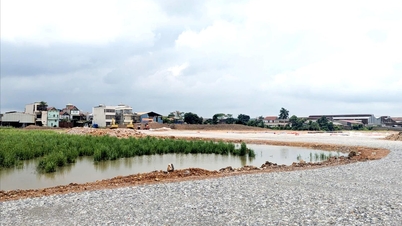
| The delegation of the National Assembly of Dong Nai province supervises land reclamation work at Bien Hoa 1 Industrial Park, Tran Bien ward, Dong Nai province. Photo: Hoang Loc |
According to Deputy Minister Le Cong Thanh, the ministry is also developing new regulations in the field of land to meet management requirements. After working with localities, the ministry will compile difficulties, obstacles, and recommendations to propose amendments to the Laws on Land, Minerals, and Environmental Protection to ensure that the two-tiered local government model operates synchronously, transparently, and effectively.
Regarding personnel matters, the Ministry of Agriculture and Environment will coordinate with the Ministry of Interior to develop specific standards and job titles for land administration, construction, urban planning, and environmental officials at the commune level. At the same time, the ministry requests that the province pay attention to allocating resources and operating funds to ensure the smooth functioning of the system.
"Local authorities need to quickly complete the land database, accelerate digital transformation, issue guidance manuals and coordination regulations to make it easier for grassroots officials to implement. Decentralization must be linked to clear responsibilities, avoiding the situation of shirking responsibility," the Deputy Minister of Agriculture and Environment emphasized.
The leaders of the Ministry of Agriculture and Environment also suggested that provinces and communes study the socialization of some public services in the land sector to encourage the participation of businesses and organizations, thereby reducing the workload for state agencies and improving service quality. Regarding specific recommendations, the ministry and its affiliated units will provide written responses and guidance to localities to effectively implement the newly decentralized and delegated tasks.
Provincial Party Committee member and Director of the Department of Agriculture and Environment, Nguyen Tuan Anh, stated: The aforementioned difficulties and obstacles are in the initial stage of operating a two-tiered local government system. In the future, to ensure the effective handling of administrative procedures in the land sector, the department will direct its divisions and departments to regularly exchange information and strengthen guidance and support for local units. Initially, this September, the department will organize in-depth training for land administration officials in communes and wards to improve their professional skills and apply technology in resolving issues.
Hoang Loc
Source: https://baodongnai.com.vn/kinh-te/202509/ho-tro-cap-xa-thao-go-vuong-mac-ho-so-dat-dai-d6917de/



















































































Comment (0)