

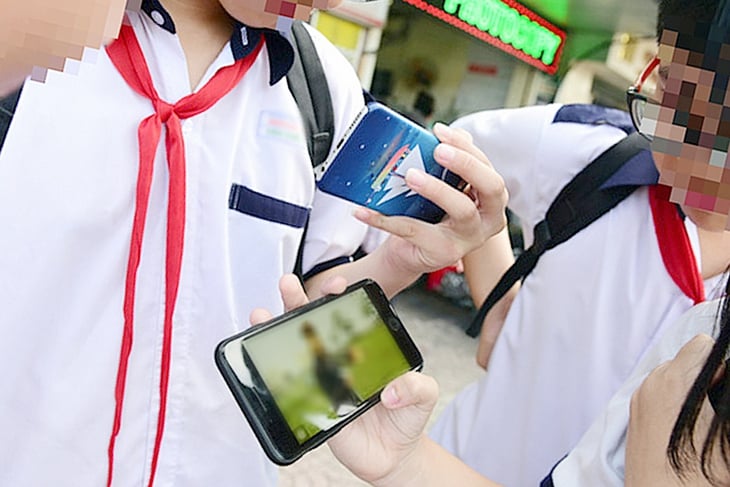
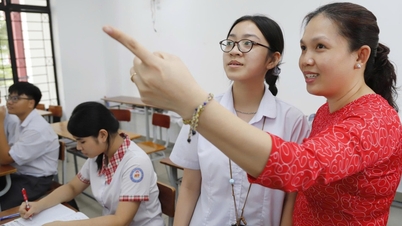
Many students have become very proficient at using social media platforms - Illustration photo: QUANG DINH
My child said that many of their friends use their phones during class, neglecting their studies, and even staying up until 3 am playing games in their rooms, making it difficult for parents to control them.
Many worrying consequences
This year, the school has strictly banned the use of phones in class, unless permitted by the teacher, yet some students still secretly use them, showing that management is not easy.
According to a 2022 Google survey, Vietnamese children typically own mobile phones by the age of 9, but don't receive much discussion about online safety until around age 13. This indicates that children have early access to technology but are slow to acquire digital skills. Mobile phones are both useful learning tools and pose many risks if not properly managed.
Undeniably, mobile phones offer students benefits in researching materials, learning foreign languages, and connecting with study groups.
However, the overuse of these devices has actually caused many worrying consequences. Social media, video games, and constant texting distract students, impairing their concentration and reducing their academic performance. The risks also extend to health, such as insomnia, reduced vision, and impaired brain development.
More concerning are the social consequences. Dependence on phones limits students' face-to-face interaction, weakens their social skills, and makes them more susceptible to harmful content.
According to UNICEF in 2022, 82% of 12-13 year olds and 93% of 14-15 year olds in Vietnam access the internet daily.
On average, children spend 5-7 hours a day on social media, while UNICEF research indicates that using social media for more than three hours a day can double the risk of anxiety and stress. This highlights the urgent need to manage usage behavior, rather than relying solely on individual awareness.
Positive effect
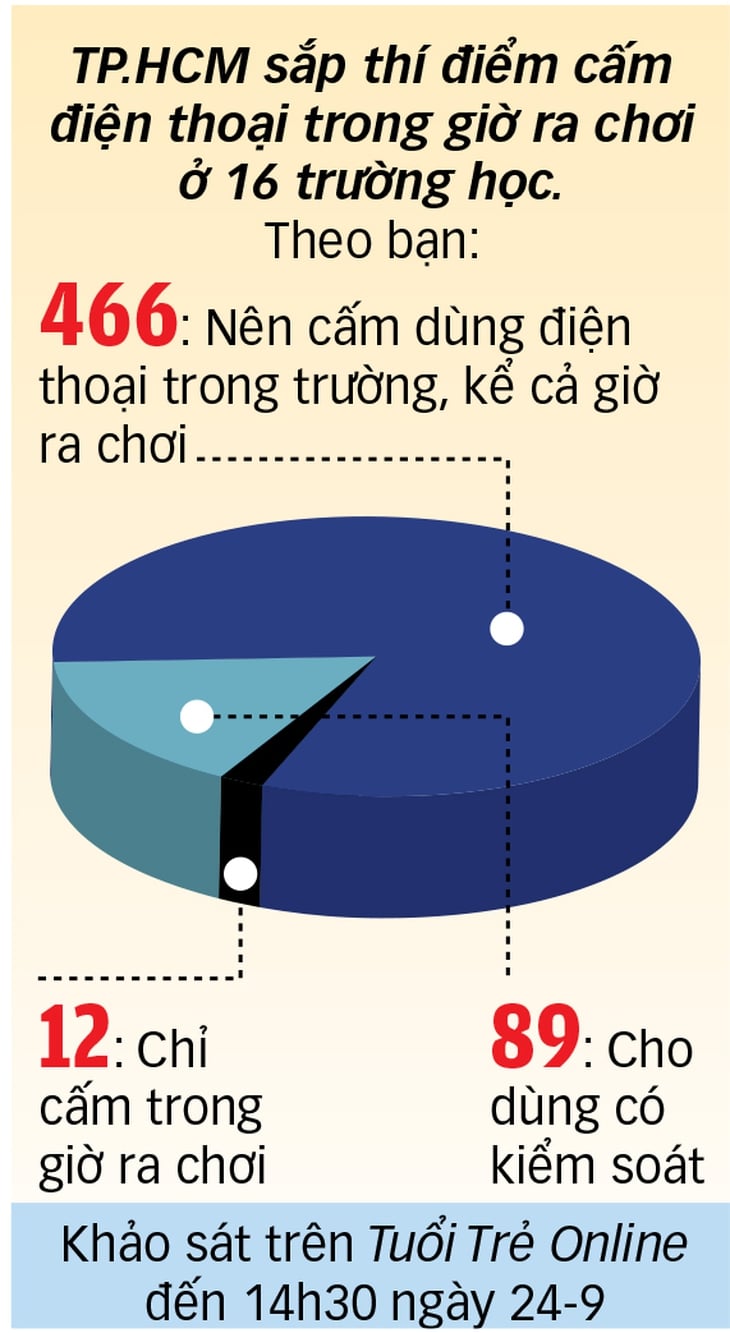
Graphics: TUAN ANH
Aware of the potential harm, the Ministry of Education and Training has issued numerous regulations regarding students' use of mobile phones.
Circular 32/2020 prohibits students from using mobile phones during class, except for educational purposes and with the teacher's permission.
Official document 5512 also affirms that schools are not allowed to require students to have mobile phones; their use in class depends on the teacher's decision.
These regulations reflect a cautious management approach, neither overly lenient nor completely prohibitive. However, in practice, the level of enforcement depends heavily on each school and each teacher.
This difference creates a management gap, making it difficult for legal regulations to be fully effective.
Many localities have implemented more specific measures. Hanoi requires students to hand over their phones at the beginning of the day and retrieve them after school, only using them when requested by the teacher.
Ho Chi Minh City has also proposed regulations banning students from using mobile phones during recess, starting from the 2025-2026 school year. Hai Phong , Bac Giang, and Thai Nguyen have implemented similar measures, confiscating phones and strictly managing the devices.
Some places have reported positive results, with students becoming more focused, engaging in more direct communication, and reducing sneaking around.
However, many schools have not implemented these measures consistently, and students still find ways to use the software. Teachers bear the additional responsibility of supervision, while parents sometimes become lax at home. This reality shows that relying solely on administrative measures makes it difficult to sustain the results.
Popular trends worldwide
International experience shows that the trend of restricting phone use in schools is common. Some US states have a complete ban, but this has also met with resistance from parents who fear losing a channel of communication with their children.
The Netherlands has a ban on mobile phones for non-educational purposes in both primary and secondary schools, but allows exceptions when necessary. Thailand restricts electronic devices in classrooms to prevent technological addiction.
Similarly, in 2025 Finland will introduce new laws severely restricting the use of mobile devices during school hours, allowing them only with teacher permission for educational or medical reasons. Sweden will ban mobile phones in schools from 2026.
The common thread among these countries is the pursuit of balance, minimizing harm without eliminating opportunities for digital skills development.
The lesson for Vietnam is that instead of applying a rigid model, it is necessary to flexibly combine conditional prohibitions with digital skills education that is appropriate to the culture, resources, and management context of each school.
Equipping students with digital skills.
A more rational approach is smart management. This management must be based on three pillars: awareness education, specific monitoring mechanisms, and an engaging school environment. Students need to be equipped with digital skills, the ability to distinguish fake news, avoid harmful content, and know how to limit their screen time.
Schools need clear regulations specifying the time and purpose of phone use, along with measures for handling violations. Solutions such as providing lockers for storing phones, requiring them to be handed over at the beginning of class, and only allowing use when requested by the teacher, could be feasible if implemented effectively.
Source: https://tuoitre.vn/hoc-sinh-va-dien-thoai-dau-la-gioi-han-20250925085117258.htm
![[Image] National Assembly discusses the implementation of the socio-economic development plan.](https://vphoto.vietnam.vn/thumb/1200x675/vietnam/resource/IMAGE/2026/04/20/1776696707422_ndo_br_img-20260420-185419-jpg.webp)



![[Photo] General Secretary and President To Lam meets with National Assembly delegates from ethnic minorities.](https://vphoto.vietnam.vn/thumb/1200x675/vietnam/resource/IMAGE/2026/04/20/1776696701056_a1-bnd-8331-3342-jpg.webp)































































































Comment (0)