Despite ethical controversies, the AI industry of 'resurrecting' the deceased remains popular in China.
In mid-December 2023, the news of a father using artificial intelligence (AI) to revive his only son, who had died from illness, attracted widespread attention from Chinese netizens.
The article describes how, at a cemetery in Zhejiang province, a man placed his mobile phone on a grave and played a recording of words his son had never spoken while alive, brought to life by artificial intelligence (AI).
"I know you suffer every day because of me, Dad, feeling guilty and helpless. Even though I can't be with you, my soul remains in this world , accompanying you throughout your life," the voice on the phone said.
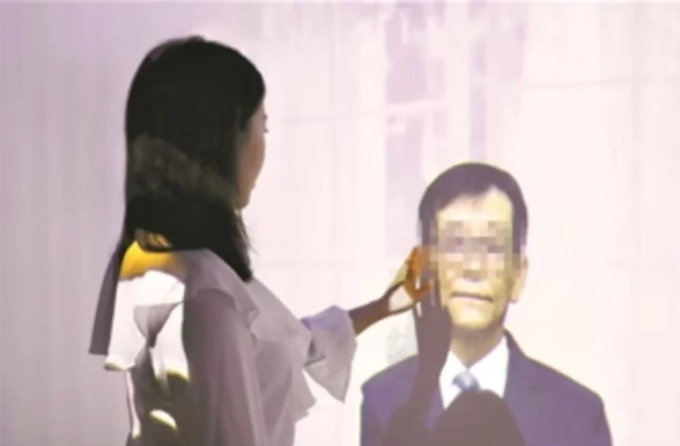
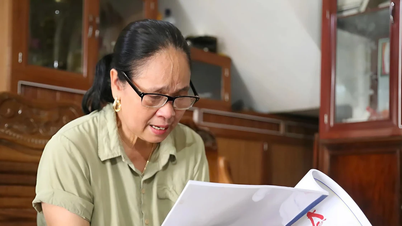
Thanks to AI technology, Chinese people can now chat directly with their deceased relatives. (Photo: Guangzhou Daily)
According to the Chinese Financial Review , this is an AI-based product that can recreate the images, sounds, speech, behavior, and even the personality and emotions of the deceased. It's being called a "digital companion" or "AI digital immortality."


Zhang Zewei, the founder of the Shanghai-based artificial intelligence company Super Brain, believes that the industry is truly booming in China.
Mr. Truong said that so far, the company has completed more than 600 orders, mostly from parents who have lost their children. There was even an order requesting the resurrection of an elderly woman's ex-boyfriend. Besides hearing voices, customers can also make video calls with people whose faces and voices have been digitized to mimic the deceased.
According to a report on the development of the next-generation artificial intelligence (AIGC) industry, China currently has 2,200 AIGC companies, mainly located in major cities such as Beijing, Zhejiang, Jiangsu, and Shandong.
Despite being high-tech, the cost per order is not exorbitant. Zhang Zewei revealed that Super Brain charges between 10,000 and 20,000 yuan (34 to 68 million VND) per order, completed within 20 days.
Meanwhile, some other technology companies in China are advertising that they can "resurrect" the dead with just 30 seconds of image and sound data. The 3D images used will create a feeling of being with loved ones, helping to alleviate some of the grief.
Some cemeteries in China are now using ChatGPT software and AI voice-mimicking technology to "recreate" the remains of those buried there. Thousands of people have used this service.
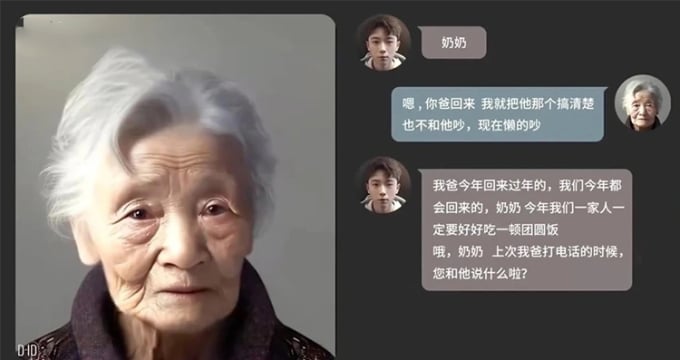
A chat between a young man and an AI version of his deceased grandmother has gone viral on social media. The conversation discusses returning home for the Lunar New Year to see her. (Photo: UDN)



However, there are concerns that the proliferation of "resurrection" services and related products could create serious ethical dilemmas. Information about the deceased would be an easy target for scammers. They could provide AI data about the deceased and then impersonate psychics to "communicate with spirits."
Furthermore, the use of personal information of the deceased is also a sensitive issue. Many people believe that simply because someone is dead, no one has the right to disclose their private information, even if that person is a family member.
Trang Vy (According to caijing )
Source