

Author Kim Cương shared: "During my years as a Standing Committee Member of the Provincial Heritage Association and Chairman of the Dong Hoi City Cultural Heritage Association in Quang Binh province (formerly), I had the opportunity to delve deeply into and research cultural heritage values. It was from this experience that I became captivated by the Le Thuy folk singing style and wrote quite a few poems about this unique folk melody." With sincerity, life experience, and cultural knowledge, the author has written simple yet moving verses.
The poem opens with a poetic scene that reflects the poet's mood. "Giving myself over to the Kien Giang River / late at night / a sliver of golden moonlight shelters me." Amidst the green river, the poet "gives himself over" to the embrace and comfort of his homeland's river. In the vastness of the river and the night, the person becomes small, but not alone, for the moonlight is his companion.
In that quiet and clear space, the sound appears as an awakening, breaking the stillness of the night: "Suddenly I hear a melodious folk song / Why wait any longer / Why wait halfway?" The song rises like a self-questioning, a loving reproach, a tender, lingering plea, causing the poet to fall into an indescribable emotional state. It is not a "burst" or an "overflow," but a feeling of "halfway" - a feeling of being in between, vague, uncertain, wistful, and restless...
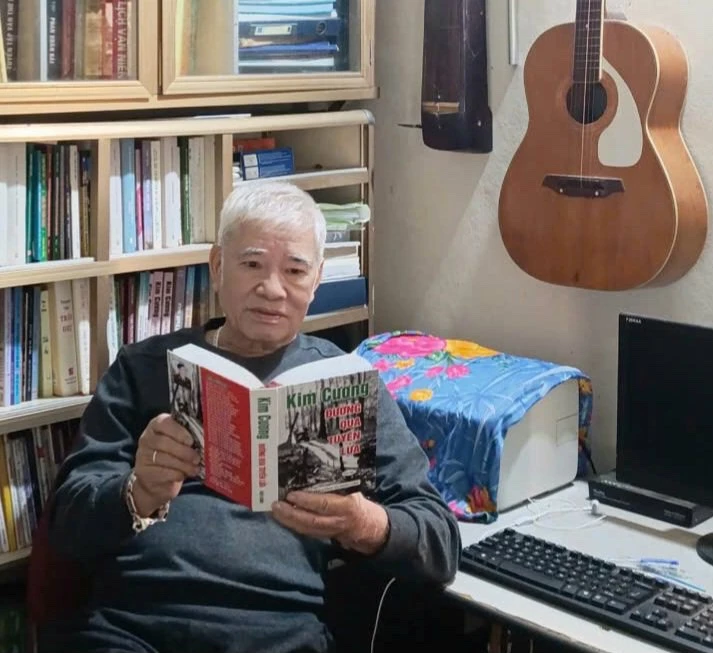 |
| Author Nguyen Kim Cuong - Photo: Nh.V |
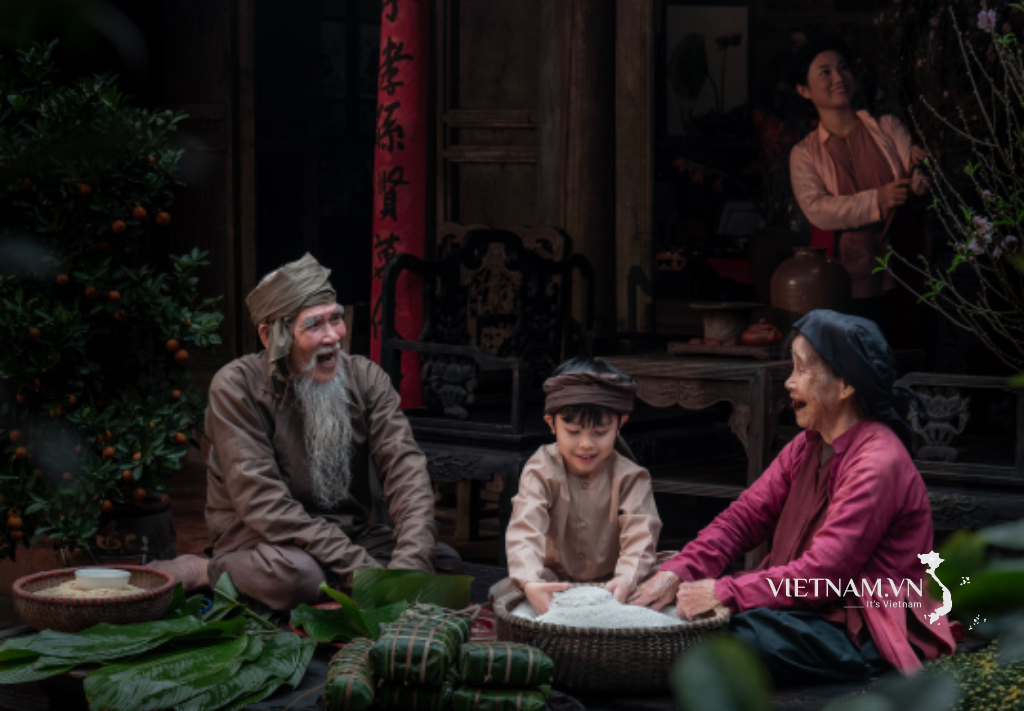
Through the sound of the chant, the author immediately associates it with the origins of the chant. The Le Thuy chant originated from labor, closely associated with the "rhythm of pounding rice." The rhythmic chant is both an imitation and an elevation of that simple pounding rhythm.
Drawing on a deep understanding of the local culture, the author begins to "decode" and fully appreciate the symphony of his homeland. "The nine-part folk songs linger/The tea-making and pounding songs/The gentle, rhythmic chants/The lively, bustling songs/The second-part and the elaborate songs evoke a sense of longing/The third-part and the relentless chants/The punctuation and chants tear through the sky."
Each verse unfolds before the reader a space of labor and cultural life, the "leisurely, rhythmic" pace of the tea-making and pounding roofs, the "lively" atmosphere of the fishing and threshing songs, the "vastness" of the lyrical and profound second-row and third-row boats, and the lingering, persistent feeling of the third-row and third-row boats, as enduring as the rhythm of human life itself. In particular, the piercing cries of the Nậu xăm and threshing songs rise up as an emotional transcendence, symbolizing the strength of the community and the spirit of the people of Lệ Thủy.
This shows that the Le Thuy folk singing style is a rich and nuanced blend of sounds, fully reflecting the emotional nuances and all aspects of human life. The singing style is the crystallization of the character of the people here: gentle, kind, but also talented and courteous. "The sweet and heartfelt singing voice / Through the years, it becomes a heroic song / Praising the glorious Saint Giap / Xuan Bo's heroic deeds endure through time / Dai Phong's strong wind / changes direction / Becoming a shining example / initiating the competition..."
The author has made an incredibly profound connection. The "sweet and tender" folk songs of love and labor, when nurtured by love of country, have "transformed into heroic songs." It is a source of pride in the national hero - General Vo Nguyen Giap, the glorious "Xuan Bo" victory linked to the sacrifices in the resistance war, and the "Dai Phong wind" movement in the 1960s, a prime example of productive labor, "opening the emulation campaign" for the entire socialist North. Le Thuy folk songs are not simply a cultural heritage but also a vibrant entity, embodying the indomitable spirit and aspirations of the people of Le Thuy to build their homeland.
Author Kim Cương is a member of the Quang Tri Provincial Association of Literature and Arts, and Head of the Literature Branch. He is known as a sharp prose writer within the police force, with many excellent short stories and novels on the themes of soldiers, homeland, and people. After retirement, he had more time to write and began to develop a passion for poetry, becoming captivated by each verse.
In the final verses, the author brings the reader back to reality without disrupting the overall emotional flow. On the contrary, it further enhances the intimate beauty and heartfelt human connection of the folk songs of the homeland. “Dreaming/in the rhythm of the oars/I feel for you enduring the midday sun in the fields/Scorching/on your rosy cheeks/Drying each grain of rice/in our golden fields…”. The dominant emotion in this stanza revolves around the word “affection.” It is precisely the diligence and hard work of “you” that creates the “golden fields of our homeland.”
The reason why the folk song "becomes a heroic song" is because it is rooted in the sweat and hard work of ordinary people. The author's love for his homeland is concretized through his affection and respect for the working people.
The poem concludes with a bright hue and a full, joyful tone. “The cheerful, rich singing/ resounds throughout the homeland tonight!” If the beginning is the “singing voice” of an individual, then the end is a “resounding,” “joyful” chorus. The individual “I” lets go and listens, dissolving into the “we” of the community in a shared joy.
With its flexible rhythm in the traditional six-eight meter, the poem has a fluid tempo, sometimes short, sometimes long, harmonizing with simple yet evocative language.
It is precisely because of its rhythmic flow, rich poetic quality, and strong folk essence that the poem was set to music by composer Le Duc Tri, Head of the Vietnam Musicians Association branch in the province, as the song "Remembering to Listen to the Ho Khoan Singing," which was successfully performed by People's Artist Thuy Linh. With its melody strongly reminiscent of Ho Khoan singing, the song quickly won the hearts of the public. The poem was also adapted into a five-part Ho Khoan melody by the distinguished artisan Hong Hoi (Le Xu Ho Lovers Club), contributing to the preservation and dissemination of the intangible cultural heritage of the homeland.
Nh.V
Source: https://baoquangtri.vn/van-hoa/202603/hon-que-trong-tieng-ho-khoan-ec66bbb/



![[Photo] Da Nang: Over 38,000 people "painted the streets red" during the Olympic Run for National Security.](https://vphoto.vietnam.vn/thumb/1200x675/vietnam/resource/IMAGE/2026/03/22/1774148860624_ndo_br_chay-15-jpg.webp)

























































Comment (0)