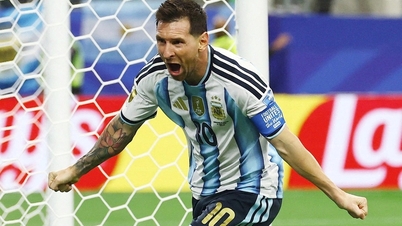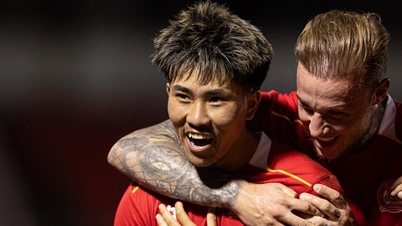


In the 21st minute of the match between Germany and Curaçao, with the German "tanks" leading 1-0, midfielder Livano Comenencia unleashed a shot that deflected off goalkeeper Manuel Neuer, leveling the score at 1-1. This was the first World Cup goal in the history of Curaçao – a country with a population of less than 200,000 participating in the World Cup for the first time. In the minutes following the equalizer, the German team truly struggled. Curaçao played with great enthusiasm, constantly pushing forward and giving the impression they could continue to surprise.
"For about five or six minutes, our opponents gained a lot more confidence, while we became a bit quiet and passive," coach Julian Nagelsmann admitted after the match.
Coach Nagelsmann continued: “At that time, we really needed some time to readjust. The water break between matches was really helpful.”
The Guardian also suggested that the three-minute break disrupted Curaçao's momentum and allowed the German coaching staff to reassemble a team showing signs of disorientation.

 |
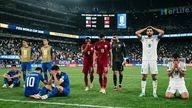
| Germany beat Curaçao 7-1 in their opening match at the 2026 World Cup. Photo: AP |
The hydration break seemed to completely change the dynamics of the game for both teams afterwards. The most noticeable change was in the speed of ball distribution. In the first 20 minutes, Germany controlled possession but their movement wasn't fast enough to stretch the opponent's defense. After the break, one-touch and two-touch passing combinations appeared more frequently, allowing Die Mannschaft to get the ball into dangerous areas significantly faster.
Germany also exploited the flanks more aggressively, particularly on the left wing. Nathaniel Brown, who had previously been primarily defensive, began appearing more frequently in the opponent's half. The 23-year-old defender took the corner that led to Nico Schlotterbeck's goal, making it 2-1, before scoring himself in the second half. That performance made Brown one of the most notable discoveries of the match.
More importantly, Jamal Musiala and Florian Wirtz began receiving the ball in more advantageous positions. Instead of having to drop deep to participate in the build-up play, the German creative duo frequently appeared between the Curaçao defenses – where they had enough space to showcase their ball-handling skills in tight spaces and create breakthroughs.
The post-match statistics somewhat reflect that shift. Germany finished the game with 26 shots, generating an expected goals (xG) of 3.91, while Curaçao only achieved 0.40 xG. In the first half alone, Nagelsmann's team unleashed 16 shots, the highest number by a national team in a World Cup half since 2006.



However, the victory against Curaçao wasn't a sufficient measure of Germany's ambitions to win the World Cup. But it did provide significant motivation for "the tanks." They had lost their opening matches in the last two World Cups and failed to even advance from the group stage. This win also extended Germany's winning streak to 10 consecutive matches and raised their total number of goals in World Cups to 239, surpassing Brazil to become the highest-scoring team in the tournament's history.
Source: https://www.qdnd.vn/the-thao/worldcup-2026/hydration-break-buoc-ngoat-cua-tuyen-duc-1044317
![[Photo] Thousands of people participate in a run to show their support for the campaign "Sharing a common determination to build drug-free communes, wards, and special zones".](https://vphoto.vietnam.vn/thumb/1200x675/vietnam/resource/IMAGE/2026/06/27/1782554475933_0673e2a3df7b5e25076a-8283-jpg.webp)


![[Photo] A phone-free summer afternoon at the village library](https://vphoto.vietnam.vn/thumb/1200x675/vietnam/resource/IMAGE/2026/06/27/1782551770949_anh-1-jpg.webp)