

Lesson 1: Plants and animals in the forest, nutrients from the sea
Two farmers, separated by a quarter of a century in age, from Tan Ha and Hoai Duc communes in Lam Ha district, have shared a common vision: building a cyclical production and livestock farming system using purebred breeds from the Central Highlands' mountainous forests and absorbing nutritional supplements from the coastal region. This not only led to the discovery of a new livelihood development but also initiated the goal of preserving the natural environment of their fields and gardens for today and tomorrow.
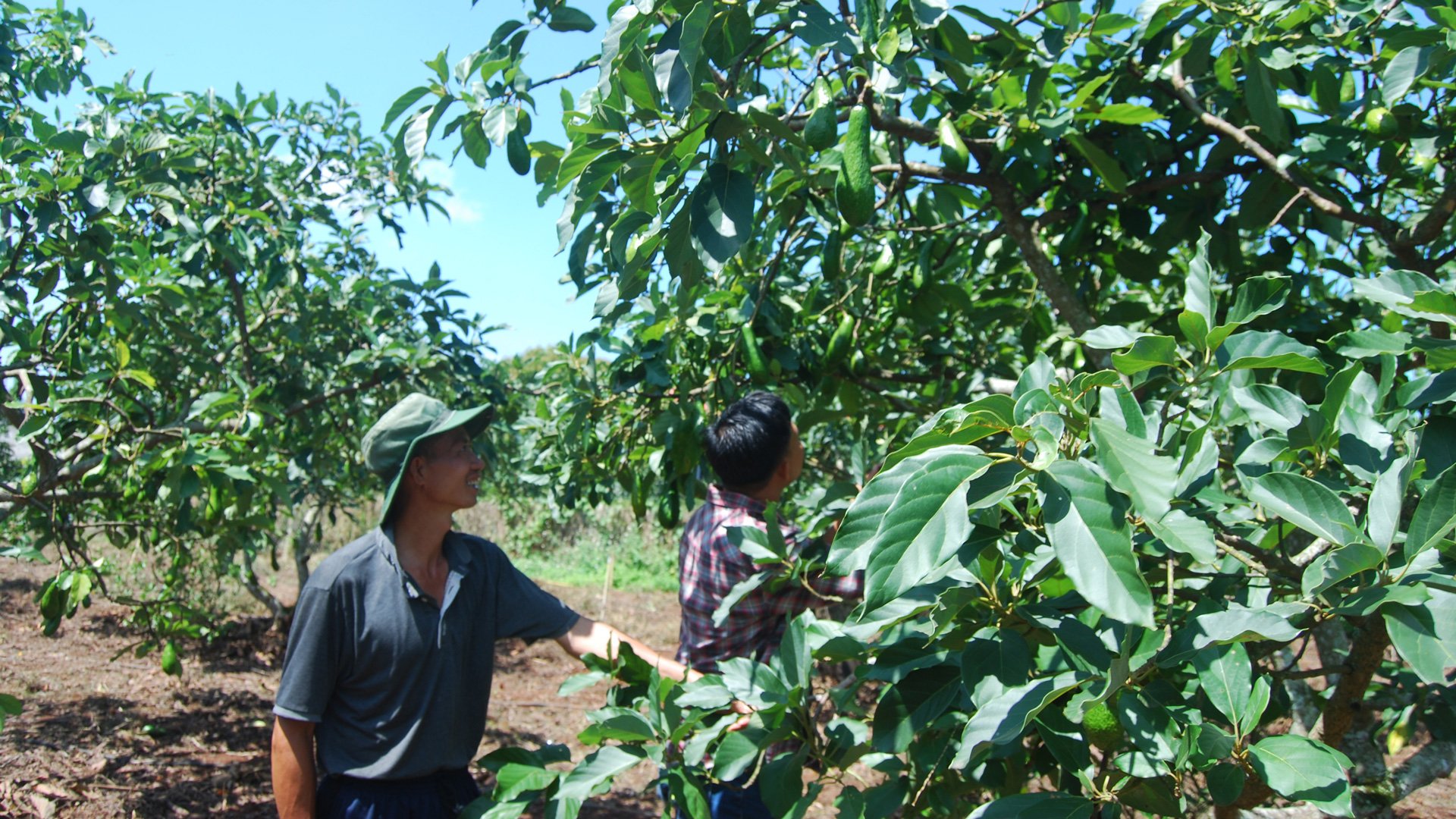 |
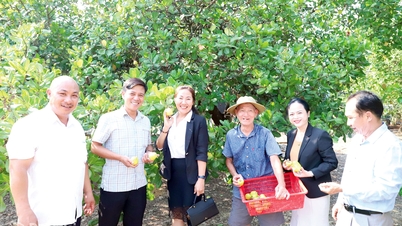
| By using a blended nutrient solution from marine and forest resources, the avocado orchard of farmer Nguyen Van Huy in Tan Ha commune, Lam Ha district, is confident of increasing its yield by approximately 30% compared to the previous season. |
• WILD BOARS DRINK SALTWATER AND CONCENTRATED SEAFOOD PROTEIN
Reporters visited the key agricultural areas of Lam Ha district, located about 80 km from Da Lat city at an altitude of 800-1,000 m above sea level in May 2025, amidst vast green spaces of lush fruit trees. Upon arriving at Minh Thanh village, Hoai Duc commune, the reporters were captivated by the continuous, closed-loop production and livestock farming process of young farmer Nguyen Tien Vinh, born in 1997. Here, under the canopy of a 3-hectare coffee plantation and other high-value intercropped fruit trees, the owner has installed a 6,000 m2 fence for free-range farming and built a 100 m2 enclosure to house a hybrid wild boar breed from Tanh Linh in Binh Thuan province, crossbred with wild boars from the rocky mountains of Ha Giang in the North. This resulted in a new generation of domesticated hybrid wild boars adapted to the Lam Dong plateau over the past two years.
As midday approached, in the enclosure area, Vinh pulled up some corn stalks and clumps of honeysuckle and other herbs planted around the pen and passed them over the partition. Immediately, 10 breeding wild boars crowded around, pulling down branches and leaves to chew and swallow with relish. Next, Vinh took a can of fish protein concentrate processed from the Binh Thuan coastal region and poured it into the trough. The 10 boars, encouraged by this, eagerly lowered their long, pointed snouts and slurped it up with apparent enjoyment. Vinh explained: “The hybrid wild boars we raise, both in confinement and free-range under the intercropped coffee and fruit trees in our 3-hectare farm, only use locally sourced green feed such as vegetables, grass, corn, and fish protein concentrate, along with pure salt water, to ensure their reproductive health, rapid weight gain, and growth. We don't use any other feed products purchased from outside or mixed feed processed using traditional methods…”
Surprisingly, even standing next to Vinh's hybrid wild boar pen for several tens of minutes, there was no smell of waste. Vinh explained that he processes the waste daily using local probiotics, activated charcoal made from burnt rice husks, coffee husks, and macadamia nut shells, extracting vinegar and mixing it with a marine fish protein solution to transform fresh pig manure into a biological bedding material. After a few months, it is collected and processed into nutrient-rich organic fertilizer for multi-cropping on-site. As a result, optimizing input costs and maximizing output revenue over the past year, young farmer Nguyen Tien Vinh has combined forest and marine elements to process and use about 20 tons of microbial organic fertilizer to fertilize his coffee plants, yielding up to 6 tons of coffee beans per 1.2 hectares, an increase of nearly 1 ton of beans compared to the previous crop. Alongside high-value fruit trees such as 50 avocado trees (variety 034), 100 durian trees, and 200 longan trees entering their first main flowering season, rows of fruit densely distributed on the branches this summer herald abundant harvests in Vinh's oxygen-filled garden...
• A BLEND OF ORGANIC MICROBIAL NUTRITION FROM MOUNTAINS AND THE SEA
In the same agricultural ecological zone of Lam Ha district, while the young farmer Nguyen Tien Vinh in Minh Thanh village, Hoai Duc commune, initially used marine resources primarily for nutrition and fish protein solution to control diseases in crops and livestock, the Huy Ngoc Organic Agricultural Cooperative in Dan Phuong 1 village, Tan Ha commune, has stabilized its formula for mixing pig, cow, chicken, and goat manure with marine nutrients. This mixture not only contains fish protein but also various components such as squid membranes, clam shells, crab shells, shrimp shells, seaweed, and coral. Specifically, the cooperative distributes the marine fish protein to member farmers, dissolving it in clean water for foliar spraying and root irrigation to protect and enhance the resistance of crops on a total area of over 13 hectares in the surrounding area against disease outbreaks, especially during the transition between the dry and rainy seasons.
To provide more details, the Director of the Cooperative, Nguyen Van Huy (born in 1972), who is also a member farmer, led the reporter to his avocado orchard (model 034) with over 50 trees, 6-7 years old, to check out the lush green trees, branches, and leaves, and the spacious surroundings. Overall, the vibrant green trees, with their photosynthetic function, help purify the air, reduce CO₂ (a greenhouse gas), and increase oxygen levels, which is very beneficial for humans and the environment. As for the practical benefits, this year, Director Nguyen Van Huy is confident that his avocado orchard (model 034) will yield over 200 kg per tree, increasing output value by approximately 30% and reducing input costs by about 20%…
“To date, on a total area of 2.5 hectares, our farm has allocated 1 hectare for cultivating long-term and short-term crops outdoors, and 1.5 hectares for constructing greenhouses specializing in growing vegetables, roots, and fruits. Every month, with tens of tons of organic microbial nutrients processed in the garden from marine and forest materials, a large quantity of diverse fresh vegetables, fruits, and roots from Lam Ha district in the mountainous province of Lam Dong are packaged and transported to consumers nationwide on the same day…”, said Mr. Nguyen Van Huy.
(TO BE CONTINUED)
Source: https://baolamdong.vn/kinh-te/202505/ket-noi-bien-rung-voi-net-zero-bai-1-45e607f/




![[Infographic] Key indicators for the period 2026-2030 to achieve "double-digit" growth targets](https://vphoto.vietnam.vn/thumb/402x226/vietnam/resource/IMAGE/2026/04/06/1775450004801_fb4e219c8aa77c339a75ff13c44b2e595f8db215db15da7b4648b200deade68240d89ec5e4bd2e86c42f5ed9eeb-_ndo_br_chi-tieu-2-con-so-thumb-1.jpeg)


![[Photo] Prime Minister Pham Minh Chinh receives the Chinese Ambassador to Vietnam](https://vphoto.vietnam.vn/thumb/1200x675/vietnam/resource/IMAGE/2026/04/05/1775397481797_ndo_br_dsc-5512-jpg.webp)














































Comment (0)