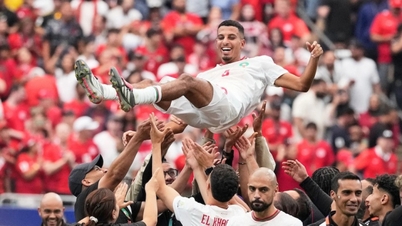
In the group stage, the teams from the Asian Football Confederation (AFC) carried much excitement and hope of creating a fresh wave at this World Cup. However, at the end of the group stage, only 2 out of 9 teams advanced to the knockout round as group runners-up, while 5 teams finished last in their groups. In the round of 16, the leading team, Japan, fell to Brazil despite a spirited start and taking the lead, losing in injury time.
 |
| The match between Senegal and Belgium was dramatic, with the European team emerging victorious. Photo: AP |
With African teams making a strong showing, 9 out of 10 teams have qualified for the Round of 16. Such a high percentage of teams advancing from the group stage has led fans to hope for surprises, promising many "dark horses" to go deep in the tournament, similar to Morocco's performance in 2022. However, with only two-thirds of the Round of 32 matches played, the gap in skill, experience, and composure between African teams and their European and South American counterparts remains quite significant.
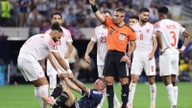
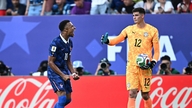

Overall, African teams are in no way inferior to European teams in terms of physique, fitness, technique, tactics, speed, etc. Many of their stars play for top clubs on the continent, honing their skills in a high-level football environment every day. Most African teams start well, creating significant pressure and often causing their opponents to feel disoriented. But beyond these qualities, what African teams lack is composure and pragmatic calculation. They need a "winning DNA" in big matches. Notably, all three highly anticipated African teams – the Democratic Republic of Congo, Ivory Coast, and Senegal – experienced turning points in the 86th minute, ultimately leading to defeat. Senegal's loss to Belgium was the most regrettable, as they led 2-0 until the 85th minute but ultimately lost 2-3.
The African teams may possess good quality, technique, and international experience, and this was evident in the early stages of the match. However, to win big matches and progress further, they need a more composed and pragmatic team. They still play with a lot of emotion, instinct, and the naiveté of players who always want to attack and settle the game in the most direct way possible.
For most African teams, the journey at the 2026 World Cup is a valuable lesson. They already have a solid foundation in terms of personnel, a rapid pace of development, and many world-class players. What they lack is tactical acumen, composure, and the ability to manage the game at crucial moments.
Based on the realities of Asian and African football, the saying "form is temporary, class is permanent" holds true when applied to the knockout rounds of the 2026 World Cup!

Source: https://www.qdnd.vn/the-thao/worldcup-2026/khac-biet-o-dang-cap-1047513