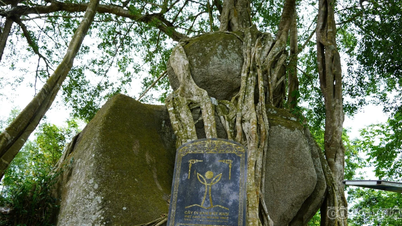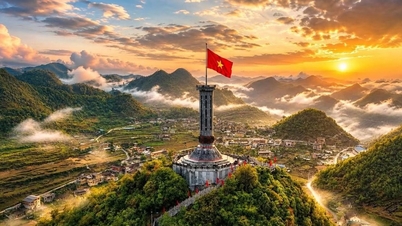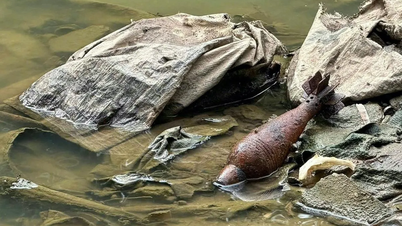
Khe Sanh, a former battlefield.
Having visited Khe Sanh many times, I keep thinking about the strategic importance of this area during the war. It's just a valley, Khe Sanh, located along Highway 9, which was once used as a model in President Lyndon B. Johnson's office during the 1968 war to manage the American forces. And later, the name Khe Sanh was mentioned again in the inaugural address of the 44th President of the United States, Barack Obama.
What was it about Khe Sanh that haunted the American president's war memories so much? Was it perhaps the 170-day siege by the Liberation Army and the first battle in which the Liberation Army deployed tanks in the mountainous jungle terrain of western Quang Tri ?
It is known that, among the revolutionary war relics in Quang Tri, the Museum of Victory on Highway 9 - Khe Sanh and Ta Con Airfield are the most visited sites, including American veterans who fought in Vietnam and tourists from Western countries.
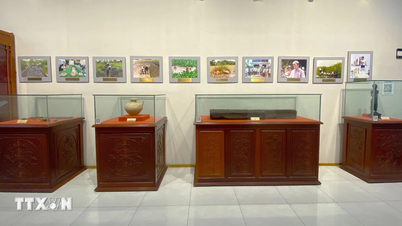
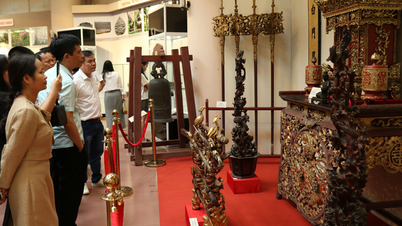
With its relatively large and well-planned grounds, the historical site features a large collection of exhibits that recreate the fierce battlefields of the past, helping visitors gain a deeper understanding of Vietnam's heroic history.
Unlike before, when the airfield site lacked aircraft, now visitors are struck by the sight of CH47, UH-14, and C-130 aircraft, "provided" by the Vietnam Military Museum for outdoor display at the historical site. Recently, Ho Chi Minh City also "provided" an additional C-119 aircraft, a type of transport and supply plane used by the US military to the Khe Sanh battlefield in 1968, further enriching this historical site.
Now, more than half a century has passed since the war ended. After the country was reunified, people from all over the countryside, both within and outside the province, came to the highlands, once a battlefield, to start a new life, a practice then known as "new economic zones."
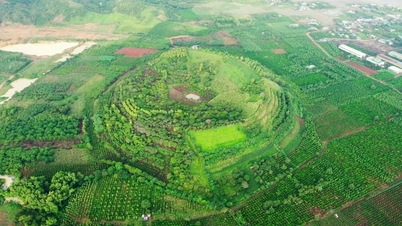
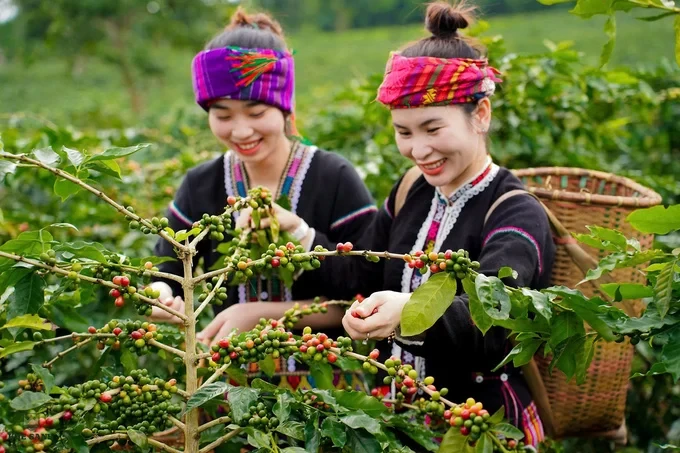
Together with the Van Kieu and Pa Ko ethnic groups, they revived the aspiration for basalt with their abundant coffee plantations. The miraculous thing is that decades later, the Arabica coffee beans from this Khe Sanh plateau are being exported to the United States and European countries. This was certainly unimaginable decades ago.
According to many published documents, coffee plants were introduced to Khe Sanh by the French in the 1920s. The first person to plant coffee in Khe Sanh was the French botanist Eugène Poilane. He died there, and his grave is still located in the garden of a local family. To this day, the people of Khe Sanh still remember him as the "pioneer" of the Huong Hoa region.
Currently, Khe Sanh coffee is part of Vietnam's specialty coffee chain. Several batches of roasted and ground Khe Sanh Arabica coffee are introduced to Japan, Europe, America, and the domestic specialty coffee market. Furthermore, Khe Sanh coffee has a very unique origin: a coffee-growing region that endured fierce warfare and then revived on the fiery red basalt soil of the historic Highway 9 battlefield. This is what gives the Khe Sanh coffee brand not only agricultural value but also cultural depth and historical memory.
Deeply attached to the land of Khe Sanh
Regarding Khe Sanh, it's also worth mentioning a generation that grew up, matured, left, and then returned to this land. Like my colleague, journalist Lam Chi Cong. Originally from Trieu Phong, Cong moved with his family to Khe Sanh in 1976 as part of a new economic zone, back when the area was still a remote and dangerous jungle.
Thanks to his parents' hard work cultivating the land in Khe Sanh, the family overcame the initial difficulties of settling there. Once the fruit trees and coffee plants were planted and firmly rooted in the basalt soil, Cong's family life stabilized, and his parents were able to raise their children to be successful in their studies.
Before reaching retirement age, Cong left his position as deputy editor-in-chief of the magazine to return to Khe Sanh and resume his long-standing work as Chairman of the Quang Tri Flower Road Development Fund. Thus, he returned to the place he had left to rebuild the wild sunflower roads along the Truong Son trail; plant more Osaca flowers in the Lia region; experiment with durian cultivation in his home garden; tend to his coffee plantation; install rooftop solar panels to save electricity for his farm; and organize journalism competitions about the Khe Sanh region.
It is known that the Flower Road Fund, founded by him, is currently actively promoting and supporting the local people to return to planting the jackfruit coffee variety - a coffee variety with a 100-year history in Khe Sanh.
It's also worth mentioning a very dedicated woman who is passionate about Khe Sanh coffee: the Chairwoman of the Khe Sanh Commune People's Committee, Thai Thi Nga. One of the things Ms. Nga has done that is very meaningful is establishing a geographical indication for Khe Sanh coffee, even when she was still an official at the Quang Tri Department of Science and Technology.
At that time, Russia connected with many units, conducted field trips to villages, and contacted the people and local authorities. Then, a significant milestone was the granting of geographical indication protection for Khe Sanh coffee (November 4, 2025) covering an area of approximately 3,900 hectares. From then on, the coffee from the Khe Sanh plateau officially gained its own "identity" in the market.
I remember when my friends from Da Nang came to visit Khe Sanh, many of them were amazed at how this land, once a battlefield, was now reviving so powerfully.


One person wrote on social media after the trip: “Unexpectedly, on the way to visit the Victory Museum of Highway 9 - Khe Sanh and Ta Con Airport, we came across a garden of Arabica coffee trees blooming with pure white flowers by the roadside. I asked the driver to stop so I could take pictures. Lost in admiration of the white coffee blossoms, it was a long time before we finally entered the historical site, where many images and various types of bombs, ammunition, and American aircraft from the 1968 life-or-death battle fought by the Liberation Army to reclaim land, houses, and fields are displayed…”
Yes, many people who visit Khe Sanh today share that feeling. Khe Sanh – once a battlefield – is now a well-known tourist destination, a land of golden coffee and sunshine.
What's even more remarkable is that many people come to Khe Sanh, falling in love with the land and captivated by the flavor of its mountain coffee, and choose to stay. They are quietly and diligently working day and night, hoping for the future development of Khe Sanh, a vibrant and livable city!
Source: https://baodanang.vn/khe-sanh-ca-phe-arabica-va-mien-dat-qua-vang-3339612.html


![[Image] National conference summarizing one year of operation of the overall organizational model of the political system, the three-tiered government model.](https://vphoto.vietnam.vn/thumb/1200x675/vietnam/resource/IMAGE/2026/07/01/1782882811691_ndo_br_1-jpg.webp)