The journey to creating "liquid gold"
Mr. Duong Xuan Qua (born in 1957, from Long Xuyen, An Giang province) is known as the "king of rice drying ovens." This is not a self-proclaimed title, because after decades of traveling from the lowlands to the Central Highlands, and even to Lang Son, Lao Cai, and Lai Chau... selling rice drying machines, he is one of the rare people who understands why dried rice is not bought by traders and who personally repairs machines that farmers have struggled with for decades.
It was his job selling rice dryers that led him to macadamia nut warehouses in the Central Highlands around 2017-2018. And he saw something that no one else paid attention to. "I've traveled a lot, and I'm familiar with everything. Only this was unusual, so I wanted to find out more," he recounted.
What Mr. Quả noticed was the damp, yellow, oily, and foul-smelling bags of macadamia nuts lying dead in the warehouse. Upon inquiry, he learned that imported drying machines take 85 hours to dry macadamia nuts, while domestic machines take 100, even 120 hours – slow, energy-intensive, and of inconsistent quality. Farmers can't find technical documents to improve their drying technology, and manufacturers simply sell the machines and then forget about responsibility.

Mr. Qua (center) on his journey to find ways to further process macadamia nuts. Photo: Provided by the interviewee.
In 2021, during the Covid-19 pandemic, Mr. Qua stayed home and began researching macadamia nut drying machines. He designed a three-function washing machine: separating damaged nuts that float to the surface, cleaning the shells, and eliminating fungi clinging to the fresh shells to prevent mold during storage. Next, he created a roller system to sort the nuts into three sizes, as uneven sizes would result in inconsistent drying temperatures. Finally, he designed a humidity control cabinet with a touchscreen display, specifying the technical requirements and hiring an electronics team to create a custom design to his specifications.
But the most important thing wasn't the machinery. It lay in a simple discovery Mr. Quả learned from an engineer: to know the moisture content of macadamia nuts, dry 1kg and weigh it repeatedly. When the weight stops decreasing, that's when the moisture content reaches 0%.
Based on that principle, he developed a 45-hour drying process, shortening it by almost half compared to foreign machines, allowing macadamia nuts to be safely stored for up to a year. His machines sold well from Lam Dong to Lang Son. The money from selling the machines provided him with the capital to continue his research and development of macadamia nuts in the following years.
Wherever Mr. Quả went, people pressed macadamia nuts for oil from yellow kernels, damaged kernels, and discarded kernels. The good kernels were sold, and only the ones nobody bought were put into the press. The oil produced varied in color and smell from place to place; there was no standard.
"People say macadamia oil is precious, but if you use bad ingredients, the oil has no value, and can even be harmful," Mr. Qua said. He bought macadamia oil from many places to compare. After looking at the color and smelling it, he decided to start over from scratch using only grade 1 macadamia nuts and his own drying process.

Mr. Quả's secret to extracting macadamia oil preserves 24 valuable active compounds in the nuts. Photo: Provided by the interviewee.
During the first batch of drying for oil extraction, the drying oven's control software malfunctioned. He had to stay up all night with an electronics technician, constantly troubleshooting to prevent the oil from being ruined. Finally, the dried seeds were dry and crispy, and the extracted oil was clear. He consulted a chemistry PhD acquaintance at Can Tho University. The short answer was: good for skin and hair.



Back in 2020, he dyed his hair, and it gradually fell out for two years. Every time he showered, his hands were covered in hair. Hearing that macadamia oil was good for hair, he dipped his toothbrush in the oil and brushed it onto his scalp every other day.
"I just applied it, not thinking my hair would grow back. But surprisingly, 20 days later, after showering, I didn't see a single strand of hair on my arm," he recounted. He asked his wife to check each hair follicle. His wife said his hair was growing back, one or two centimeters long, and there was a lot of it.
From that moment, he knew he was getting closer to something extraordinary. He spent over 13 million VND to have macadamia oil samples tested and analyzed at a center in Ho Chi Minh City. The results came back full of chemical terms, so he had to ask a PhD working at the Vietnam Academy of Science and Technology to read the analysis. The PhD looked at the analysis report and texted him: "Your oil contains a valuable compound; if separated, it would be worth 50 USD per milligram."

Mr. Quả makes use of every part of the macadamia nut. Photo: Provided by the interviewee.
The compound is 1-palmitoleyl-2-oleyl-3-stearoyl-glycerol. He didn't know the details of its uses, only that it has strong antibacterial properties and promotes skin regeneration.
Macadamia oil also contains Omega-7, a compound he understands best. Omega-7 helps wounds heal very quickly, including open wounds in people with diabetes. His wife had varicose veins, and after using macadamia oil for a while, her condition almost returned to normal.
In addition, he also hired someone to translate 12 international scientific articles about macadamia oil, costing 20 million VND, so he could read what scientists around the world were saying about this type of oil.
Deep processing leads to wealth.
From every kilogram of macadamia nuts, Mr. Qua extracts 700 grams of oil, 200 grams of starch, and 100 grams of macadamia butter. These figures may seem ordinary at first glance, but when considered together, the added value becomes clear.
He bought 1.3kg of fresh macadamia nuts for about 120,000 VND. After drying, 1.3kg yielded 1kg of dried nuts (about 110 large nuts), from which he produced 55 bottles of 5-milligram oil, which he sold wholesale for 50,000 VND per bottle. This totaled 2,750,000 VND in oil sales from 120,000 VND worth of raw materials.
He only sells regular macadamia nut oil for 800,000 VND/liter, while the special oil containing 24 compounds costs 4.2 million VND/liter. The price difference for the same liter of oil is more than five times due to the different drying processes.
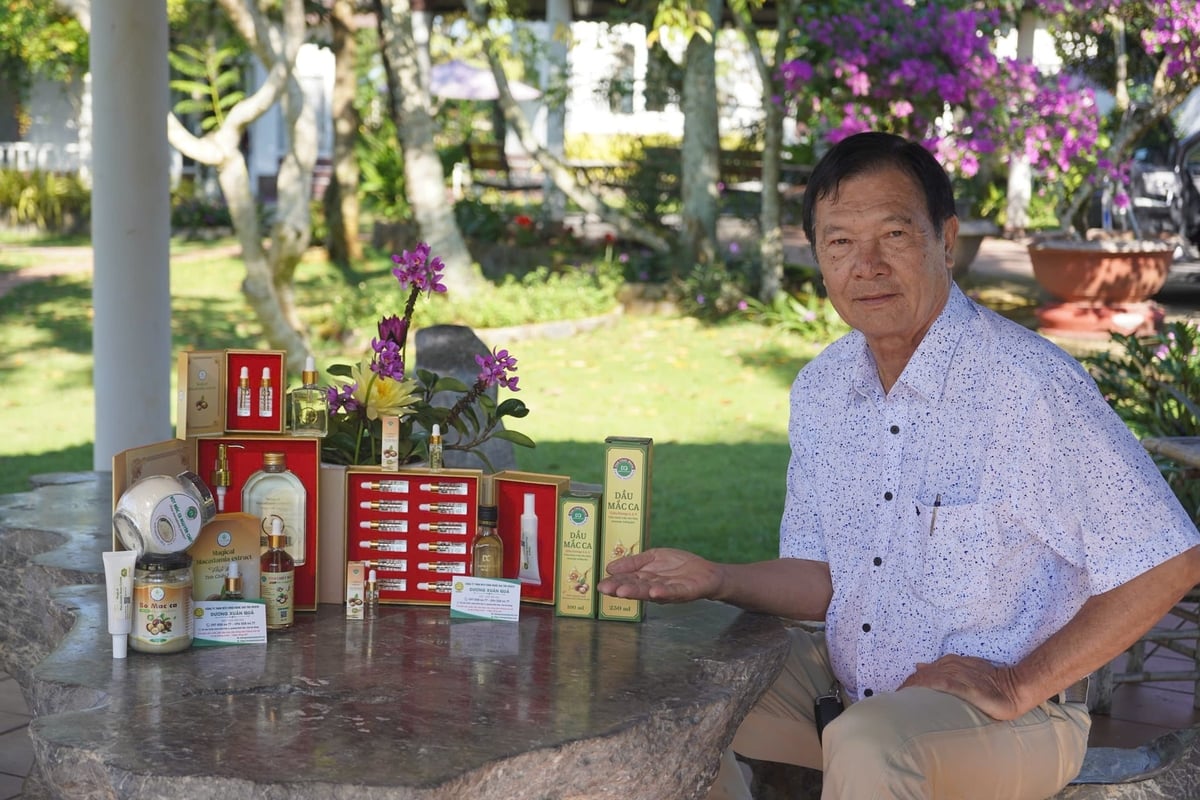
Through advanced processing techniques, Mr. Quả has increased the value of macadamia nuts many times over. Photo: Provided by the interviewee.



In many places, the residue left after oil extraction is fed to livestock or discarded because not all the oil can be extracted. Mr. Quả devised a way to completely extract the oil from the residue and then grind it into a fine powder that is completely soluble in water. He discovered that macadamia nuts contain no hard fiber, only soluble fiber. This powder is good for the stomach, helps with reflux, and sells for 1 million VND per kilogram.
The hard shells of the seeds—which export containers discard tons of—he turns into activated charcoal, which acts as a skin exfoliant.
His current business model is still small, with average monthly revenue of around one hundred million VND. For the first 3-4 years, he gave away processed macadamia nut products for free, until actual customers returned to buy them, at which point he started selling. A spa owner saw a bottle of oil displayed on a table at an automation fair, tried it on his hand, walked around, and then came back saying the oil absorbed very quickly, dried without being greasy. A week later, the owner contacted him to buy 2 liters. That was his first order.
He already has a license for macadamia nut oil, but the license for his skin and hair care oil is still pending because it requires cosmetic testing to be properly approved. He said, "I'm a farmer, nobody believes me. If you want people to believe you, you have to let them see it firsthand."
What he desires most is not to sell more oil: "I want to prove that macadamia nuts, if processed correctly, can be a valuable medicinal herb of the Central Highlands. Right now, people only know it as the queen of dried nuts, just for snacking."
Source: https://nongnghiepmoitruong.vn/khi-hat-mac-ca-hoa-thanh-vang-long-d814740.html


![[Image] National conference summarizing one year of operation of the overall organizational model of the political system, the three-tiered government model.](https://vphoto.vietnam.vn/thumb/1200x675/vietnam/resource/IMAGE/2026/07/01/1782882811691_ndo_br_1-jpg.webp)