Editor's Note: The agricultural extension system has always left its mark on major programs and projects in the agricultural sector, especially in its role as a bridge to disseminate production models, transfer scientific and technical knowledge, and form new mindsets in production for farmers... Behind the achievements of the agricultural sector are the quiet, tireless steps of grassroots agricultural extension officers.
With over 100,000 hectares of coffee plantations, Gia Lai is one of the key coffee-producing regions in the Central Highlands. However, in recent years, climate change has posed many challenges to the coffee industry. In this context, developing smart coffee farming models that adapt to climate change will not only improve production efficiency but also open up a sustainable development path for coffee growers.
Laying the foundation for sustainable production.
Over the two years from 2024 to 2025, the Gia Lai Provincial Agricultural Extension Center, in collaboration with the Western Highlands Agricultural and Forestry Science and Technology Institute and Binh Dien Fertilizer Joint Stock Company, will implement three smart coffee farming models adapted to climate change: a pure coffee cultivation model (Chu Prong commune), a coffee intercropped with pepper model (Kon Gang commune), and a coffee intercropped with durian model (Ia Phi commune). These models will be implemented in key coffee-producing areas of the province to evaluate the effectiveness of advanced farming solutions under real-world conditions.

Smart coffee shop models will be implemented in Gia Lai province over the two years 2024-2025. Photo: Tuan Anh.
The highlight of these models is the synchronized application of multiple technical solutions such as soil analysis to develop appropriate nutrient regimes, increased use of organic fertilizers, supplementation with beneficial microorganisms, maintenance of vegetation cover, integrated pest management (IPM), water-saving irrigation practices, and improved soil carbon sequestration. These solutions are considered to be well-adapted to the increasingly evident impacts of climate change on coffee plants.
After two years of implementation, the models have yielded positive results. In the pure coffee cultivation model, the fruit drop rate decreased significantly compared to traditional farming methods. While the control group's fruit drop rate in 2024 reached 17.8%, the smart farming models reduced it to approximately 10.4-10.6%. In 2025, the fruit drop rate continued to remain significantly lower than the control group. This indicates that the use of balanced nutrition combined with appropriate technical measures has helped the plants grow healthier and increased their resistance to adverse weather conditions.
Not only does the model improve fruit retention, but it also demonstrates a significant effect in reducing greenhouse gas emissions. Monitoring results show that smart farming practices reduce emissions by 12.6% to over 14% compared to conventional farming methods. In particular, when combined with the use of beneficial microorganisms, the emission intensity per ton of green coffee beans is reduced by over 30%, while the carbon absorption capacity of the coffee plantation ecosystem is significantly improved.
In the coffee-pepper intercropping model, both growth and yield indicators improved. The coffee fruit drop rate decreased from 15.8% in the control group to 9.8% in the treatment group that fully applied smart farming solutions. The number of reserve nodes on the trees increased, creating a foundation for stable yields in subsequent seasons. The economic efficiency of the model was also enhanced by making good use of land and diversifying products on the same unit area.

Smart coffee plantations yield superior productivity and quality. Photo: Tuan Anh.

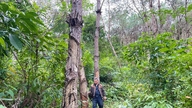

Directly participating in the smart coffee farming model adapted to climate change, Mr. Hoang Van Thang (Grang village, Chu Prong commune) said that after two years of applying the new technical process, his family's coffee garden is growing well and productivity has improved significantly. According to Mr. Thang, although he has been involved with coffee cultivation for many years, his previous care was mainly based on experience. When participating in the model, he received guidance on techniques for balancing soil nutrients and applying fertilizer appropriately according to the plant's needs, thus helping his coffee garden develop more stably.
"Thanks to proper guidance on cultivation techniques, our family's coffee plantation is yielding excellent productivity and quality this year. With over 900 coffee trees, we expect to harvest over 5 tons of coffee beans, much higher than in previous years," Mr. Thang said excitedly.
Field classes
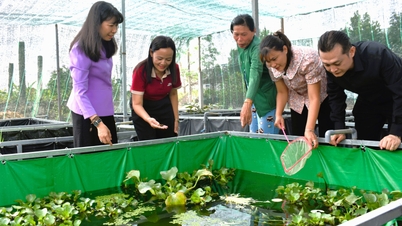
Behind the achievements of the smart coffee model lies the significant contribution of the agricultural extension officers in Gia Lai. Not only do they act as a bridge to bring scientific and technological advancements to farmers, but Gia Lai's agricultural extension officers also directly participate in surveying and selecting households, guiding the construction of the model, monitoring crop growth, and organizing training activities and field workshops.
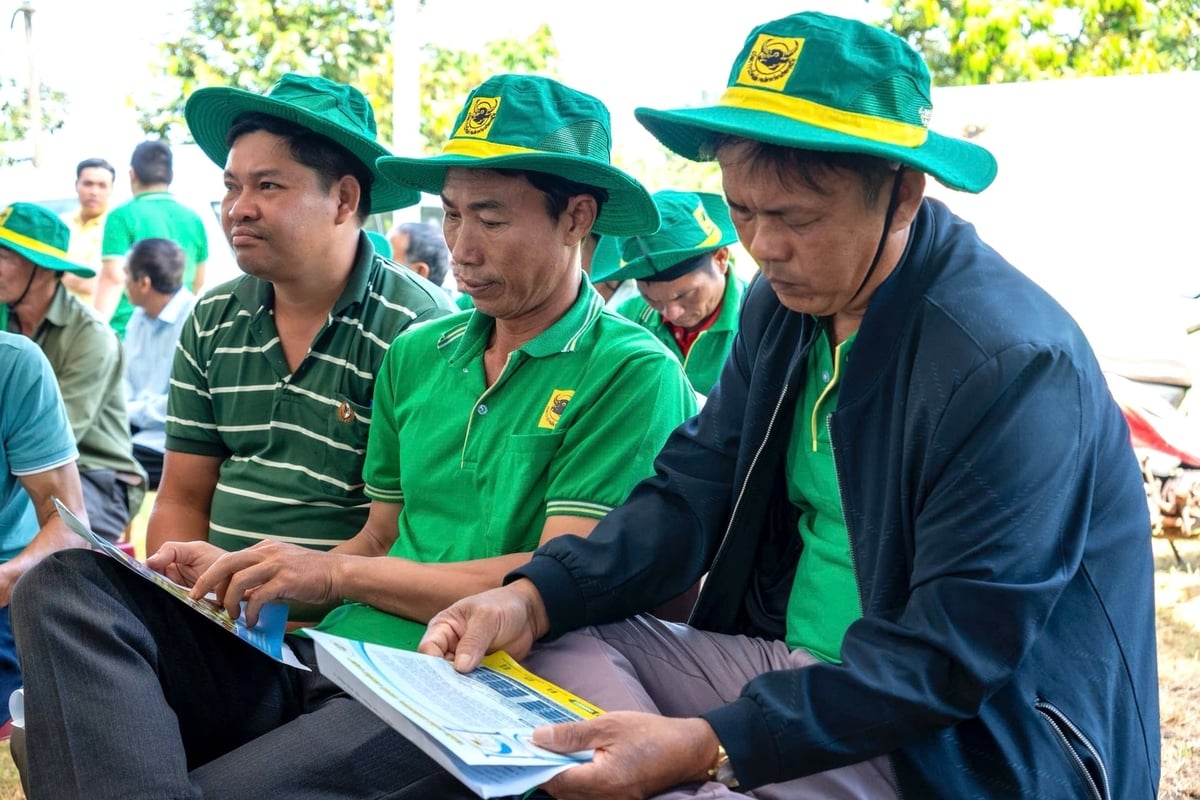
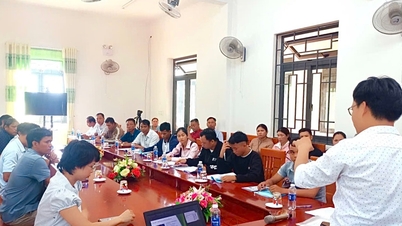
Locals are being trained in smart coffee farming models. Photo: Tuan Anh.
Throughout the implementation process, agricultural extension officers regularly visited the grassroots level, working alongside farmers from soil sampling and nutrient analysis to developing fertilization procedures, and providing guidance on irrigation water management and pest control. Knowledge previously only found in scientific research was transformed into easily understandable instructions tailored to the specific production conditions of each farming household.
According to Mr. Vo Van Ke, an official at the Gia Lai Provincial Agricultural Extension Center, through training courses and demonstration activities, people have access to new technical solutions and a better understanding of the benefits of increasing organic fertilizer use, reducing chemical fertilizer use, maintaining vegetation cover, and using beneficial microorganisms. This is an important factor in changing production practices towards greater sustainability.
Furthermore, these models have become practical training sessions right in the fields, where people can witness firsthand the effectiveness of smart farming solutions. As a result, many households in the region have proactively learned, applied, and gradually expanded the model to their family's production areas.

The smart coffee shop model will continue to be replicated in Gia Lai in the coming time. Photo: Tuan Anh.



Mr. Huynh Viet Hung, Director of the Gia Lai Provincial Agricultural Extension Center, said that after two years of implementation, the smart coffee model has yielded many positive results. Fertilizer use is more rational, based on the actual needs of the soil and crops, contributing to improved production efficiency. As a result, the model not only helps increase productivity, product quality, and income for farmers, but also reduces greenhouse gas emissions, protects soil and water resources, and enhances the adaptability of coffee plants to the impacts of climate change.
Given the results achieved, in the coming time, the Gia Lai Provincial Agricultural Extension Center will continue to coordinate with relevant units to expand the model, gradually changing the coffee farming practices of the people towards a more efficient and sustainable direction.
“In the context of the coffee industry moving towards green production standards, low emissions, and meeting the increasingly stringent requirements of the international market, smart coffee farming models in Gia Lai are of particular importance. This is not only a technical solution but also an inevitable direction to enhance the value of the coffee industry,” Mr. Huynh Viet Hung shared.
Source: https://nongnghiepmoitruong.vn/kien-tao-canh-tac-ca-phe-thong-minh-d815604.html



![[Image] National conference summarizing one year of operation of the overall organizational model of the political system, the three-tiered government model.](https://vphoto.vietnam.vn/thumb/1200x675/vietnam/resource/IMAGE/2026/07/01/1782882811691_ndo_br_1-jpg.webp)