

 |
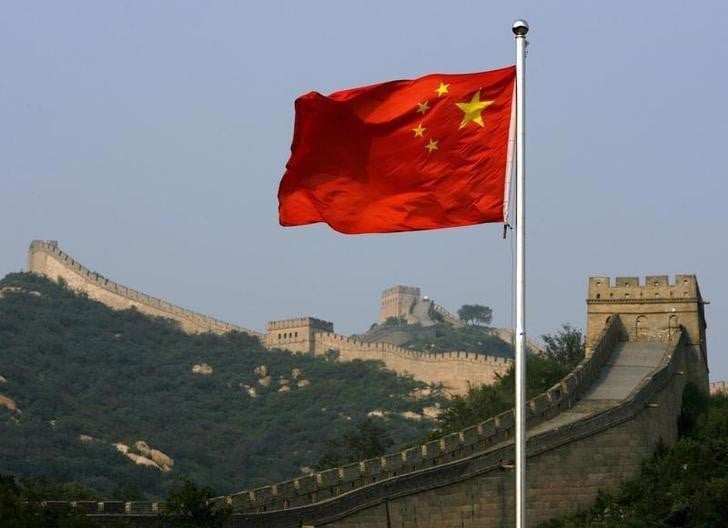
| Finding new drivers of economic growth will be a major challenge for China in 2024 and beyond. (Source: Reuters) |
Will the recovery continue to be bumpy?
The bumpy recovery of the Chinese economy in 2023 is expected to extend into 2024.
In January, China reopened after the Covid-19 pandemic, coinciding with challenging economic conditions overseas. High inflation worldwide reduced consumer spending.
Domestically, consumers are showing caution in their spending. Weak purchasing power stems from a decline in consumer confidence. Experts explain that this is a consequence of the meager aid provided to households during the pandemic, which left many struggling.
By July, China had bucked the global trend and entered a period of deflation – a phase it struggled to break out of during the latter half of the year.
The consumer price index (CPI) fell 0.5% in November compared to the same period last year – the sharpest decline in three years.
The real estate crisis in China continues as more and more property developers face bankruptcy and home sales remain low. This is crippling the economy, where real estate accounts for approximately 30% of Gross Domestic Product (GDP) and nearly 70% of household assets.
Notably, in the third quarter of this year, China's net foreign direct investment (FDI) turned negative for the first time. This means that outbound investment exceeded inbound foreign investment.
According to Goldman Sachs, capital outflows from the world's second-largest economy in September reached $75 billion – the highest in seven years.
The International Finance Association (IIF) points out that China's stock and bond markets have seen capital outflows for five consecutive quarters, setting a record for the longest period in history.
In addition, the youth unemployment rate in the country exceeded 21% in June. This was the last time China released such statistics.
Many university graduates in China are having to accept low-skilled jobs to make ends meet. Meanwhile, the rest of the workforce is suffering from sharply declining incomes.
Even in the electric vehicle sector – one of the few bright spots in the world's second-largest economy at this time – the price war is causing significant losses for suppliers and workers.
Furthermore, the International Monetary Fund (IMF) estimates that the massive debt of local governments in China reached $12.6 trillion, equivalent to 76% of economic output in 2022. This poses a significant challenge for policymakers in the future.
Reform and open up further.
The Asia Times also noted that China's old model of growth based on credit and investment has been undermined by the real estate crisis as well as weak consumer demand and exports.
However, recent data suggests that the world's second-largest economy has regained its recovery momentum.
China's real Gross Domestic Product (GDP) growth rate for the past three quarters reached 5.2% year-on-year. Production of solar panels, service robots, and integrated circuits increased by 62.8%, 59.1%, and 34.5% respectively in October.
Investment in infrastructure and manufacturing increased by 5.9% and 6.2% respectively during the January-October period, offsetting a 9.3% decline in real estate investment. Outside of real estate, private investment increased by 9.1%.
Simultaneously, consumption also witnessed a strong recovery, although exports in October fell 6.4% year-on-year, marking six consecutive months of decline due to weak global demand and the trend of globalization imbalances.
In particular, China's automobile exports are expected to surpass 4 million units by the end of 2023, marking a significant milestone in the country's industrial upgrading process and its move up the value chain.
Some government advisers expect Beijing to announce a GDP growth target of around 5% for 2024 – the same as the target set for 2023 – provided there are more expansionary policies.
What most economic analysts have observed is that the world's second-largest economy could implement significant reforms to offset its growth.
Ding Shuang, chief economist for China at Standard Chartered Bank, argues that Beijing cannot rely solely on aggressive stimulus policies to boost consumer and business expectations.
"China needs to create internal momentum for its economy through further reforms and opening up," the expert stated.
Source



![[Image] National Assembly discusses the implementation of the socio-economic development plan.](https://vphoto.vietnam.vn/thumb/1200x675/vietnam/resource/IMAGE/2026/04/20/1776696707422_ndo_br_img-20260420-185419-jpg.webp)
![[Photo] General Secretary and President To Lam meets with National Assembly delegates from ethnic minorities.](https://vphoto.vietnam.vn/thumb/1200x675/vietnam/resource/IMAGE/2026/04/20/1776696701056_a1-bnd-8331-3342-jpg.webp)














































































Comment (0)