|
| Ke Go Lake eco- tourism area - a green oasis in Ha Tinh. |
A makeshift airfield beneath the lake.
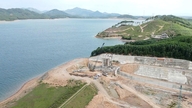
Ke Go Lake - a large-scale irrigation project that began construction in 1976, was initially planned to take 6 years, but thanks to the determination of the people of Nghe Tinh, it was completed in just 3 years.
This large-scale irrigation project, located entirely within Cam Due commune, has long been known for its capacity of 345 million cubic meters of water, making it the second largest in Ha Tinh province – after Ngan Truoi Lake with a capacity of 775 million cubic meters.
Ke Go Lake not only helps control flooding in the downstream area during the rainy season but also provides irrigation for 19,500 hectares of agricultural land, supports tourism, and greens an entire area devastated by bombs and bullets.
However, hidden deep beneath the calm, perpetually emerald green surface of Ke Go Lake lies a former "battleground." Within it are the remnants of the Libyan airfield – a place that commemorates the heroic and tragic epic of soldiers, youth volunteers, workers, civilian laborers, and local people during the years of the war against the Americans.
According to the official history of Ha Tinh province: The American imperialists launched a fierce bombing campaign in this region for nearly 10 years. At the end of 1966, when the national highways were cut off, we decided to build strategic Route 22. The route is 65km long, starting from Thinh Thinh intersection (Thach Xuan commune), winding through Cam Due and many communes in the former Ky Anh region, and ending in Tuyen Hoa, now part of Quang Tri province. A portion of Route 22 now lies beneath the Ke Go reservoir.
The story goes that in September 1972, our troops chose a section of Highway 22 in the Da Bac area to build National Defense Project 723 - the Li Bi airfield. Li Bi is named after a stream in Da Bac village, Cam Due commune. After many months of hard work, the forces poured all their strength and spirit into the project, determined to quickly bring the Li Bi airfield into operation.
In early 1973, as construction was nearing completion, the airport was discovered by the enemy and subjected to numerous intense air raids. On the night of January 7, 1973, the US Air Force launched a fierce attack, completely destroying Libyan airport.
The vast majority of the engineering troops, volunteer youth, and other construction forces bravely sacrificed their lives. Their bodies were hastily buried under the harsh conditions of war, with many buried deep underground.

Rejuvenation from the pain
 |
| A group of alumni from the Class of 20, Faculty of Literature (Hanoi University) at Ke Go Lake. |
After about 40 minutes of boat travel on the lake, our group arrived at the Memorial Temple for Heroes and Martyrs at Ke Go Lake. This spiritual site commemorates the heroic martyrs who bravely fought and sacrificed their lives during the construction and defense of the Libyan airfield and the strategic Route 22 during the resistance war against the American imperialist invasion.
The monument is a testament to the journey of rediscovering forgotten chapters of history, and also the result of the collective efforts and contributions from grateful hearts, becoming a significant historical landmark. The memorial site has compiled a provisional list of 62 martyrs who sacrificed their lives in the Ke Go Lake area. Among them, 32 martyrs bravely died at Li Bi airport on the night of January 7, 1973.
Offering incense at the temple, visitors have the opportunity to learn about Ha Tinh's glorious past: During the years of fighting under the rain of bombs and bullets from the American enemy, the army and people of Ha Tinh opened many new roads over 500km long, repaired more than 654km of roads and many bridges and culverts that were destroyed, and cleared nearly 50,000 bombs and mines of all kinds…
Along strategic transportation routes passing through Ha Tinh such as National Highways 1A, 15A, 8A, and roads 21 and 22, associated with "fire zones" like Ben Thuy, Linh Cam, Cau Nhe, Dong Loc Crossroads, Khe Giao, Dia Loi, Phu River - Nai Mountain, Ngang Pass... countless tragic stories have been recorded.
Every inch of this land bears the mark of battles against enemy bombs and bullets, where the blood and bones of countless people have mingled with the motherland, so that today, generations to come can proudly stand firm on this land.
To create a solemn place of worship for the fallen heroes who perished at Ke Go Lake and Li Bi Airport, in 2011, the Ke Go Nature Reserve Management Board and Cam Xuyen district collaborated to mobilize social resources to build a shrine right next to the Li Bi airport area.
During the summer months, when the water level of Ke Go Lake recedes to serve irrigation purposes, the Li Bi makeshift airfield appears. Even after more than 50 years, the lakebed is still riddled with craters left by enemy bombs dropped years ago. Within the temple grounds are two memorial plaques inscribed with the names and hometowns of those who sacrificed their lives on the Ke Go battlefield.
From a land once ravaged by bombs and bullets, Ke Go Lake is transforming into a green space, a tourist destination, a sacred place, and a place for educating future generations about patriotic traditions. Although the Li Bi airfield has merged into the clear blue waters of Ke Go, the epic tale of those who shed their blood and sacrificed their lives to weave history will live on forever.



Kẻ Gỗ was originally the name of an ancient Vietnamese village in Cẩm Duệ commune (now Cẩm Mỹ), located along the Rào Cái river and about 20km from Hà Tĩnh city. In the early 20th century, due to the Rào Cái river frequently experiencing drought during the dry season, the French planned to build a dam to control the river's flow. After the reunification of the country, the State continued to implement and complete the project under the name "Ke Go Large-Scale Irrigation Project". From then on, this large artificial lake officially bore the name Ke Go Lake. |
Source: https://baothainguyen.vn/que-huong-dat-nuoc/202604/ky-uc-con-lai-duoi-long-ho-ke-go-6047fee/





![[Photo] Strengthening character and expertise: Intense training for artillery soldiers.](https://vphoto.vietnam.vn/thumb/1200x675/vietnam/resource/IMAGE/2026/06/30/1782815602541_lu-368-1875-4571-jpg.webp)