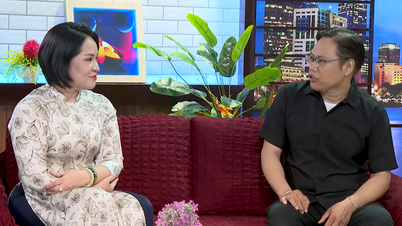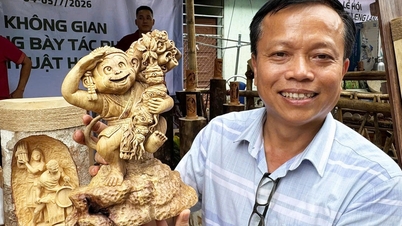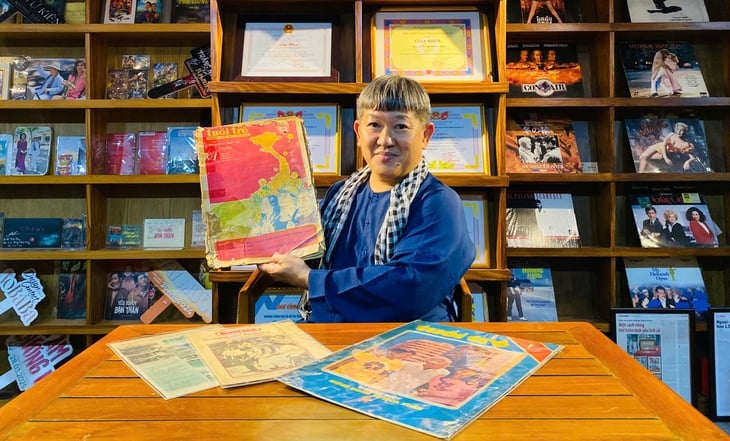
Collector Huynh Minh Hiep next to the first issue of Tuoi Tre newspaper's Spring issue, published in 1976.
2026 marks the 40th anniversary of Vietnam officially abolishing the subsidy system and entering the period of reform. The artifacts and images that remain today serve as vivid evidence of a difficult but also humane period in history.
Mr. Huynh Minh Hiep, who owns a collection of artifacts from the subsidy period, said that each memento evokes special memories because he himself experienced that time. This July, he is organizing an exhibition themed "Saigon - The Subsidy Period" at the Xu Nam Ky coffee shop to help young people better understand the lives of their fathers and grandfathers during that difficult period.
Looking back on the journey, countless Vietnamese people had to live through difficult times of scarcity, arduous and challenging years, yet filled with cherished memories, overflowing with human kindness, and a willingness to share food and clothing with one another.
Collector Huynh Minh Hiep

Cooperative purchase and sale ledger - Photo: H. Lê
The origin of the phrases "laying a brick" and "looking like you've lost your rice ration book"
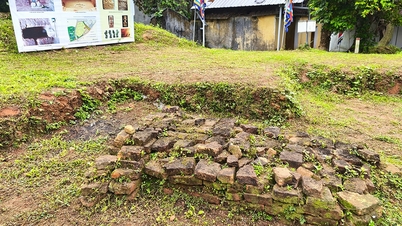
"I was born and raised in Saigon, so I still vividly remember the subsidy period. Back then, I used to carry my ration book and follow my grandfather to queue up to receive the state-allocated goods for each family. Usually, we could only buy one or two items at a time, like rice, sugar, soap... Because we had to queue for many days to buy enough necessities, people often used bricks to hold their place," he recounted.
He also recalled a time when many residential areas frequently experienced power outages for 2-3 nights a week. At that time, oil lamps were an almost indispensable household item, so each family had a ration coupon to buy oil for their lamps and oil stoves. According to Mr. Hiep, many expressions currently in use, such as "putting down a brick" or "looking like you've lost your rice ration book," originated from the subsidy period.
You may also like

Gia Lai: Exhibition “Subsidy Period - A Time to Remember”VHO - The flow of time has led the country into new stages of development, but memories of the subsidy era with ration coupons, rice books, state-run stores, cooperatives, queuing culture, small kitchens, and rural markets… remain etched in the memories of the people, a time long gone. "Placing a brick" is a familiar sight among people queuing to buy goods at department stores or cooperatives. The person who arrives first places a brick down to mark their position in the long line.
"Rice ration books," also known as food purchase books or food coupons, are documents issued by the State that record the monthly food ration allowed for each household. Losing a ration book could lead to starvation for the entire family, as the procedure for obtaining a replacement is very complicated. Besides these, there were also sugar stamps, cloth coupons, food coupons, and other items that were integral to people's lives for many years.
Additionally, there was a popular saying in the early 1980s: "A TV, a refrigerator, and a Honda – having those three things makes it easy to search a house." By the end of the subsidy period, the saying was changed to: "A TV, a refrigerator, and a Honda – having those three things makes you a real person," reflecting a shift in social thinking.
Another slogan that was widely seen on the streets at the time was: "Handsome men should dress handsomely; the office doesn't welcome those with long hair and flared pants." At that time, youth groups would remind and deal with those deemed to be dressed inappropriately for the lifestyle of the time.

The registration form for building self-managed streets in 1985 included 9 specific clauses - Photo: H. Lê
Unforgettable artifacts from the subsidy era.
The term "subsidized economy" refers to the period from 1964-1975 in North Vietnam and from 1976-1986 nationwide, when the economy operated under a centralized planning mechanism. Goods and people's lives depended largely on state distribution. Items such as rice, meat, sugar, fabrics, and fuel had to be purchased using ration coupons in limited quantities.
Mr. Hiep's collection includes many unique artifacts such as savings passbooks, movie ticket vouchers, bicycle repair vouchers, daily bread ration books, train tickets, travel documents, fabric vouchers, food vouchers, fuel vouchers, shopping books, and children's toys from the subsidy era.
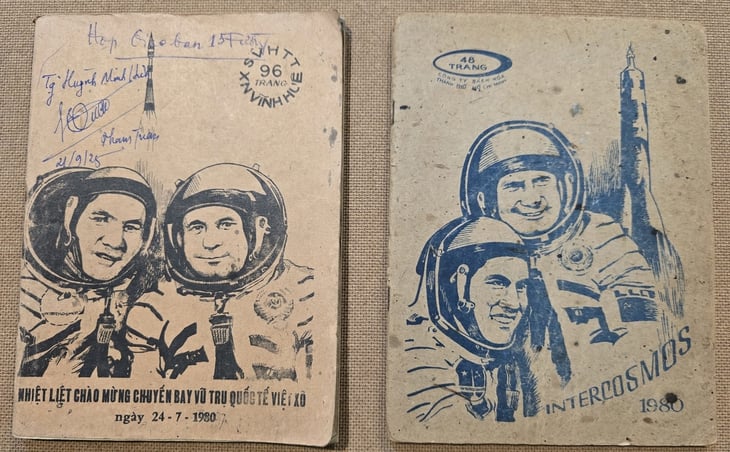
The notebook contains a picture of cosmonaut Pham Tuan and a Soviet pilot during the historic Vietnam-Soviet Union flight on July 23, 1980 - Photo: H. Le
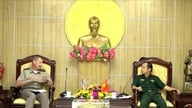
Strengthening the friendship between Vietnam and the United States.On July 3rd, as part of the Pacific Partnership - Friends of the Pacific 2026 program, the U.S. Army Pacific delegation, led by Lieutenant General Joel Vowell, Deputy Commander of the U.S. Army Pacific, paid a courtesy visit to the Quang Tri Provincial Military Command. The collection also preserves the Register of Self-Governing People's Streets, dated 1985. Many points in this register remain relevant today. For example, Article 2 states: Do not occupy sidewalks or roads for trading, parking, repairing vehicles, or erecting illegal stalls; do not gather to play, play football, or fly kites on sidewalks or roads. Article 7 states: Do not dump garbage or litter on the road; do not hang clothes, blankets, or curtains in front of houses (houses next to main roads).
Additionally, there are clauses such as: "Every Sunday and on holidays, participate in cleaning the streets and sidewalks to keep them clean."
Notably, the notebook features a picture of cosmonaut Pham Tuan and a Soviet pilot during the historic Vietnam-Soviet Union space flight on July 23, 1980. This flight made Pham Tuan the first Vietnamese and Asian person to fly into space. The notebook was signed and gifted by Mr. Pham Tuan on September 21, 2025.
Back to the topic
HOANG LE
Source: https://tuoitre.vn/ky-uc-thoi-so-gao-2026051609445858.htm